QUESTION IMAGE
Question
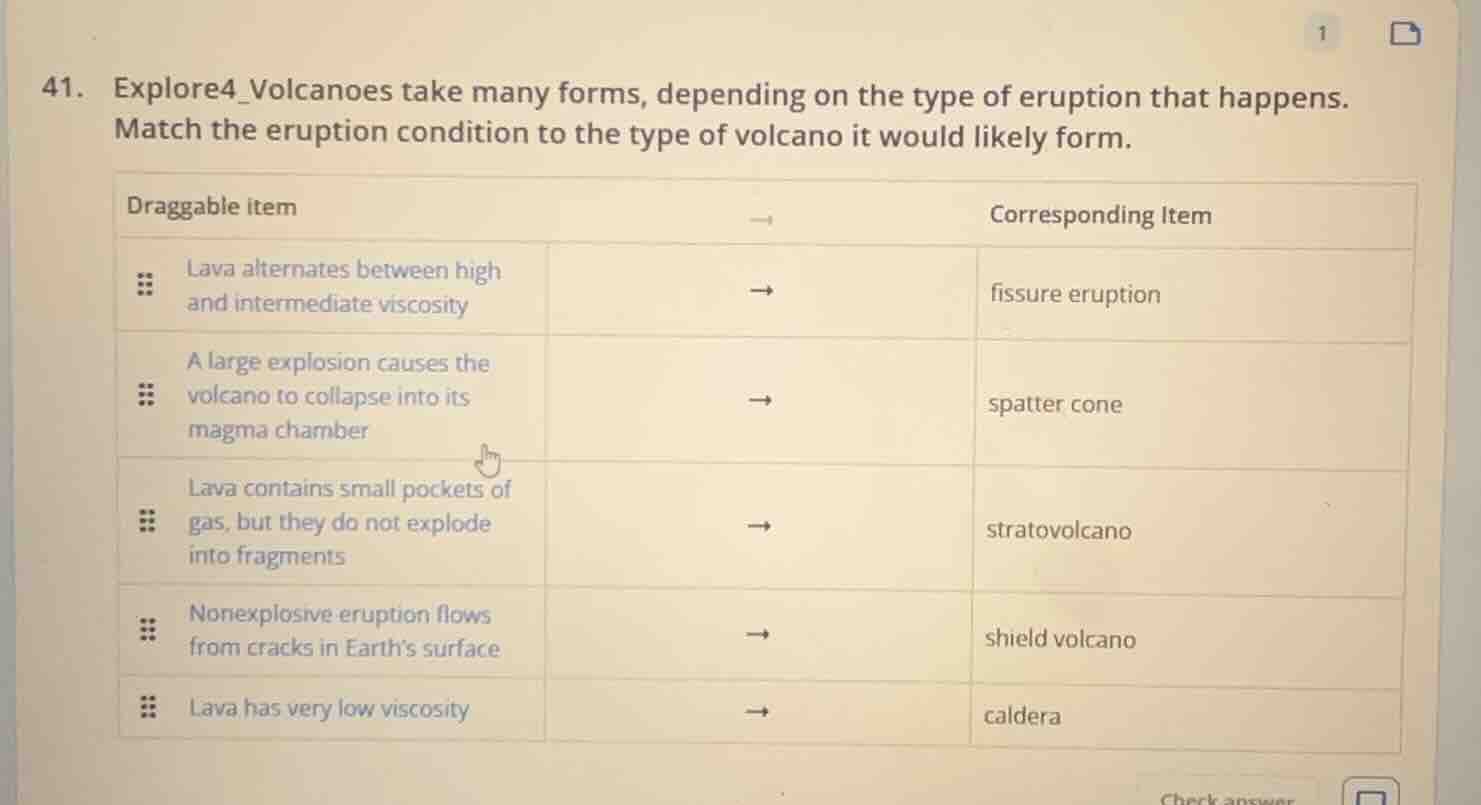
- explore4_volcanoes take many forms, depending on the type of eruption that happens. match the eruption condition to the type of volcano it would likely form.
draggable item → corresponding item
lava alternates between high and intermediate viscosity → fissure eruption
a large explosion causes the volcano to collapse into its magma chamber → spatter cone
lava contains small pockets of gas, but they do not explode into fragments → stratovolcano
nonexplosive eruption flows from cracks in earth’s surface → shield volcano
lava has very low viscosity → caldera
Brief Explanations
- Lava alternates between high and intermediate viscosity: Stratovolcanoes form from lava with varying (high to intermediate) viscosity, leading to layered structures. So this matches "stratovolcano".
- A large explosion causes the volcano to collapse into its magma chamber: Calderas form when a volcano collapses after a massive explosion empties the magma chamber. So this matches "caldera".
- Lava contains small pockets of gas, but they do not explode into fragments: Spatter cones form from lava with gas bubbles that don't explode, allowing lava to spatter and build the cone. So this matches "spatter cone".
- Nonexplosive eruption flows from cracks in Earth’s surface: Fissure eruptions involve nonexplosive lava flowing from long cracks. So this matches "fissure eruption".
- Lava has very low viscosity: Shield volcanoes form from low - viscosity lava that flows easily, creating broad, shield - like structures. So this matches "shield volcano".

Snap & solve any problem in the app
Get step-by-step solutions on Sovi AI
Photo-based solutions with guided steps
Explore more problems and detailed explanations
- Lava alternates between high and intermediate viscosity → stratovolcano
- A large explosion causes the volcano to collapse into its magma chamber → caldera
- Lava contains small pockets of gas, but they do not explode into fragments → spatter cone
- Nonexplosive eruption flows from cracks in Earth’s surface → fissure eruption
- Lava has very low viscosity → shield volcano