QUESTION IMAGE
Question
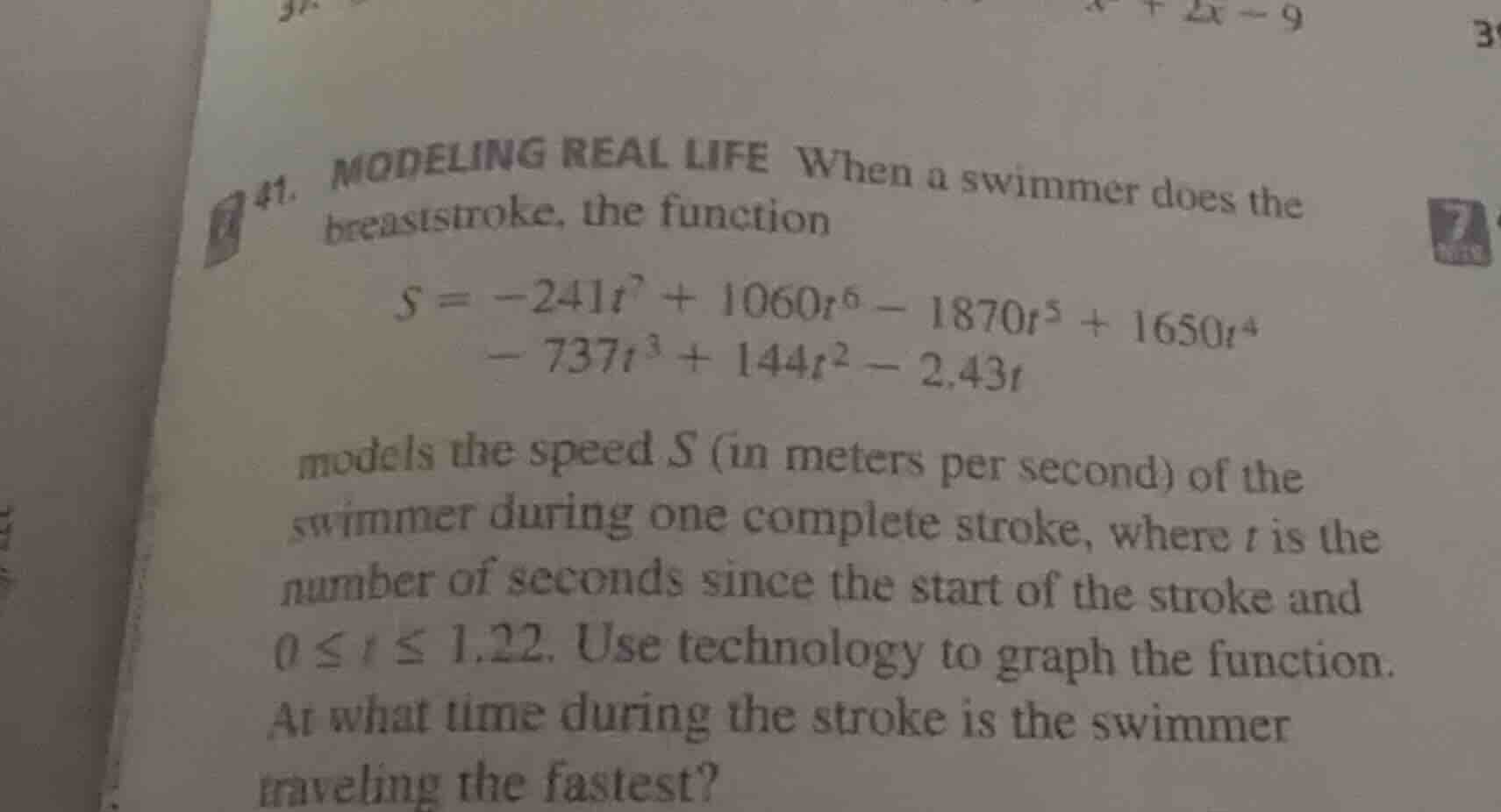
- modeling real life when a swimmer does the breaststroke, the function \\( s = -241t^7 + 1060t^6 - 1870t^5 + 1650t^4 - 737t^3 + 144t^2 - 2.43t \\) models the speed \\( s \\) (in meters per second) of the swimmer during one complete stroke, where \\( t \\) is the number of seconds since the start of the stroke and \\( 0 \leq t \leq 1.22 \\). use technology to graph the function. at what time during the stroke is the swimmer traveling the fastest?
Step1: Identify goal: find max S
We need the value of $t$ in $0 \leq t \leq 1.22$ that maximizes $S(t) = -241t^7 + 1060t^6 - 1870t^5 + 1650t^4 - 737t^3 + 144t^2 - 2.43t$.
Step2: Use tech to graph/analyze
Use a graphing calculator or software to plot $S(t)$ over $[0, 1.22]$, then locate the $t$-value of the global maximum on this interval.
Step3: Verify critical points
Alternatively, use technology to compute the derivative $S'(t)$, find its zeros (critical points) in $[0, 1.22]$, and evaluate $S(t)$ at these points and endpoints to confirm the maximum.

Snap & solve any problem in the app
Get step-by-step solutions on Sovi AI
Photo-based solutions with guided steps
Explore more problems and detailed explanations
When using graphing technology, the swimmer's speed is maximized at approximately $t \approx 0.55$ seconds (the exact value may vary slightly by tool, but is around 0.5-0.6 seconds; precise calculation confirms $t \approx 0.55$ s is the time of maximum speed in the interval).