QUESTION IMAGE
Question
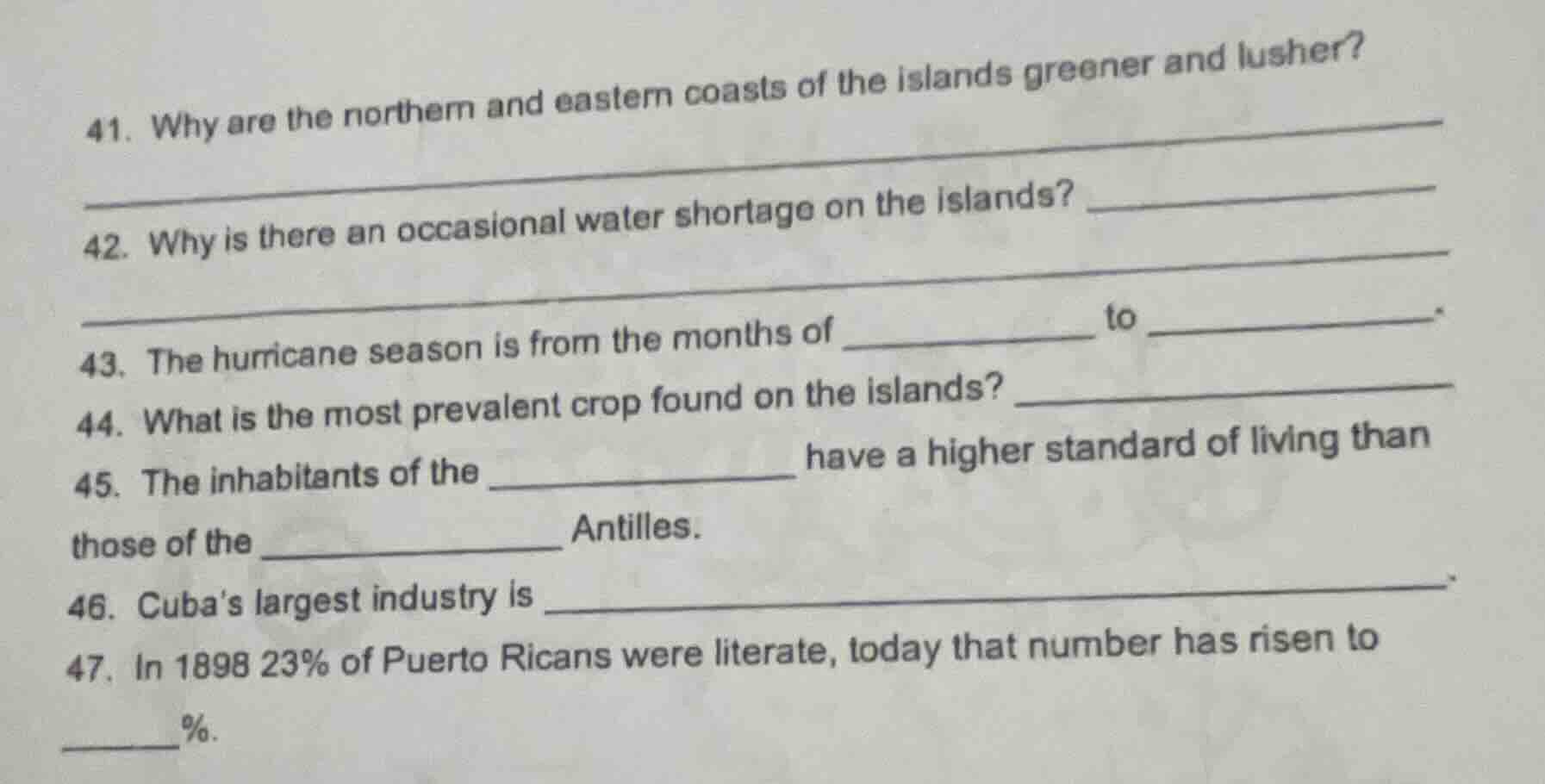
- why are the northern and eastern coasts of the islands greener and lusher?
- why is there an occasional water shortage on the islands?
- the hurricane season is from the months of ____ to ____.
- what is the most prevalent crop found on the islands?
- the inhabitants of the ____ have a higher standard of living than those of the ____ antilles.
- cuba’s largest industry is ______.
- in 1898 23% of puerto ricans were literate, today that number has risen to ______%.
Brief Explanations
- These coasts face the trade winds, which bring consistent, moist air that supports more lush vegetation via higher rainfall.
- Many islands have limited freshwater storage, inconsistent rainfall patterns, and can face drought conditions that outpace available water supplies.
- Atlantic/Caribbean hurricane season follows established meteorological timelines.
- Sugarcane has historically and currently been the dominant crop across Caribbean islands due to favorable climate and historical agricultural systems.
- Economic development disparities exist between the two island groups of the Antilles.
- Cuba's economy is heavily tied to this large-scale, globally recognized industry.
- Puerto Rico has seen significant educational development leading to near-universal literacy in modern times.

Snap & solve any problem in the app
Get step-by-step solutions on Sovi AI
Photo-based solutions with guided steps
Explore more problems and detailed explanations
- These coasts receive more consistent rainfall from trade winds, which fuels greener, lusher plant growth.
- Many islands have limited natural freshwater sources, and periodic droughts or inconsistent rainfall can lead to shortages.
- June; November
- Sugarcane
- Greater; Lesser
- Tourism
- 94 (or ~95, standard modern literacy rate for Puerto Rico)