QUESTION IMAGE
Question
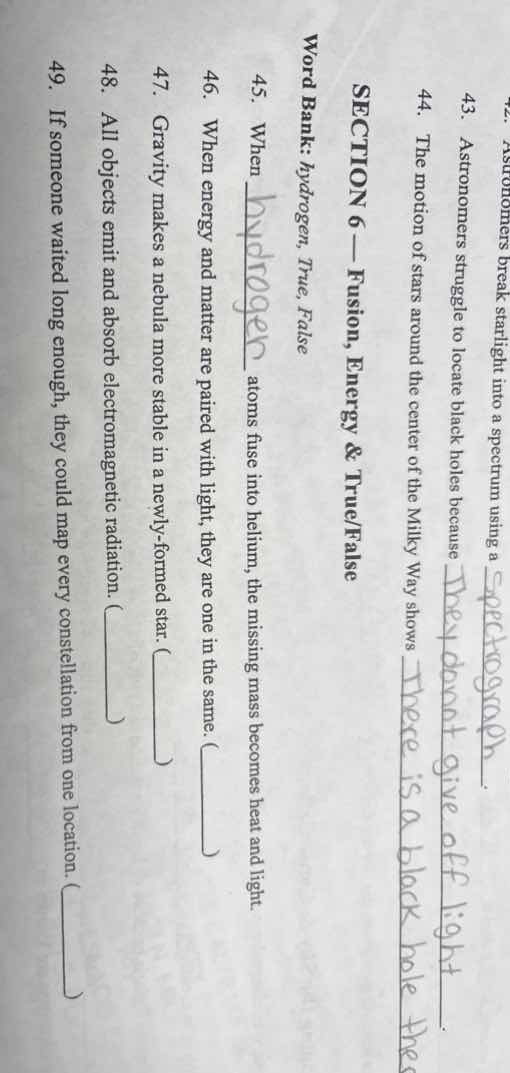
- astronomers break starlight into a spectrum using a ______.
- astronomers struggle to locate black holes because ______.
- the motion of stars around the center of the milky way shows ______.
section 6 — fusion, energy & true/false
word bank: hydrogen, true, false
- when ______ atoms fuse into helium, the missing mass becomes heat and light.
- when energy and matter are paired with light, they are one in the same. (______)
- gravity makes a nebula more stable in a newly - formed star. (______)
- all objects emit and absorb electromagnetic radiation. (______)
- if someone waited long enough, they could map every constellation from one location. (______)
Step1: Identify Q42 tool for star spectra
Astronomers use a spectrograph to split starlight into a spectrum.
Step2: Identify Q43 black hole property
Black holes do not emit light, making them hard to find.
Step3: Identify Q44 Milky Way center observation
The orbital motion of central stars proves a supermassive black hole exists there.
Step4: Confirm Q45 fusion fuel
Hydrogen is the fusing atom for helium in stars.
Step5: Evaluate Q46 mass-energy equivalence
Energy and matter are interchangeable (E=mc²), not identical.
Step6: Evaluate Q47 nebula stability
Gravity collapses nebulae to form stable stars.
Step7: Evaluate Q48 electromagnetic radiation
All objects above 0K emit/absorb EM radiation.
Step8: Evaluate Q49 constellation visibility
Earth's position blocks some constellations from one location.

Snap & solve any problem in the app
Get step-by-step solutions on Sovi AI
Photo-based solutions with guided steps
Explore more problems and detailed explanations
- spectrograph
- black holes do not emit light
- a supermassive black hole exists at its core
- hydrogen
- False
- True
- True
- False