QUESTION IMAGE
Question
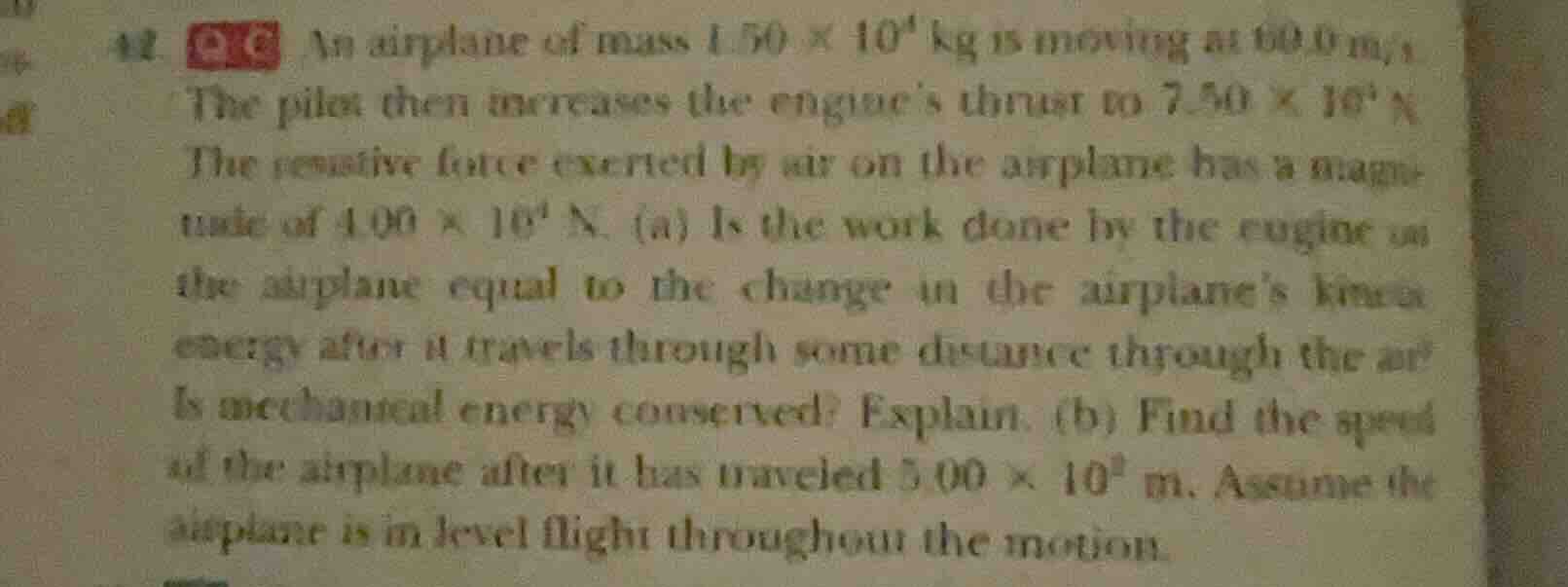
42 qc an airplane of mass 1.50 × 10⁴ kg is moving at 60.0 m/s. the pilot then increases the engine’s thrust to 7.50 × 10⁴ n. the resistive force exerted by air on the airplane has a magnitude of 4.00 × 10⁴ n. (a) is the work done by the engine on the airplane equal to the change in the airplane’s kinetic energy after it travels through some distance through the air? is mechanical energy conserved? explain. (b) find the speed of the airplane after it has traveled 5.00 × 10² m. assume the airplane is in level flight throughout the motion.
Part (a)
To determine if the work done by the engine equals the change in kinetic energy and if mechanical energy is conserved, we analyze the forces and energy principles:
- Work - Kinetic Energy Relationship: The work - energy theorem states that the net work done on an object is equal to the change in its kinetic energy, \(W_{net}=\Delta K\). The net work is the work done by all forces acting on the object. Here, the engine does work \(W_{engine}\), and the air exerts a resistive (frictional) force \(F_{resistive}\) that does work \(W_{resistive}\). So, \(W_{net}=W_{engine}+W_{resistive}\), and thus \(W_{engine}
eq\Delta K\) because there is work done by the resistive force.
- Mechanical Energy Conservation: Mechanical energy conservation requires that non - conservative forces (like the resistive force from air) do no work. Since the air exerts a resistive force that does work (as the airplane moves through the air, the resistive force acts opposite to the displacement, doing negative work), mechanical energy is not conserved. The mechanical energy of the airplane (kinetic + potential, but potential energy is constant in level flight) will change because of the work done by the non - conservative resistive force.
Step 1: Calculate the net force
The thrust force of the engine is \(F_{thrust}=7.50\times 10^{4}\ N\) and the resistive force is \(F_{resistive} = 4.00\times 10^{4}\ N\). Since the airplane is in level flight, the net force in the direction of motion is \(F_{net}=F_{thrust}-F_{resistive}\)
\[F_{net}=7.50\times 10^{4}- 4.00\times 10^{4}=3.50\times 10^{4}\ N\]
Step 2: Calculate the net work done
The work done by a force \(F\) over a displacement \(d\) is given by \(W = Fd\) (since the force and displacement are in the same direction for the net force). The displacement \(d = 5.00\times 10^{2}\ m\)
\[W_{net}=F_{net}d=(3.50\times 10^{4}\ N)\times(5.00\times 10^{2}\ m)=1.75\times 10^{7}\ J\]
Step 3: Use the work - energy theorem
The work - energy theorem states that \(W_{net}=\Delta K=\frac{1}{2}mv_{f}^{2}-\frac{1}{2}mv_{i}^{2}\)
We know the mass of the airplane \(m = 1.50\times 10^{4}\ kg\), the initial velocity \(v_{i}=60.0\ m/s\), and \(W_{net}=1.75\times 10^{7}\ J\)
First, rewrite the work - energy equation:
\[\frac{1}{2}mv_{f}^{2}=\frac{1}{2}mv_{i}^{2}+W_{net}\]
Step 2: Solve for the final velocity \(v_{f}\)
Multiply both sides of the equation by \(2\) to get rid of the fraction:
\[mv_{f}^{2}=mv_{i}^{2}+2W_{net}\]
Then, divide both sides by \(m\):
\[v_{f}^{2}=v_{i}^{2}+\frac{2W_{net}}{m}\]
Substitute the values: \(v_{i} = 60.0\ m/s\), \(W_{net}=1.75\times 10^{7}\ J\), \(m = 1.50\times 10^{4}\ kg\)
\[v_{f}^{2}=(60.0)^{2}+\frac{2\times1.75\times 10^{7}}{1.50\times 10^{4}}\]
\[v_{f}^{2}=3600+\frac{3.5\times 10^{7}}{1.5\times 10^{4}}\]
\[v_{f}^{2}=3600 + \frac{35000000}{15000}\]
\[v_{f}^{2}=3600+2333.33\]
\[v_{f}^{2}=5933.33\]
Take the square root of both sides:
\[v_{f}=\sqrt{5933.33}\approx 77.0\ m/s\]

Snap & solve any problem in the app
Get step-by-step solutions on Sovi AI
Photo-based solutions with guided steps
Explore more problems and detailed explanations
- The work done by the engine on the airplane is not equal to the change in the airplane's kinetic energy. The net work done on the airplane (work by engine plus work by resistive force) equals the change in kinetic energy.
- Mechanical energy is not conserved. The resistive force (a non - conservative force) does work on the airplane, so mechanical energy (kinetic + potential) changes (potential energy is constant in level flight, but kinetic energy change is not just due to engine work as resistive force also does work).
Part (b)
We will use the work - energy theorem. The work done by the net force is equal to the change in kinetic energy.