QUESTION IMAGE
Question
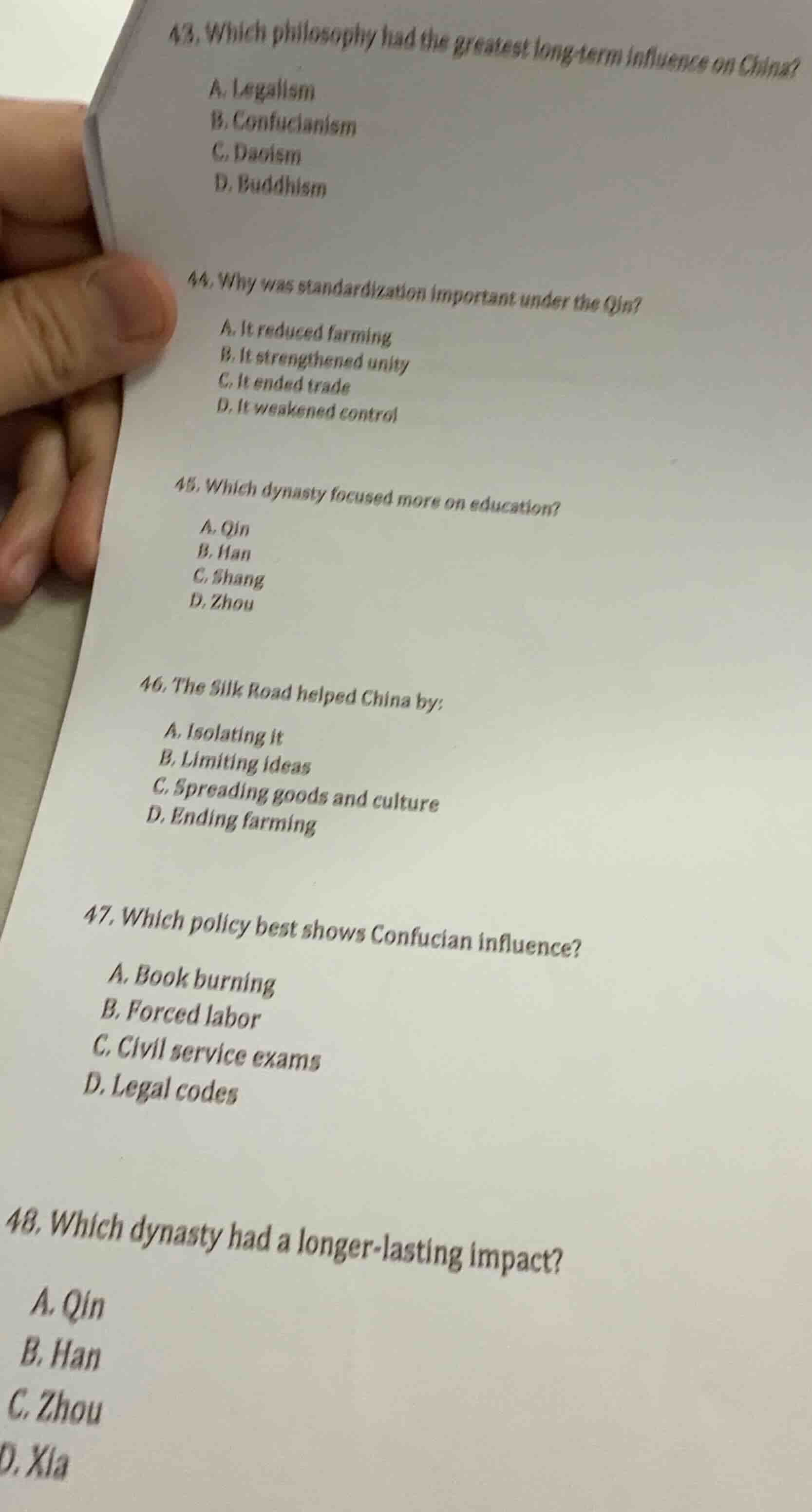
- which philosophy had the greatest long - term influence on china?
a. legalism
b. confucianism
c. daoism
d. buddhism
- why was standardization important under the qin?
a. it reduced farming
b. it strengthened unity
c. it ended trade
d. it weakened control
- which dynasty focused more on education?
a. qin
b. han
c. shang
d. zhou
- the silk road helped china by:
a. isolating it
b. limiting ideas
c. spreading goods and culture
d. ending farming
- which policy best shows confucian influence?
a. book burning
b. forced labor
c. civil service exams
d. legal codes
- which dynasty had a longer - lasting impact?
a. qin
b. han
c. zhou
d. xia
Question 43
Confucianism has been the dominant philosophy in China for over two millennia, shaping its social, ethical, and political systems. Legalism was more for Qin's short - term control, Daoism is more about nature and simplicity, and Buddhism, while influential, came later and is not as deeply ingrained in the long - term cultural and social fabric as Confucianism.
Under the Qin Dynasty, standardization (of weights, measures, writing, etc.) was done to unify the newly conquered territories. It did not reduce farming (A is wrong), it promoted trade (so C is wrong) and strengthened control (not weakened, so D is wrong). So it strengthened unity.
The Han Dynasty emphasized education, especially with the establishment of the imperial academy and promotion of Confucian learning. The Qin Dynasty was more about Legalist control and had policies like burning books, the Shang was more about oracle bones and early governance, and the Zhou had a feudal system with less emphasis on formal education as the Han.

Snap & solve any problem in the app
Get step-by-step solutions on Sovi AI
Photo-based solutions with guided steps
Explore more problems and detailed explanations
B. Confucianism