QUESTION IMAGE
Question
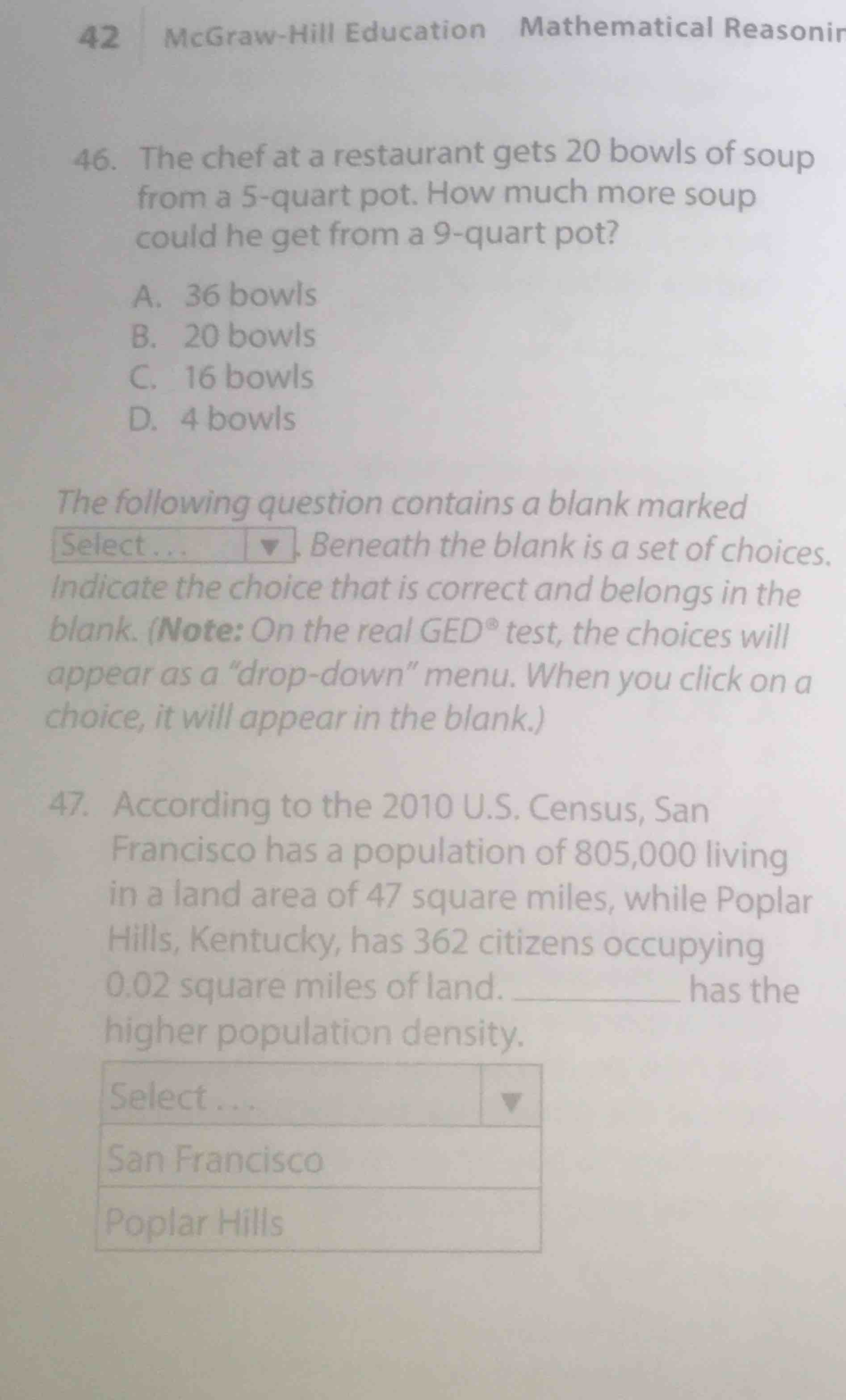
- the chef at a restaurant gets 20 bowls of soup from a 5 - quart pot. how much more soup could he get from a 9 - quart pot? a. 36 bowls b. 20 bowls c. 16 bowls d. 4 bowls the following question contains a blank marked select... ▼. beneath the blank is a set of choices. indicate the choice that is correct and belongs in the blank. (note: on the real ged® test, the choices will appear as a “drop - down” menu. when you click on a choice, it will appear in the blank.) 47. according to the 2010 u.s. census, san francisco has a population of 805,000 living in a land area of 47 square miles, while poplar hills, kentucky, has 362 citizens occupying 0.02 square miles of land. ________ has the higher population density. select... ▼ san francisco poplar hills
Question 46
Step1: Find bowls per quart
First, find how many bowls of soup are in 1 quart. Since 5 quarts give 20 bowls, we divide the number of bowls by the number of quarts. So, $20 \div 5 = 4$ bowls per quart.
Step2: Find bowls from 9 - quart pot
Now, to find how many bowls are in a 9 - quart pot, we multiply the number of bowls per quart by 9. So, $4\times9 = 36$ bowls.
Step3: Find the difference (though not necessary for the answer here, but to check the "more" part)
The chef gets 20 bowls from 5 quarts. From 9 quarts, he gets 36 bowls. The difference is $36 - 20=16$? Wait, no, wait. Wait, the question is "How much more soup could he get from a 9 - quart pot?" Wait, no, first, let's re - read. The chef gets 20 bowls from 5 - quart. So per quart is $20/5 = 4$ bowls per quart. Then 9 - quart would be $4\times9 = 36$ bowls. The amount more than 20 is $36 - 20 = 16$? Wait, no, the options: A is 36, C is 16. Wait, maybe I misread. Wait, the question is "How much more soup could he get from a 9 - quart pot?" Wait, no, maybe the question is "How many bowls from 9 - quart" and then the "more" is compared to 20? Wait, no, let's check the options. Option C is 16, which is $36 - 20$. Wait, but let's do it again.
Wait, 5 quarts: 20 bowls. So 1 quart: $20\div5 = 4$ bowls. 9 quarts: $4\times9 = 36$ bowls. The number of bowls from 9 - quart is 36, and from 5 - quart is 20. So the "more" is $36 - 20 = 16$? But option A is 36, which is the number of bowls from 9 - quart. Wait, maybe the question is "How many bowls from 9 - quart" and the "more" is a mis - read. Wait, the original question: "How much more soup could he get from a 9 - quart pot?" Wait, no, maybe the question is "How many bowls from 9 - quart" and the options are A:36, B:20, C:16, D:4. Wait, if we calculate the number of bowls from 9 - quart, it's 36, and the number from 5 - quart is 20, so the "more" is $36 - 20 = 16$. But the options: C is 16. Wait, I think I made a mistake earlier. Let's re - calculate.
Wait, 5 quarts → 20 bowls. So the rate is $20\div5 = 4$ bowls per quart.
For 9 quarts, number of bowls is $4\times9 = 36$ bowls.
The amount "more" than 20 bowls is $36 - 20 = 16$ bowls. So the answer is C? Wait, no, the options: A is 36, C is 16. Wait, maybe the question is "How many bowls from 9 - quart" and the "more" is a wrong interpretation. Wait, let's check the options again.
Option A: 36 bowls (number of bowls from 9 - quart)
Option C: 16 bowls (36 - 20)
Wait, the question says "How much more soup could he get from a 9 - quart pot?" So compared to the 20 bowls from 5 - quart, how much more from 9 - quart. So 36 - 20 = 16. So the answer is C. Wait, but my first step - by - step had an error. Let's correct it.
Step1: Calculate bowls per quart
Number of bowls per quart = $\frac{20}{5}=4$ bowls per quart.
Step2: Calculate bowls from 9 - quart pot
Bowls from 9 - quart pot = $4\times9 = 36$ bowls.
Step3: Calculate the difference (more than 20 bowls)
More bowls = $36 - 20 = 16$ bowls.
Population density is calculated as $\text{Population Density}=\frac{\text{Population}}{\text{Land Area}}$.
For San Francisco:
Population = 805000, Land Area = 47 square miles.
Population density = $\frac{805000}{47}\approx17127.66$ people per square mile.
For Poplar Hills:
Population = 362, Land Area = 0.02 square miles.
Population density = $\frac{362}{0.02}=18100$ people per square mile.
Since $18100>17127.66$, Poplar Hills has a higher population density.

Snap & solve any problem in the app
Get step-by-step solutions on Sovi AI
Photo-based solutions with guided steps
Explore more problems and detailed explanations
C. 16 bowls