QUESTION IMAGE
Question
5-2 practice quiz
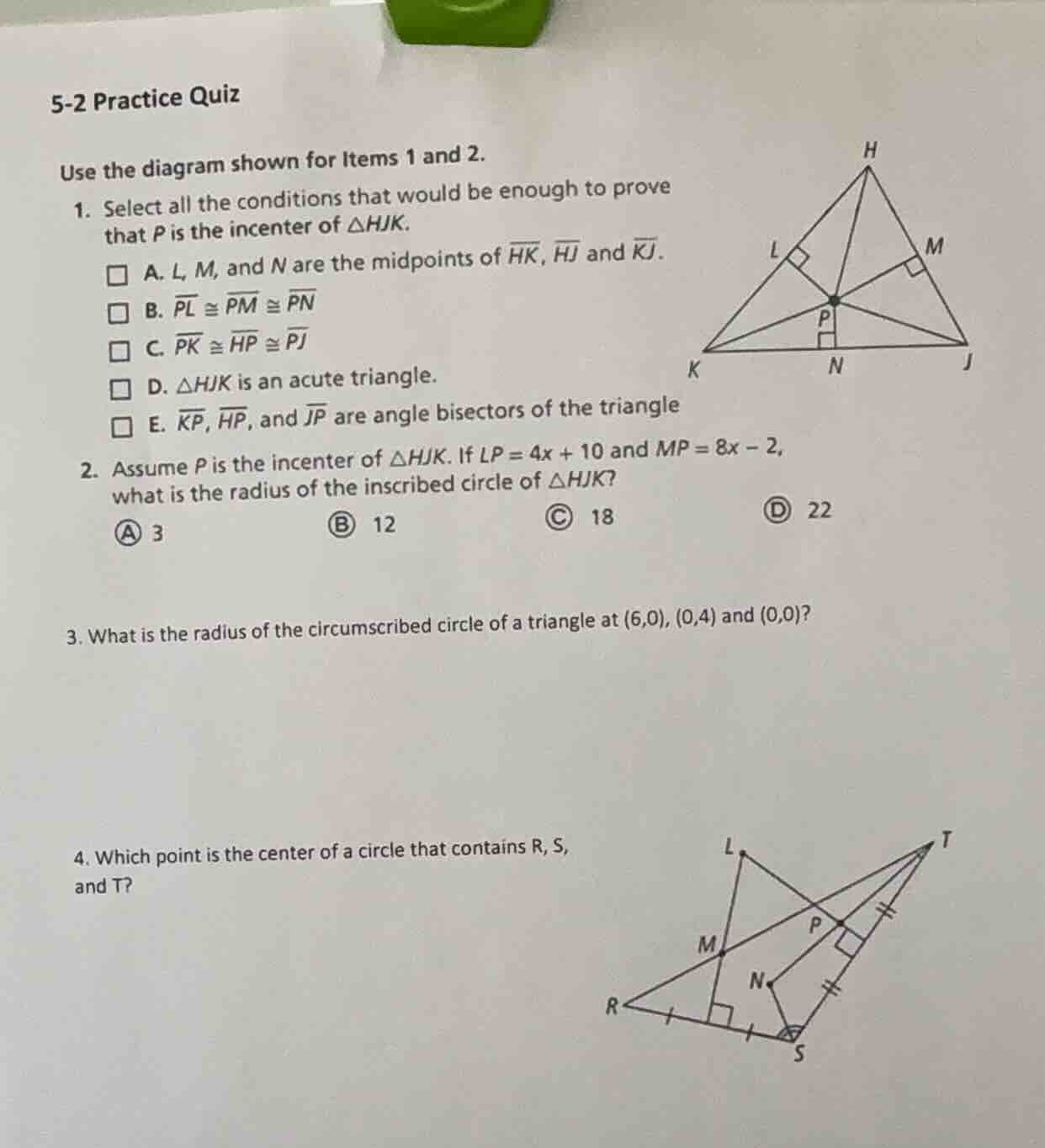
use the diagram shown for items 1 and 2.
- select all the conditions that would be enough to prove
that p is the incenter of $\triangle hjk$.
\\(\square\\) a. l, m, and n are the midpoints of $\overline{hk}$, $\overline{hj}$ and $\overline{kj}$.
\\(\square\\) b. $\overline{pl} \cong \overline{pm} \cong \overline{pn}$
\\(\square\\) c. $\overline{pk} \cong \overline{hp} \cong \overline{pj}$
\\(\square\\) d. $\triangle hjk$ is an acute triangle.
\\(\square\\) e. $\overline{kp}$, $\overline{hp}$, and $\overline{jp}$ are angle bisectors of the triangle
- assume p is the incenter of $\triangle hjk$. if $lp = 4x + 10$ and $mp = 8x - 2$,
what is the radius of the inscribed circle of $\triangle hjk$
\\(\boldsymbol{\textcircled{a}}\\) 3 \\(\boldsymbol{\textcircled{b}}\\) 12 \\(\boldsymbol{\textcircled{c}}\\) 18 \\(\boldsymbol{\textcircled{d}}\\) 22
- what is the radius of the circumscribed circle of a triangle at (6,0), (0,4) and (0,0)?
- which point is the center of a circle that contains r, s,
and t?
Item 1
- The incenter of a triangle is the intersection of its angle bisectors, and it is equidistant from all three sides (these distances are the radii of the incircle).
- Option A: Midpoints relate to centroids, not incenters, so this is incorrect.
- Option B: If \( \overline{PL} \cong \overline{PM} \cong \overline{PN} \), \( P \) is equidistant from all sides, which defines the incenter (given \( PL, PM, PN \) are perpendicular to the sides), so this is correct.
- Option C: Equal distances from vertices define the circumcenter, not incenter, so this is incorrect.
- Option D: Triangle type does not determine the incenter's location, so this is incorrect.
- Option E: The incenter is the intersection of angle bisectors, so if these are angle bisectors, \( P \) is the incenter, so this is correct.
Step1: Set lengths equal (inradius property)
Since \( P \) is the incenter, \( LP = MP \), so:
\( 4x + 10 = 8x - 2 \)
Step2: Solve for \( x \)
Rearrange to isolate \( x \):
\( 10 + 2 = 8x - 4x \)
\( 12 = 4x \)
\( x = \frac{12}{4} = 3 \)
Step3: Calculate inradius (substitute \( x \))
Use \( LP = 4x + 10 \):
\( LP = 4(3) + 10 = 12 + 10 = 22 \)
Step1: Identify triangle type
The points \((6,0)\), \((0,4)\), \((0,0)\) form a right triangle (right angle at \((0,0)\)).
Step2: Use right triangle circumradius rule
For a right triangle, the circumradius is half the length of the hypotenuse. First calculate hypotenuse length between \((6,0)\) and \((0,4)\):
\( \text{Hypotenuse} = \sqrt{(6-0)^2 + (0-4)^2} = \sqrt{36 + 16} = \sqrt{52} = 2\sqrt{13} \)
Step3: Compute radius
\( \text{Radius} = \frac{1}{2} \times 2\sqrt{13} = \sqrt{13} \)

Snap & solve any problem in the app
Get step-by-step solutions on Sovi AI
Photo-based solutions with guided steps
Explore more problems and detailed explanations
B. \( \overline{PL} \cong \overline{PM} \cong \overline{PN} \)
E. \( \overline{KP}, \overline{HP}, \) and \( \overline{JP} \) are angle bisectors of the triangle
---