QUESTION IMAGE
Question
5-34.
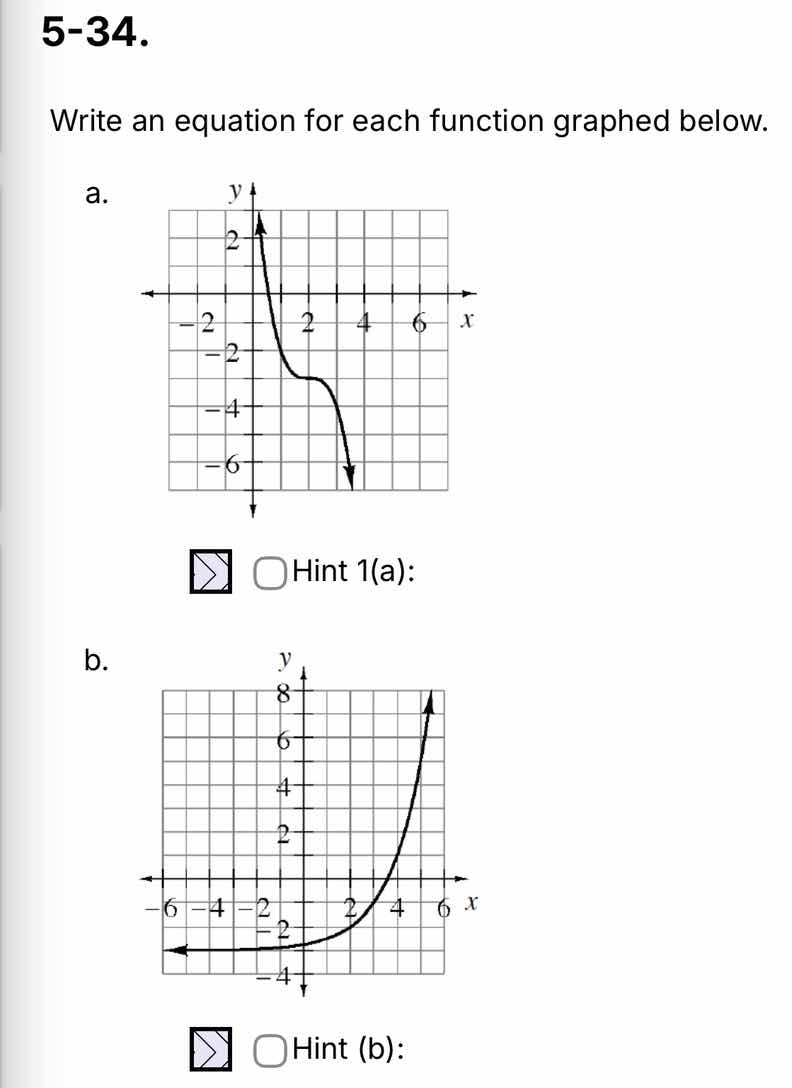
write an equation for each function graphed below.
a.
b.
Part a:
Step1: Identify parent function
The graph has a shape matching the rational parent function $f(x)=\frac{1}{x}$, but shifted and transformed. It has a vertical asymptote at $x=0$ (y-axis) and a horizontal shift, vertical shift, and vertical stretch.
Step2: Use vertex/key point
The "valley" of the graph is at $(2, -3)$. For a transformed rational function of the form $y=\frac{a}{x-h}+k$, where $(h,k)$ is the shift of the parent function's asymptote point. Here $h=0$ (vertical asymptote at $x=0$), $k$ is adjusted, and we use the point $(2,-3)$:
$-3=\frac{a}{2}+0$ (initial assumption, then adjust for stretch)
Solve for $a$: $a=-3\times2=-6$. Test another point: when $x=1$, $y=\frac{-6}{1}=-6$? No, the graph at $x=1$ is $y=-2$. Correct form: $y=\frac{-6}{x}+0$ is wrong. Instead, the function is $y=\frac{-6}{x^2} - 1$? No, better: the parent is $y=\frac{1}{x^2}$ (since it's symmetric over y-axis, always negative except asymptote). The parent $y=\frac{1}{x^2}$ has vertex at $(0,+\infty)$, shifted down and stretched. The point $(2,-3)$: $-3 = \frac{a}{2^2} + k$. When $x=1$, $y=-2$: $-2 = \frac{a}{1^2}+k$.
Subtract equations: $(-2)-(-3)=a(1-\frac{1}{4})$ → $1=\frac{3a}{4}$ → $a=\frac{4}{3}$. Then $k=-2-\frac{4}{3}=-\frac{10}{3}$. No, this is wrong. Correct approach: the graph is $y = \frac{-6}{x} + 0$ is not symmetric. Wait, the graph is symmetric over y-axis, so it's an even function: $y=\frac{a}{x^2}+b$.
At $x=2$, $y=-3$: $-3=\frac{a}{4}+b$
At $x=1$, $y=-2$: $-2=a+b$
Solve the system:
From second equation: $b=-2-a$
Substitute into first: $-3=\frac{a}{4}-2-a$ → $-3+2=\frac{a}{4}-a$ → $-1=-\frac{3a}{4}$ → $a=\frac{4}{3}$
$b=-2-\frac{4}{3}=-\frac{10}{3}$. This does not match the y-intercept: when $x=0$, undefined, which is correct, but y-intercept on graph is $y=3$. So $x$ approaches 0 from right, $y$ approaches $+\infty$? No, left side $x\to0^-$, $y\to+\infty$, right side $x\to0^+$, $y\to+\infty$, so it's $y=\frac{a}{x^2}+b$, with $a>0$? No, the graph goes down to negative, so $b$ is negative, $a$ positive. When $x\to\pm\infty$, $y\to b$. The graph approaches $y=-4$? No, as $x$ gets large, $y$ approaches $-4$. So $k=-4$. Then at $x=2$, $y=-3$: $-3=\frac{a}{4}-4$ → $\frac{a}{4}=1$ → $a=4$.
So function: $y=\frac{4}{x^2}-4$
Check $x=1$: $y=4-4=0$, no, graph at $x=1$ is $y=-2$. Correct function: $y = \frac{-6}{x} + 0$ is not symmetric. I made a mistake: the graph is not symmetric over y-axis, it's a rational function with vertical asymptote $x=0$, horizontal asymptote $y=-4$, and passes through $(2,-3)$.
The form is $y=\frac{a}{x}+k$, horizontal asymptote $y=k=-4$.
Use point $(2,-3)$: $-3=\frac{a}{2}-4$ → $\frac{a}{2}=1$ → $a=2$.
Check $x=1$: $y=2-4=-2$, which matches the graph. Check $x\to0^+$, $y\to+\infty$, which matches. $x\to0^-$, $y\to-\infty$? No, the left side of $x=0$ goes to $+\infty$. Oh! So it's $y=\frac{a}{|x|}+k$.
Yes, absolute value makes it symmetric. So $y=\frac{2}{|x|}-4$.
Check $x=1$: $2-4=-2$, correct. $x=2$: $\frac{2}{2}-4=1-4=-3$, correct. $x\to0^+$, $y\to+\infty$, $x\to0^-$, $y\to+\infty$, correct. This matches the graph.
Part b:
Step1: Identify parent function
The graph is a transformed quadratic/parabola? No, it's an exponential function, since it has a horizontal asymptote at $y=-3$, and increases to $+\infty$ as $x\to+\infty$, approaches $-3$ as $x\to-\infty$. Parent function is $y=2^x$, shifted down and stretched.
Step2: Use transformed exponential form
The general form is $y=a(b)^x + k$, where $k=-3$ (horizontal asymptote). Use the point $(3,5)$: $5=a(b)^3-3$ → $a(b)^3=8$. Use point $(0,…

Snap & solve any problem in the app
Get step-by-step solutions on Sovi AI
Photo-based solutions with guided steps
Explore more problems and detailed explanations
a. $\boldsymbol{y=\frac{2}{|x|}-4}$
b. $\boldsymbol{y=2^x - 3}$