QUESTION IMAGE
Question
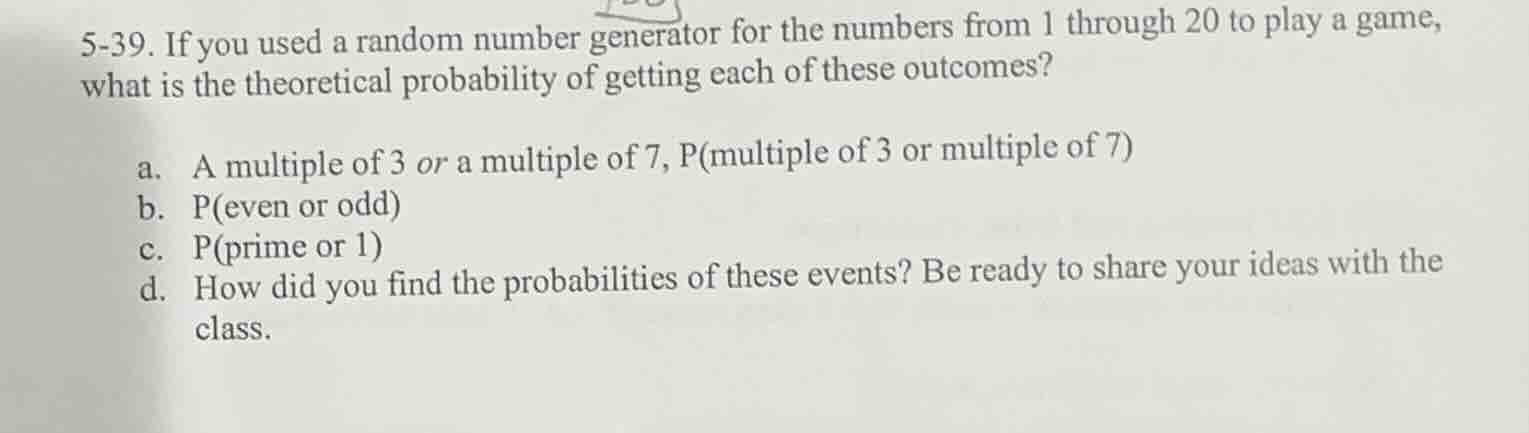
5-39. if you used a random number generator for the numbers from 1 through 20 to play a game, what is the theoretical probability of getting each of these outcomes?
a. a multiple of 3 or a multiple of 7, p(multiple of 3 or multiple of 7)
b. p(even or odd)
c. p(prime or 1)
d. how did you find the probabilities of these events? be ready to share your ideas with the class.
Part a:
Step1: Identify multiples of 3 and 7
Multiples of 3 from 1 - 20: 3, 6, 9, 12, 15, 18 (6 numbers).
Multiples of 7 from 1 - 20: 7, 14 (2 numbers).
No overlap (3 and 7 are coprime), so total favorable = \( 6 + 2 = 8 \).
Total numbers: 20.
Step2: Calculate probability
Probability \( P = \frac{\text{Favorable}}{\text{Total}} = \frac{8}{20} = \frac{2}{5} \).
Part b:
Step1: Analyze even/odd
All numbers from 1 - 20 are either even or odd (no overlap, covers all).
Favorable outcomes = 20, total = 20.
Step2: Calculate probability
Probability \( P = \frac{20}{20} = 1 \).
Part c:
Step1: Identify primes and 1
Primes from 1 - 20: 2, 3, 5, 7, 11, 13, 17, 19 (8 numbers).
Add 1: total favorable = \( 8 + 1 = 9 \).
Step2: Calculate probability
Probability \( P = \frac{9}{20} \).
Part d:

Snap & solve any problem in the app
Get step-by-step solutions on Sovi AI
Photo-based solutions with guided steps
Explore more problems and detailed explanations
s:
a. \( \boldsymbol{\frac{2}{5}} \)
b. \( \boldsymbol{1} \)
c. \( \boldsymbol{\frac{9}{20}} \)
d. As explained (using sample space, favorable outcomes, and probability formula).