QUESTION IMAGE
Question
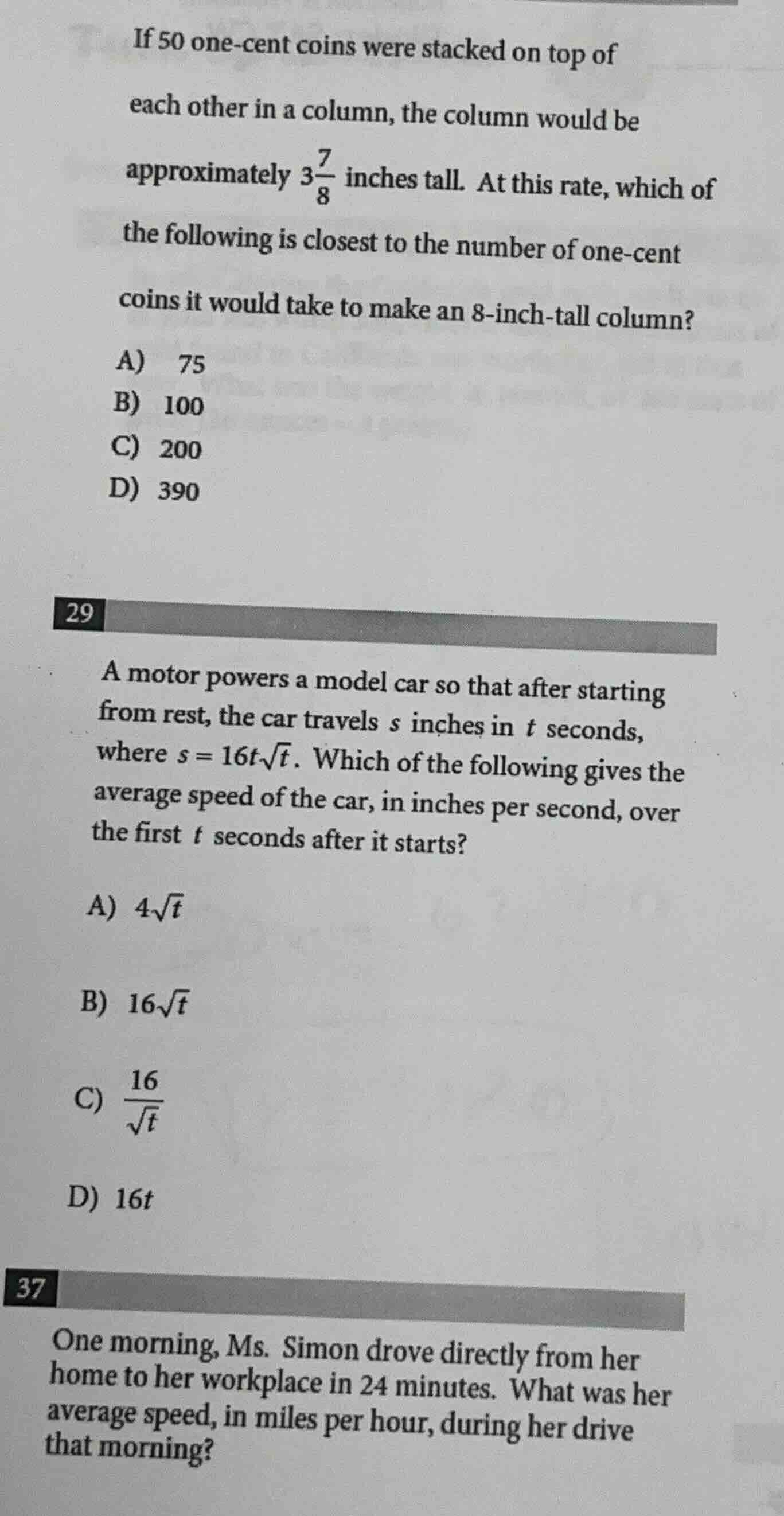
if 50 one - cent coins were stacked on top of each other in a column, the column would be approximately $3\frac{7}{8}$ inches tall. at this rate, which of the following is closest to the number of one - cent coins it would take to make an 8 - inch - tall column?\
a) 75\
b) 100\
c) 200\
d) 390\
\
29\
a motor powers a model car so that after starting from rest, the car travels $s$ inches in $t$ seconds, where $s = 16t\sqrt{t}$. which of the following gives the average speed of the car, in inches per second, over the first $t$ seconds after it starts?\
a) $4\sqrt{t}$\
b) $16\sqrt{t}$\
c) $\frac{16}{\sqrt{t}}$\
d) $16t$\
\
37\
one morning, ms. simon drove directly from her home to her workplace in 24 minutes. what was her average speed, in miles per hour, during her drive that morning?
First Question (Coin Stacking)
Step1: Convert mixed number to improper fraction
The height of 50 coins is \( 3\frac{7}{8} \) inches. Convert \( 3\frac{7}{8} \) to an improper fraction: \( 3\frac{7}{8}=\frac{3\times8 + 7}{8}=\frac{31}{8} \) inches.
Step2: Find the number of coins per inch
Let \( x \) be the number of coins per inch. We know that 50 coins correspond to \( \frac{31}{8} \) inches. So, \( x=\frac{50}{\frac{31}{8}} = 50\times\frac{8}{31}=\frac{400}{31}\approx12.9 \) coins per inch.
Step3: Calculate coins for 8 - inch column
To find the number of coins for an 8 - inch column, multiply the number of coins per inch by 8. Let \( n \) be the number of coins. Then \( n=\frac{400}{31}\times8=\frac{3200}{31}\approx103.2 \). The closest option to 103.2 is 100.
Step1: Recall the formula for average speed
The formula for average speed \( v \) is \( v=\frac{\text{distance}}{\text{time}} \).
Step2: Substitute the given distance and time
The distance \( s = 16t\sqrt{t} \) and the time is \( t \) seconds. So, \( v=\frac{16t\sqrt{t}}{t} \).
Step3: Simplify the expression
Cancel out the \( t \) terms: \( v = 16\sqrt{t} \).

Snap & solve any problem in the app
Get step-by-step solutions on Sovi AI
Photo-based solutions with guided steps
Explore more problems and detailed explanations
B) 100