QUESTION IMAGE
Question
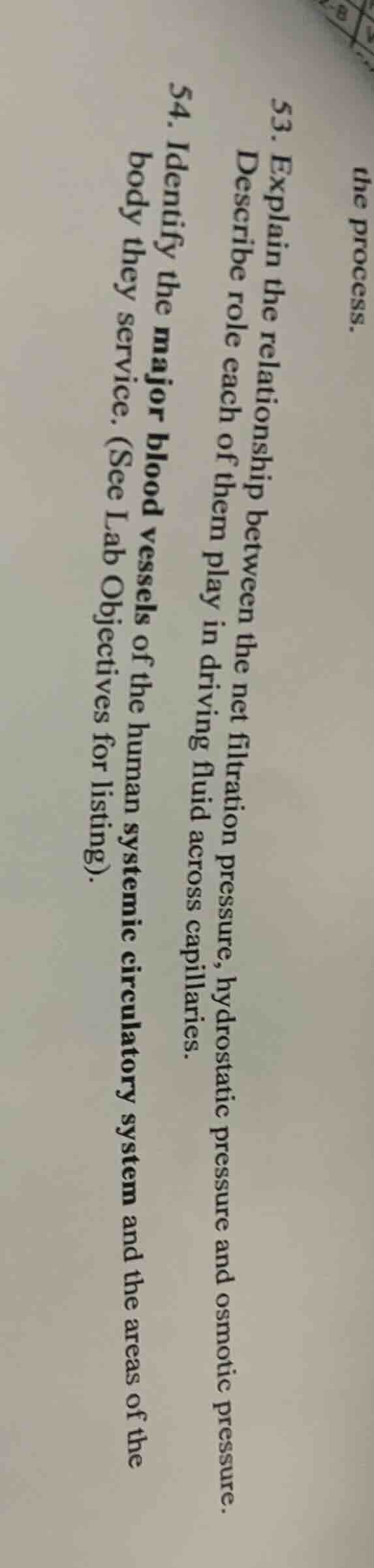
- explain the relationship between the net filtration pressure, hydrostatic pressure and osmotic pressure. describe the role each of them play in driving fluid across capillaries.
- identify the major blood vessels of the human systemic circulatory system and the areas of the body they service. (see lab objectives for listing).
Question 53
Net filtration pressure (NFP) drives fluid movement across capillaries. It is calculated as \( \text{NFP} = (\text{Hydrostatic Pressure}_{\text{capillary}} - \text{Hydrostatic Pressure}_{\text{interstitial}}) - (\text{Osmotic Pressure}_{\text{capillary}} - \text{Osmotic Pressure}_{\text{interstitial}}) \). Hydrostatic pressure (HP) is the force of fluid pushing against vessel walls; capillary HP pushes fluid out, interstitial HP pushes it in. Osmotic pressure (OP, from solutes like proteins) pulls fluid: capillary OP pulls fluid into capillaries, interstitial OP pulls it out. NFP is positive for filtration (fluid out) or negative for reabsorption (fluid in).
In the systemic circulatory system:
- Arteries: Aorta (from heart) distributes oxygenated blood to arteries (e.g., carotid, femoral) that branch into arterioles, carrying blood to tissues.
- Arterioles: Regulate blood flow to capillaries via vasoconstriction/vasodilation, controlling perfusion.
- Capillaries: Thin-walled, site of nutrient/gas exchange between blood and tissues.
- Venules: Collect deoxygenated blood from capillaries, merge into veins.
- Veins: Venae cavae (superior/inferior) return deoxygenated blood to the heart.
Areas served: Systemic arteries supply all body tissues (e.g., brain, muscles, organs); veins drain them.

Snap & solve any problem in the app
Get step-by-step solutions on Sovi AI
Photo-based solutions with guided steps
Explore more problems and detailed explanations
Net filtration pressure (NFP) is the driving force for fluid movement across capillaries, calculated as \( \text{NFP} = (\text{HP}_c - \text{HP}_i) - (\text{OP}_c - \text{OP}_i) \). Hydrostatic pressure (HP) pushes fluid (capillary HP \( \text{HP}_c \) favors filtration out; interstitial HP \( \text{HP}_i \) opposes it). Osmotic pressure (OP, from solutes) pulls fluid (capillary OP \( \text{OP}_c \) favors reabsorption in; interstitial OP \( \text{OP}_i \) opposes it). NFP determines if fluid filters out (positive NFP) or is reabsorbed (negative NFP).