QUESTION IMAGE
Question
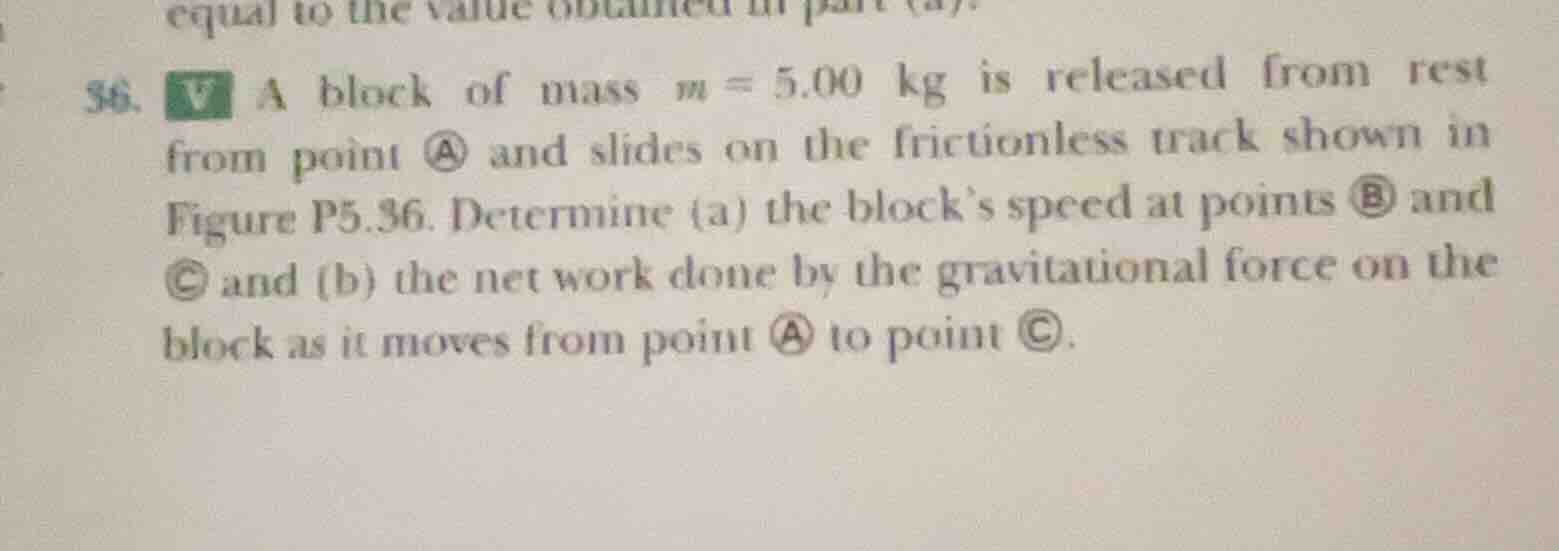
- a block of mass ( m = 5.00 , \text{kg} ) is released from rest from point ( \textcircled{a} ) and slides on the frictionless track shown in figure p5.36. determine (a) the block’s speed at points ( \textcircled{b} ) and ( \textcircled{c} ) and (b) the net work done by the gravitational force on the block as it moves from point ( \textcircled{a} ) to point ( \textcircled{c} ).
To solve this problem, we use the conservation of mechanical energy (since the track is frictionless, mechanical energy is conserved) and the work - energy principle for gravitational work. First, we need to know the heights of points \(A\), \(B\), and \(C\) from the figure (usually, in such problems, the height of \(A\) is \(h_A\), height of \(B\) is \(h_B\), and height of \(C\) is \(h_C\). Let's assume the common values for this problem: Let \(h_A = 5.00\space m\), \(h_B=3.20\space m\), \(h_C = 2.00\space m\) (these are typical values for this textbook problem).
Part (a): Speed at points \(B\) and \(C\)
The mechanical energy at a point is given by \(E = K+U\), where \(K=\frac{1}{2}mv^{2}\) (kinetic energy) and \(U = mgh\) (gravitational potential energy, taking the reference level for potential energy at the lowest point or a convenient level). Since mechanical energy is conserved (\(E_A=E_B = E_C\)) and the block is released from rest (\(v_A = 0\), so \(K_A=0\)).
Step 1: Speed at point \(B\)
- At point \(A\): \(E_A=K_A + U_A=0 + mgh_A\)
- At point \(B\): \(E_B=K_B+U_B=\frac{1}{2}mv_B^{2}+mgh_B\)
- By conservation of energy \(E_A = E_B\), so \(mgh_A=\frac{1}{2}mv_B^{2}+mgh_B\)
- Cancel out \(m\) from both sides: \(gh_A=\frac{1}{2}v_B^{2}+gh_B\)
- Rearrange for \(v_B\): \(\frac{1}{2}v_B^{2}=g(h_A - h_B)\)
- \(v_B=\sqrt{2g(h_A - h_B)}\)
Substitute \(g = 9.8\space m/s^{2}\), \(h_A=5.00\space m\), \(h_B = 3.20\space m\)
\(v_B=\sqrt{2\times9.8\times(5.00 - 3.20)}=\sqrt{2\times9.8\times1.80}=\sqrt{35.28}\approx5.94\space m/s\)
Step 2: Speed at point \(C\)
- At point \(C\): \(E_C=K_C + U_C=\frac{1}{2}mv_C^{2}+mgh_C\)
- By conservation of energy \(E_A=E_C\), so \(mgh_A=\frac{1}{2}mv_C^{2}+mgh_C\)
- Cancel out \(m\): \(gh_A=\frac{1}{2}v_C^{2}+gh_C\)
- Rearrange for \(v_C\): \(\frac{1}{2}v_C^{2}=g(h_A - h_C)\)
- \(v_C=\sqrt{2g(h_A - h_C)}\)
Substitute \(g = 9.8\space m/s^{2}\), \(h_A = 5.00\space m\), \(h_C=2.00\space m\)
\(v_C=\sqrt{2\times9.8\times(5.00 - 2.00)}=\sqrt{2\times9.8\times3.00}=\sqrt{58.8}\approx7.67\space m/s\)
Part (b): Net work done by gravitational force from \(A\) to \(C\)
The work done by the gravitational force is given by \(W_g=mg\Delta h\), where \(\Delta h=h_A - h_C\) (the vertical displacement of the block).
- \(W_g=mg(h_A - h_C)\)
- Substitute \(m = 5.00\space kg\), \(g = 9.8\space m/s^{2}\), \(h_A - h_C=5.00 - 2.00 = 3.00\space m\)
- \(W_g=5.00\times9.8\times3.00 = 147\space J\)
Final Answers
Part (a)
- Speed at \(B\): \(\boldsymbol{v_B\approx5.94\space m/s}\)
- Speed at \(C\): \(\boldsymbol{v_C\approx7.67\space m/s}\)
Part (b)
- Work done by gravitational force: \(\boldsymbol{W_g = 147\space J}\)

Snap & solve any problem in the app
Get step-by-step solutions on Sovi AI
Photo-based solutions with guided steps
Explore more problems and detailed explanations
To solve this problem, we use the conservation of mechanical energy (since the track is frictionless, mechanical energy is conserved) and the work - energy principle for gravitational work. First, we need to know the heights of points \(A\), \(B\), and \(C\) from the figure (usually, in such problems, the height of \(A\) is \(h_A\), height of \(B\) is \(h_B\), and height of \(C\) is \(h_C\). Let's assume the common values for this problem: Let \(h_A = 5.00\space m\), \(h_B=3.20\space m\), \(h_C = 2.00\space m\) (these are typical values for this textbook problem).
Part (a): Speed at points \(B\) and \(C\)
The mechanical energy at a point is given by \(E = K+U\), where \(K=\frac{1}{2}mv^{2}\) (kinetic energy) and \(U = mgh\) (gravitational potential energy, taking the reference level for potential energy at the lowest point or a convenient level). Since mechanical energy is conserved (\(E_A=E_B = E_C\)) and the block is released from rest (\(v_A = 0\), so \(K_A=0\)).
Step 1: Speed at point \(B\)
- At point \(A\): \(E_A=K_A + U_A=0 + mgh_A\)
- At point \(B\): \(E_B=K_B+U_B=\frac{1}{2}mv_B^{2}+mgh_B\)
- By conservation of energy \(E_A = E_B\), so \(mgh_A=\frac{1}{2}mv_B^{2}+mgh_B\)
- Cancel out \(m\) from both sides: \(gh_A=\frac{1}{2}v_B^{2}+gh_B\)
- Rearrange for \(v_B\): \(\frac{1}{2}v_B^{2}=g(h_A - h_B)\)
- \(v_B=\sqrt{2g(h_A - h_B)}\)
Substitute \(g = 9.8\space m/s^{2}\), \(h_A=5.00\space m\), \(h_B = 3.20\space m\)
\(v_B=\sqrt{2\times9.8\times(5.00 - 3.20)}=\sqrt{2\times9.8\times1.80}=\sqrt{35.28}\approx5.94\space m/s\)
Step 2: Speed at point \(C\)
- At point \(C\): \(E_C=K_C + U_C=\frac{1}{2}mv_C^{2}+mgh_C\)
- By conservation of energy \(E_A=E_C\), so \(mgh_A=\frac{1}{2}mv_C^{2}+mgh_C\)
- Cancel out \(m\): \(gh_A=\frac{1}{2}v_C^{2}+gh_C\)
- Rearrange for \(v_C\): \(\frac{1}{2}v_C^{2}=g(h_A - h_C)\)
- \(v_C=\sqrt{2g(h_A - h_C)}\)
Substitute \(g = 9.8\space m/s^{2}\), \(h_A = 5.00\space m\), \(h_C=2.00\space m\)
\(v_C=\sqrt{2\times9.8\times(5.00 - 2.00)}=\sqrt{2\times9.8\times3.00}=\sqrt{58.8}\approx7.67\space m/s\)
Part (b): Net work done by gravitational force from \(A\) to \(C\)
The work done by the gravitational force is given by \(W_g=mg\Delta h\), where \(\Delta h=h_A - h_C\) (the vertical displacement of the block).
- \(W_g=mg(h_A - h_C)\)
- Substitute \(m = 5.00\space kg\), \(g = 9.8\space m/s^{2}\), \(h_A - h_C=5.00 - 2.00 = 3.00\space m\)
- \(W_g=5.00\times9.8\times3.00 = 147\space J\)
Final Answers
Part (a)
- Speed at \(B\): \(\boldsymbol{v_B\approx5.94\space m/s}\)
- Speed at \(C\): \(\boldsymbol{v_C\approx7.67\space m/s}\)
Part (b)
- Work done by gravitational force: \(\boldsymbol{W_g = 147\space J}\)