QUESTION IMAGE
Question
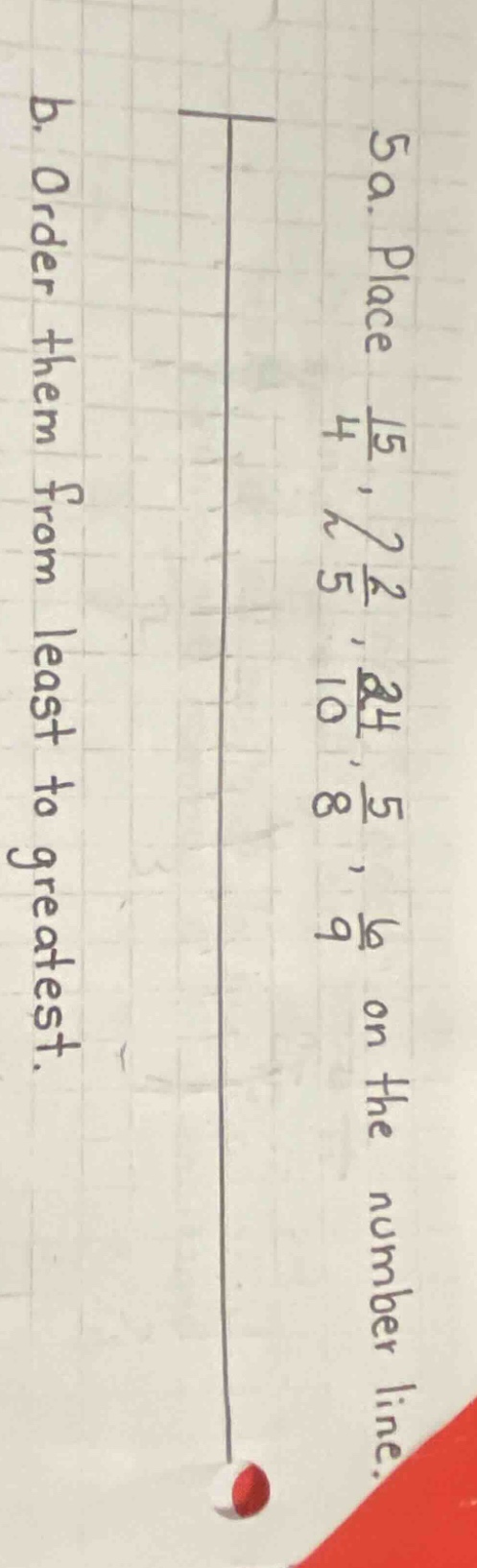
5a. place \\(\frac{15}{4}\\), \\(\frac{2}{5}\\), \\(\frac{24}{10}\\), \\(\frac{5}{8}\\), \\(\frac{6}{9}\\) on the number line.
b. order them from least to greatest.
Step1: Find a common denominator
To compare the fractions \(\frac{15}{4}\), \(\frac{2}{5}\), \(\frac{24}{10}\), \(\frac{5}{8}\), \(\frac{6}{9}\) (simplify \(\frac{6}{9}=\frac{2}{3}\) first), we find the least common multiple (LCM) of the denominators 4, 5, 10, 8, 3. The LCM of 4, 5, 10, 8, 3 is 120.
Step2: Convert each fraction to have denominator 120
- \(\frac{15}{4}=\frac{15\times30}{4\times30}=\frac{450}{120}\)
- \(\frac{2}{5}=\frac{2\times24}{5\times24}=\frac{48}{120}\)
- \(\frac{24}{10}=\frac{24\times12}{10\times12}=\frac{288}{120}\)
- \(\frac{5}{8}=\frac{5\times15}{8\times15}=\frac{75}{120}\)
- \(\frac{2}{3}=\frac{2\times40}{3\times40}=\frac{80}{120}\) (since \(\frac{6}{9}=\frac{2}{3}\))
Step3: Compare the numerators
Now we have the fractions with the same denominator: \(\frac{48}{120}\) (from \(\frac{2}{5}\)), \(\frac{75}{120}\) (from \(\frac{5}{8}\)), \(\frac{80}{120}\) (from \(\frac{6}{9}=\frac{2}{3}\)), \(\frac{288}{120}\) (from \(\frac{24}{10}\)), \(\frac{450}{120}\) (from \(\frac{15}{4}\)).
Since \(48 < 75 < 80 < 288 < 450\), the original fractions in order from least to greatest are:
\(\frac{2}{5}\), \(\frac{5}{8}\), \(\frac{6}{9}\) (or \(\frac{2}{3}\)), \(\frac{24}{10}\), \(\frac{15}{4}\)
Wait, there was a typo in the original problem, the second fraction should be \(\frac{2}{5}\) (probably a writing error, assuming \(\frac{2}{5}\) instead of the unclear one). Also, \(\frac{6}{9}\) simplifies to \(\frac{2}{3}\). Let's re - check the original fractions: if the fractions are \(\frac{15}{4}\), \(\frac{2}{5}\), \(\frac{24}{10}\), \(\frac{5}{8}\), \(\frac{6}{9}\) (simplified to \(\frac{2}{3}\))
Another way: maybe the second fraction is \(\frac{22}{5}\) (if it's a mixed number? Wait, the original writing is unclear, maybe a miswriting. If we assume the fractions are \(\frac{15}{4}\), \(\frac{2}{5}\), \(\frac{24}{10}\), \(\frac{5}{8}\), \(\frac{6}{9}\) (simplify \(\frac{6}{9}=\frac{2}{3}\))
Wait, let's re - do with correct fractions (maybe the second fraction is \(\frac{2}{5}\), third \(\frac{24}{10}\) (which is \(\frac{12}{5}\)), fourth \(\frac{5}{8}\), fifth \(\frac{6}{9}\) (=\(\frac{2}{3}\))
Wait, \(\frac{15}{4}=3.75\), \(\frac{2}{5}=0.4\), \(\frac{24}{10}=2.4\), \(\frac{5}{8}=0.625\), \(\frac{6}{9}\approx0.666\)
Now comparing the decimal values: \(0.4 < 0.625 < 0.666 < 2.4 < 3.75\)
So the order from least to greatest is \(\frac{2}{5}\), \(\frac{5}{8}\), \(\frac{6}{9}\) (or \(\frac{2}{3}\)), \(\frac{24}{10}\), \(\frac{15}{4}\)

Snap & solve any problem in the app
Get step-by-step solutions on Sovi AI
Photo-based solutions with guided steps
Explore more problems and detailed explanations
\(\frac{2}{5}\), \(\frac{5}{8}\), \(\frac{6}{9}\) (or \(\frac{2}{3}\)), \(\frac{24}{10}\), \(\frac{15}{4}\) (assuming the fractions are \(\frac{15}{4}\), \(\frac{2}{5}\), \(\frac{24}{10}\), \(\frac{5}{8}\), \(\frac{6}{9}\) after correcting possible writing errors)