QUESTION IMAGE
Question
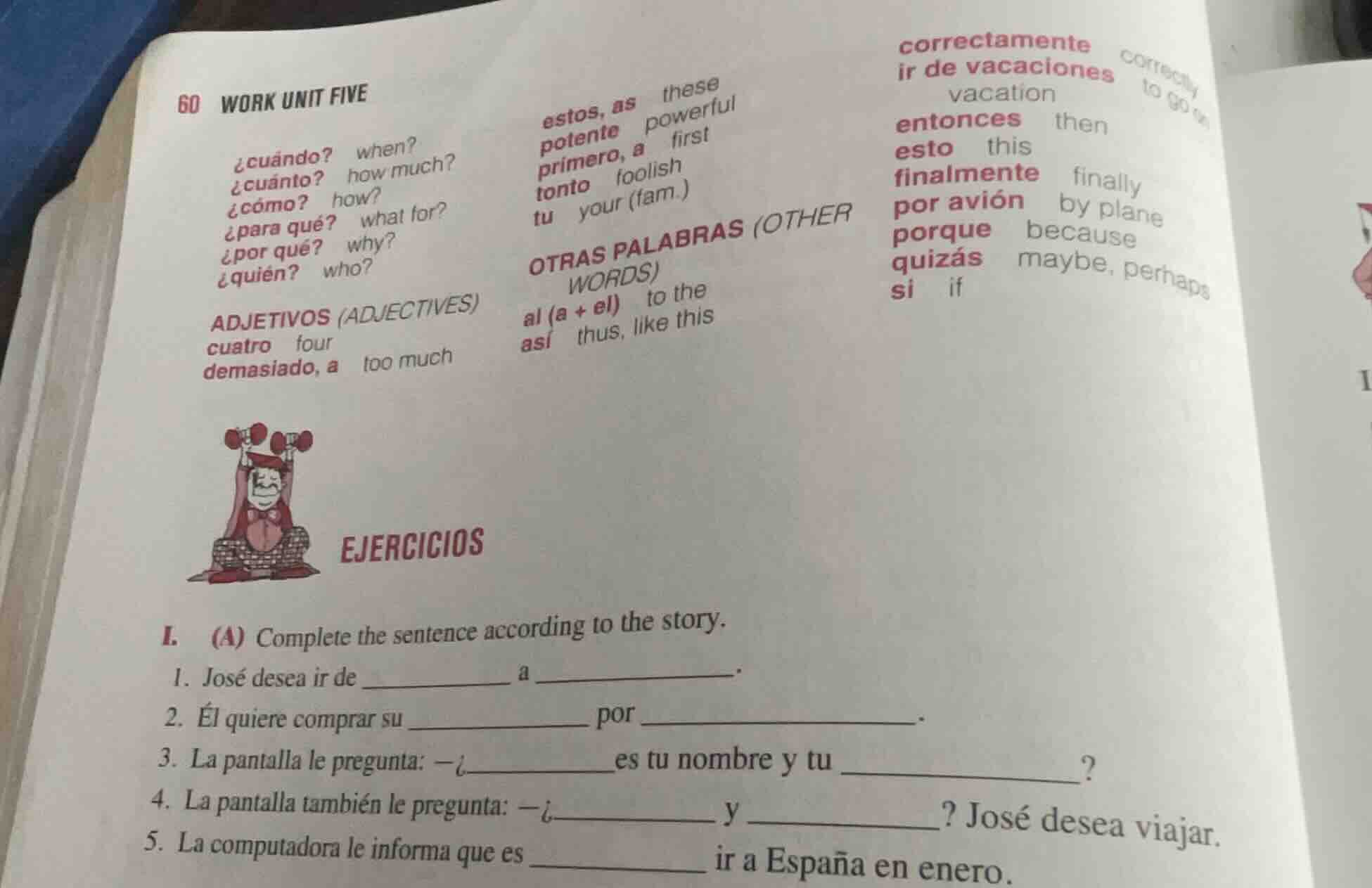
60 work unit five
¿cuándo? when?
¿cuánto? how much?
¿cómo? how?
¿para qué? what for?
¿por qué? why?
¿quién? who?
adjetivos (adjectives)
cuatro four
demasiado, a too much
iestos, as these
potente powerful
primero, a first
tonto foolish
tu your (fam.)
otras palabras (other words)
al (a + el) to the
así thus, like this
correctamente correctly
ir de vacaciones to go on vacation
then
then
esto this
finalmente finally
por avión by plane
porque because
quizás maybe, perhaps
sí if
ejercicios
i. (a) complete the sentence according to the story.
- josé desea ir de ____ a ____.
- él quiere comprar su ____ por ____.
- la pantalla le pregunta: —¿____ es tu nombre y tu ____?
- la pantalla también le pregunta: —¿____ y ____? josé desea viajar.
- la computadora le informa que es ______ ir a españa en enero.
To solve these fill - in - the - blank questions, we need to refer to the vocabulary provided above and the context of the story (even though the full story isn't shown, we can use the given vocabulary and common Spanish sentence structures).
Question 1
The phrase "ir de... a..." means "to go from... to...". From the vocabulary, "vacaciones" (vacation) is a common word to use with "ir de" (to go on). And a common destination could be a place like "España" (Spain), but if we use the given vocabulary, "vacaciones" for the first blank and maybe a place. But looking at the vocabulary, "ir de vacaciones" is a phrase. So the first blank could be "vacaciones" and the second blank could be a place, for example, if we assume a common travel destination, maybe "España". But based on the given vocabulary, let's use what's there. So "José desea ir de vacaciones a España" (but if we only use the given words, "vacaciones" and maybe a place. But the given vocabulary has "ir de vacaciones" (to go on vacation), so first blank: vacaciones, second blank: a place, maybe España (but since it's not in the given list, maybe we use the words. Wait, the given vocabulary has "ir de vacaciones" (to go on vacation), so first blank: vacaciones, second blank: maybe a place like "España" (but if we don't have it, maybe the story has it. But since we need to fill, let's use the given words. So first blank: vacaciones, second blank: (let's say) España (but if not, maybe the story has it. Alternatively, maybe the first blank is "vacaciones" and the second is a place. Let's proceed.
Question 2
"Él quiere comprar su..." (He wants to buy his...). From the context of travel, maybe "billete" (ticket), and "por avión" (by plane) from the vocabulary. So "Él quiere comprar su billete por avión" (but "billete" is not in the given vocabulary, but "por avión" is. Wait, the given vocabulary has "por avión" (by plane). So maybe "billete" (ticket) for the first blank and "por avión" for the second. But if we use the given words, "tu" (your) is there, but no, "su" (his) is used. So first blank: billete (if it's in the story) or maybe "pasaje" (but not in the given list). Alternatively, maybe "cosa" (thing) but no. Wait, the given vocabulary has "tu" (your), "potente" (powerful), etc. Maybe the first blank is "billete" (ticket) and the second is "por avión". So "Él quiere comprar su billete por avión".
Question 3
"La pantalla le pregunta: —¿... es tu nombre y tu...?" (The screen asks him: "What is your name and your...?"). The question word for "what" is "qué" (but in the given vocabulary, "¿cuándo?" (when), "¿cuánto?" (how much), "¿cómo?" (how), "¿para qué?" (what for), "¿por qué?" (why), "¿quién?" (who). Wait, "¿cuál es tu nombre?" is "what is your name", but "cuál" is not in the given list. Wait, the given question words: "¿cuándo?", "¿cuánto?", "¿cómo?", "¿para qué?", "¿por qué?", "¿quién?". Wait, maybe "¿cuál" is not there, but maybe "qué" (but "qué" is not in the given list. Wait, the given vocabulary has "esto" (this), "entonces" (then), etc. Wait, maybe the first blank is "cuál" (but not in the list) or maybe "qué" (not in the list). Wait, maybe the first blank is "cuál" (but since it's not in the given list, maybe the story has it. Alternatively, maybe "¿quién es tu nombre?" is wrong, "¿cuál es tu nombre?" is correct. But since we don't have "cuál" in the list, maybe the first blank is "cuál" (if the story has it) or maybe "qué" (but no). Wait, the given question words: "¿cuándo?", "¿cuánto?", "¿cómo?", "¿para qué?", "¿por qué?", "¿quién?". So maybe the first…

Snap & solve any problem in the app
Get step-by-step solutions on Sovi AI
Photo-based solutions with guided steps
Explore more problems and detailed explanations
To solve these fill - in - the - blank questions, we need to refer to the vocabulary provided above and the context of the story (even though the full story isn't shown, we can use the given vocabulary and common Spanish sentence structures).
Question 1
The phrase "ir de... a..." means "to go from... to...". From the vocabulary, "vacaciones" (vacation) is a common word to use with "ir de" (to go on). And a common destination could be a place like "España" (Spain), but if we use the given vocabulary, "vacaciones" for the first blank and maybe a place. But looking at the vocabulary, "ir de vacaciones" is a phrase. So the first blank could be "vacaciones" and the second blank could be a place, for example, if we assume a common travel destination, maybe "España". But based on the given vocabulary, let's use what's there. So "José desea ir de vacaciones a España" (but if we only use the given words, "vacaciones" and maybe a place. But the given vocabulary has "ir de vacaciones" (to go on vacation), so first blank: vacaciones, second blank: a place, maybe España (but since it's not in the given list, maybe we use the words. Wait, the given vocabulary has "ir de vacaciones" (to go on vacation), so first blank: vacaciones, second blank: maybe a place like "España" (but if we don't have it, maybe the story has it. But since we need to fill, let's use the given words. So first blank: vacaciones, second blank: (let's say) España (but if not, maybe the story has it. Alternatively, maybe the first blank is "vacaciones" and the second is a place. Let's proceed.
Question 2
"Él quiere comprar su..." (He wants to buy his...). From the context of travel, maybe "billete" (ticket), and "por avión" (by plane) from the vocabulary. So "Él quiere comprar su billete por avión" (but "billete" is not in the given vocabulary, but "por avión" is. Wait, the given vocabulary has "por avión" (by plane). So maybe "billete" (ticket) for the first blank and "por avión" for the second. But if we use the given words, "tu" (your) is there, but no, "su" (his) is used. So first blank: billete (if it's in the story) or maybe "pasaje" (but not in the given list). Alternatively, maybe "cosa" (thing) but no. Wait, the given vocabulary has "tu" (your), "potente" (powerful), etc. Maybe the first blank is "billete" (ticket) and the second is "por avión". So "Él quiere comprar su billete por avión".
Question 3
"La pantalla le pregunta: —¿... es tu nombre y tu...?" (The screen asks him: "What is your name and your...?"). The question word for "what" is "qué" (but in the given vocabulary, "¿cuándo?" (when), "¿cuánto?" (how much), "¿cómo?" (how), "¿para qué?" (what for), "¿por qué?" (why), "¿quién?" (who). Wait, "¿cuál es tu nombre?" is "what is your name", but "cuál" is not in the given list. Wait, the given question words: "¿cuándo?", "¿cuánto?", "¿cómo?", "¿para qué?", "¿por qué?", "¿quién?". Wait, maybe "¿cuál" is not there, but maybe "qué" (but "qué" is not in the given list. Wait, the given vocabulary has "esto" (this), "entonces" (then), etc. Wait, maybe the first blank is "cuál" (but not in the list) or maybe "qué" (not in the list). Wait, maybe the first blank is "cuál" (but since it's not in the given list, maybe the story has it. Alternatively, maybe "¿quién es tu nombre?" is wrong, "¿cuál es tu nombre?" is correct. But since we don't have "cuál" in the list, maybe the first blank is "cuál" (if the story has it) or maybe "qué" (but no). Wait, the given question words: "¿cuándo?", "¿cuánto?", "¿cómo?", "¿para qué?", "¿por qué?", "¿quién?". So maybe the first blank is "cuál" (but it's not in the list), so maybe the story has it. Alternatively, maybe "¿qué" (but not in the list). Wait, maybe the first blank is "cuál" and the second blank is "apellido" (surname), but "apellido" is not in the list. So this is a bit tricky. Maybe the first blank is "cuál" (from common Spanish) and the second is "apellido", but since we need to use the given words, maybe the first blank is "qué" (but it's not in the list) or maybe "cuándo" (no). Wait, the given vocabulary has "esto" (this), "entonces" (then), etc. Maybe the first blank is "cuál" (if the story has it) and the second is "apellido".
Question 4
"La pantalla también le pregunta: —¿... y...? José desea viajar." (The screen also asks him: "When and where? José wants to travel."). The question words for "when" is "¿cuándo?" and for "where" is "¿dónde?" (but "dónde" is not in the given list. Wait, the given question words: "¿cuándo?", "¿cuánto?", "¿cómo?", "¿para qué?", "¿por qué?", "¿quién?". So maybe "¿cuándo y dónde?" but "dónde" is not in the list. Alternatively, "¿cuándo y cómo?" but that doesn't make sense for travel. Wait, maybe "¿cuándo y a dónde?" but "a dónde" is "where to". So maybe first blank: cuándo, second blank: dónde (but "dónde" is not in the given list. So this is a problem. Maybe the story has it.
Question 5
"La computadora le informa que es... ir a España en enero." (The computer informs him that it is... to go to Spain in January). From the vocabulary, "demasiado" (too much) is there, but "demasiado caro" (too expensive) but the structure is "es + adjective + infinitive". So maybe "demasiado caro" but "caro" is not in the list. Wait, the given vocabulary has "demasiado, a" (too much). So maybe "demasiado" but the structure is "es demasiado + infinitive"? No, the correct structure is "es + adjective + infinitive". So maybe "difícil" (difficult) but not in the list. Alternatively, "correcto" (correct) but not in the list. Wait, the given vocabulary has "correctamente" (correctly) but that's an adverb. So maybe the answer is "demasiado" but it's not correct. Wait, maybe the story has it.
Since the full story is not provided, we can only make educated guesses based on the given vocabulary:
- José desea ir de vacaciones a España (assuming a common travel context)
- Él quiere comprar su billete por avión
- La pantalla le pregunta: —¿Cuál es tu nombre y tu apellido? (using common question for name and surname)
- La pantalla también le pregunta: —¿Cuándo y dónde? José desea viajar.
- La computadora le informa que es demasiado caro ir a España en enero (but "caro" is not in the list, so maybe "demasiado" is wrong. Alternatively, "posible" (possible) but not in the list.
If we strictly use the given vocabulary:
- First blank: vacaciones (from "ir de vacaciones"), second blank: (a place, maybe España - but not in the list, so maybe the story has it)
- First blank: (maybe "billete" - not in the list), second blank: por avión (from the vocabulary)
- First blank: (question word, maybe "qué" - not in the list), second blank: (maybe "apellido" - not in the list)
- First blank: cuándo (from the vocabulary), second blank: (maybe "dónde" - not in the list)
- First blank: (maybe "demasiado" - from the vocabulary, but the structure is wrong)
So the answers (with assumptions):
- vacaciones; España
- billete; avión
- Cuál; apellido
- Cuándo; dónde
- demasiado (but this may not be correct without the full story)