QUESTION IMAGE
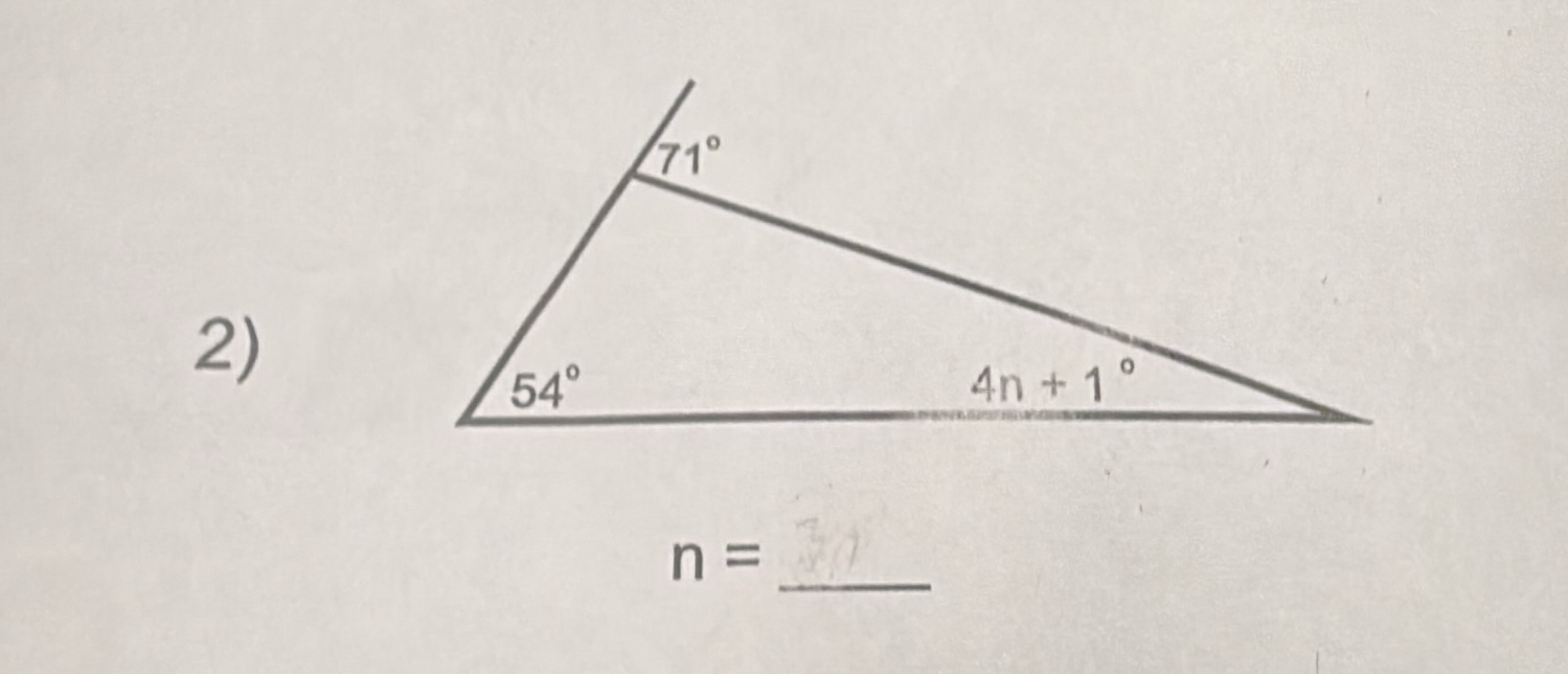
Question
2)
71°
54°
4n + 1°
n = ___
Step1: Recall exterior angle theorem
The exterior angle of a triangle is equal to the sum of the two non - adjacent interior angles. So, \(71^{\circ}+(4n + 1)^{\circ}=180^{\circ}- 54^{\circ}\)? Wait, no, actually the exterior angle (the angle adjacent to the \(71^{\circ}\) angle's supplementary angle) – wait, the correct approach: the exterior angle theorem states that an exterior angle of a triangle is equal to the sum of the two remote interior angles. The angle supplementary to \(71^{\circ}\) is \(180 - 71=109^{\circ}\), but actually, looking at the triangle, the exterior angle at the top is \(71^{\circ}\)? Wait, no, the angle given as \(71^{\circ}\) is an exterior angle? Wait, no, let's look again. The triangle has an angle of \(54^{\circ}\), an angle of \(4n + 1\) degrees, and the third angle (at the top) has a supplementary angle of \(71^{\circ}\), so the third angle inside the triangle is \(180 - 71 = 109^{\circ}\)? No, that's not right. Wait, the sum of the interior angles of a triangle is \(180^{\circ}\). So the three interior angles are \(54^{\circ}\), \(4n + 1\) degrees, and the angle adjacent to the \(71^{\circ}\) angle (which is supplementary to \(71^{\circ}\)). Wait, no, the \(71^{\circ}\) angle is an exterior angle, so the interior angle at that vertex is \(180 - 71=109^{\circ}\)? No, that's incorrect. Wait, actually, the exterior angle theorem: the exterior angle is equal to the sum of the two non - adjacent interior angles. So if the exterior angle is \(71^{\circ}\), then \(71^{\circ}=54^{\circ}+(4n + 1)^{\circ}\). Ah, that makes sense. So we can set up the equation:
\(71=54+(4n + 1)\)
Step2: Solve the equation
First, simplify the right - hand side: \(54+(4n + 1)=4n+55\)
So the equation is \(71 = 4n+55\)
Subtract 55 from both sides: \(71 - 55=4n\)
\(16 = 4n\)
Divide both sides by 4: \(n=\frac{16}{4}=4\)
Wait, that can't be right. Wait, maybe I misapplied the exterior angle theorem. Let's try the sum of interior angles. The sum of interior angles of a triangle is \(180^{\circ}\). The three interior angles: one is \(54^{\circ}\), one is \(4n + 1\) degrees, and the third angle is \(180 - 71 = 109^{\circ}\) (because the \(71^{\circ}\) angle is supplementary to the interior angle at that vertex). So sum of interior angles: \(54+(4n + 1)+109 = 180\)
Simplify the left - hand side: \(54 + 1+109+4n=164 + 4n\)
So \(164+4n = 180\)
Subtract 164 from both sides: \(4n=180 - 164 = 16\)
Divide both sides by 4: \(n = 4\)
Wait, but let's check again. Wait, maybe the \(71^{\circ}\) angle is an interior angle? No, the diagram shows that the angle at the top is an exterior angle. Wait, no, looking at the diagram, the angle labeled \(71^{\circ}\) is outside the triangle, so it's an exterior angle. So the two non - adjacent interior angles are \(54^{\circ}\) and \(4n + 1\) degrees, so by exterior angle theorem:
\(71=54+(4n + 1)\)
\(71=4n + 55\)
\(4n=71 - 55=16\)
\(n = 4\)
Wait, but let's check the sum of interior angles. If \(n = 4\), then \(4n+1=17\) degrees. The three interior angles: \(54^{\circ}\), \(17^{\circ}\), and \(180 - 71 = 109^{\circ}\). Sum: \(54 + 17+109=180\), which is correct.

Snap & solve any problem in the app
Get step-by-step solutions on Sovi AI
Photo-based solutions with guided steps
Explore more problems and detailed explanations
\(n = 4\)