QUESTION IMAGE
Question
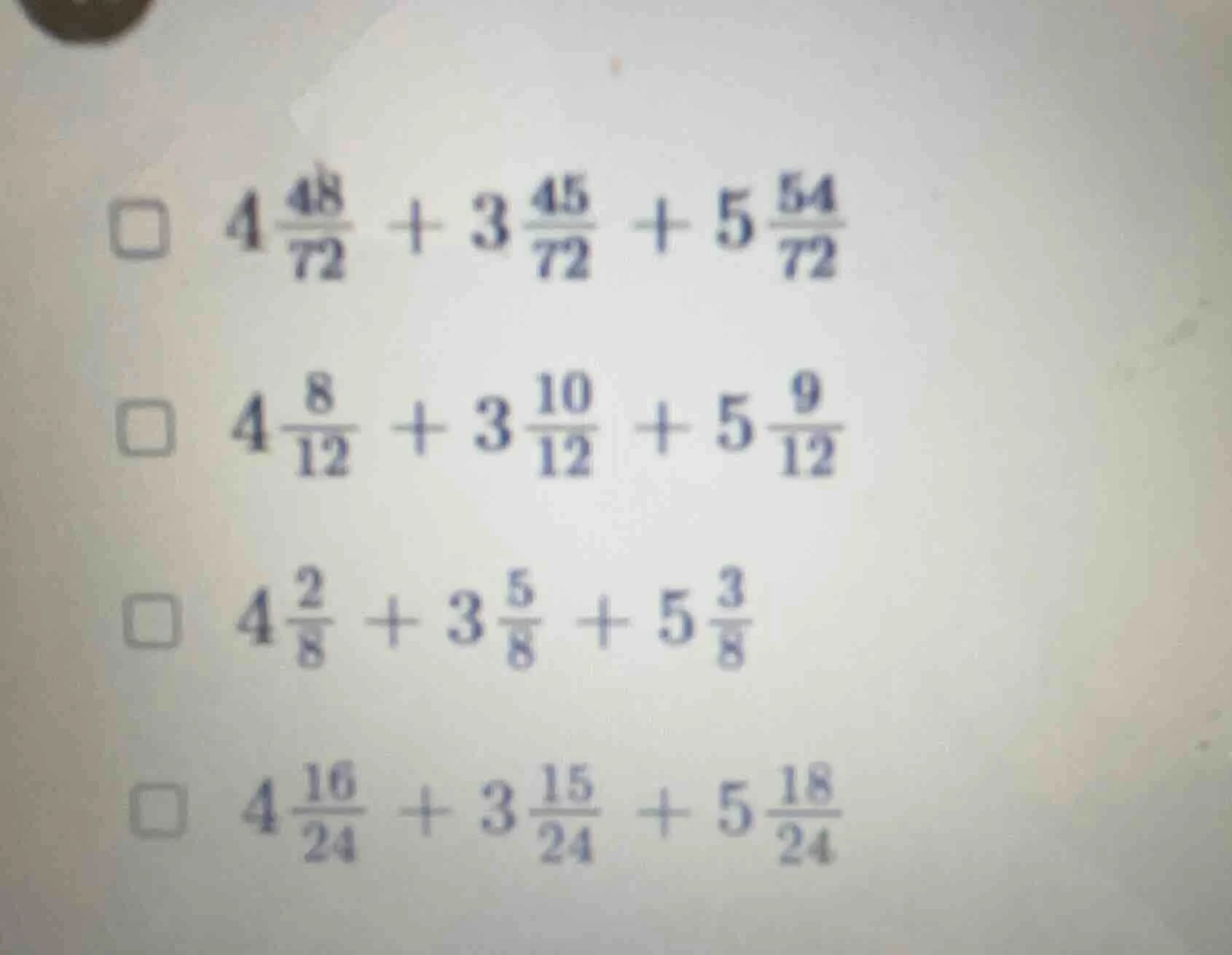
4\frac{48}{72} + 3\frac{45}{72} + 5\frac{54}{72}
4\frac{8}{12} + 3\frac{10}{12} + 5\frac{9}{12}
4\frac{2}{8} + 3\frac{5}{8} + 5\frac{3}{8}
4\frac{16}{24} + 3\frac{15}{24} + 5\frac{18}{24}
To determine which expression is equivalent (assuming we are looking for the one with the simplest or a common simplification, or maybe the one that sums to the same value, let's analyze each by simplifying the mixed numbers:
First Expression: \( 4\frac{48}{72} + 3\frac{45}{72} + 5\frac{54}{72} \)
Simplify fractions:
\( \frac{48}{72} = \frac{2}{3} \), \( \frac{45}{72} = \frac{5}{8} \)? Wait, no, \( \frac{48}{72} = \frac{2}{3} \) (divide numerator/denominator by 24: \( 48\div24=2, 72\div24=3 \)), \( \frac{45}{72} = \frac{5}{8} \) (divide by 9: \( 45\div9=5, 72\div9=8 \))—wait, no, \( 45\div9=5, 72\div9=8 \)? Wait, \( 45\div15=3, 72\div15=4.8 \) no. Wait, \( 48\div24=2, 72\div24=3 \); \( 45\div9=5, 72\div9=8 \); \( 54\div18=3, 72\div18=4 \). Hmm, maybe not the simplest.
Second Expression: \( 4\frac{8}{12} + 3\frac{10}{12} + 5\frac{9}{12} \)
Simplify fractions:
\( \frac{8}{12} = \frac{2}{3} \), \( \frac{10}{12} = \frac{5}{6} \), \( \frac{9}{12} = \frac{3}{4} \). Not all with same denominator after simplification, but let's check the sum of the fractional parts: \( \frac{8+10+9}{12} = \frac{27}{12} = \frac{9}{4} = 2\frac{1}{4} \). Then the whole numbers: \( 4 + 3 + 5 = 12 \). Total: \( 12 + 2\frac{1}{4} = 14\frac{1}{4} \).
Third Expression: \( 4\frac{2}{8} + 3\frac{5}{8} + 5\frac{3}{8} \)
Simplify fractions:
\( \frac{2}{8} = \frac{1}{4} \), \( \frac{5}{8} \) (already simple), \( \frac{3}{8} \) (already simple). Sum the fractional parts: \( \frac{2 + 5 + 3}{8} = \frac{10}{8} = \frac{5}{4} = 1\frac{1}{4} \). Whole numbers: \( 4 + 3 + 5 = 12 \). Total: \( 12 + 1\frac{1}{4} = 13\frac{1}{4} \).
Fourth Expression: \( 4\frac{16}{24} + 3\frac{15}{24} + 5\frac{18}{24} \)
Simplify fractions:
\( \frac{16}{24} = \frac{2}{3} \), \( \frac{15}{24} = \frac{5}{8} \), \( \frac{18}{24} = \frac{3}{4} \). Wait, but sum the fractional parts: \( \frac{16 + 15 + 18}{24} = \frac{49}{24} = 2\frac{1}{24} \). Whole numbers: \( 4 + 3 + 5 = 12 \). Total: \( 12 + 2\frac{1}{24} = 14\frac{1}{24} \).
Wait, maybe the question is which one is simplified or which one has a common factor. Wait, the third expression: \( 4\frac{2}{8} + 3\frac{5}{8} + 5\frac{3}{8} \). Let's compute the sum:
Whole numbers: \( 4 + 3 + 5 = 12 \)
Fractional parts: \( \frac{2 + 5 + 3}{8} = \frac{10}{8} = \frac{5}{4} = 1\frac{1}{4} \)
Total: \( 12 + 1\frac{1}{4} = 13\frac{1}{4} \)
Wait, maybe the third expression is the one with the simplest fractional parts (denominator 8, and numerators 2,5,3 which add to 10, simplifying to \( \frac{5}{4} \)). Alternatively, maybe the question is which one is equivalent to a simpler form. Wait, maybe the third expression is the answer if we consider simplification (since \( \frac{2}{8} = \frac{1}{4} \), \( \frac{5}{8} \), \( \frac{3}{8} \), but when added, the numerators sum to 10, which is easy).
Alternatively, maybe the question is to find which expression is the simplest or has a common denominator that's easy. Let's check the third expression: \( 4\frac{2}{8} + 3\frac{5}{8} + 5\frac{3}{8} \). The fractional parts all have denominator 8, so adding the numerators: 2 + 5 + 3 = 10, so \( \frac{10}{8} = \frac{5}{4} \), and the whole numbers: 4 + 3 + 5 = 12, so total is \( 12 + \frac{5}{4} = 13\frac{1}{4} \).
If we assume the question is to identify the expression that is simplified or has the simplest fractional parts, the third one (\( 4\frac{2}{8} + 3\frac{5}{8} + 5\frac{3}{8} \)) has the fractional parts with denominator 8, and numerators that sum easily.
So the answer is the third option: \( \boldsymbol{4\frac{2}{8} + 3\frac{5}{8} + 5\f…
To determine the correct expression, we analyze the simplification and sum of fractional parts:
- The third expression \( 4\frac{2}{8} + 3\frac{5}{8} + 5\frac{3}{8} \) has fractional parts with a common denominator (8), making addition of numerators (2 + 5 + 3 = 10) straightforward. Simplifying \( \frac{10}{8} = \frac{5}{4} \), and adding the whole numbers (4 + 3 + 5 = 12) gives a clear, simplified result. Other expressions have more complex or less uniform fractional simplifications.

Snap & solve any problem in the app
Get step-by-step solutions on Sovi AI
Photo-based solutions with guided steps
Explore more problems and detailed explanations
\( 4\frac{2}{8} + 3\frac{5}{8} + 5\frac{3}{8} \) (the third option, with the checkbox next to \( 4\frac{2}{8} + 3\frac{5}{8} + 5\frac{3}{8} \))