QUESTION IMAGE
Question
8-73.
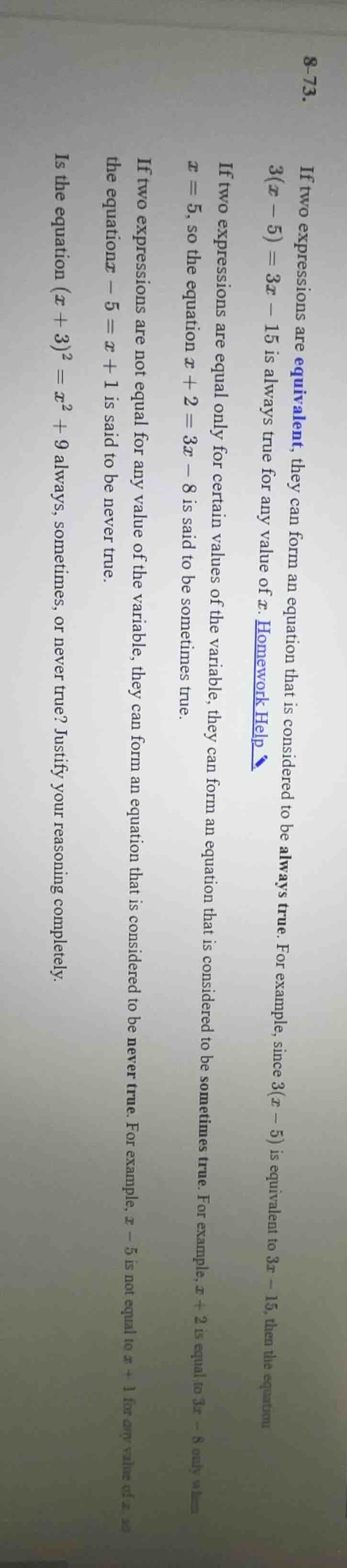
if two expressions are equivalent, they can form an equation that is considered to be always true. for example, since ( 3(x - 5) ) is equivalent to ( 3x - 15 ), then the equation ( 3(x - 5) = 3x - 15 ) is always true for any value of ( x ).
if two expressions are equal only for certain values of the variable, they can form an equation that is considered to be sometimes true. for example, ( x + 2 ) is equal to ( 3x - 8 ) only when ( x = 5 ), so the equation ( x + 2 = 3x - 8 ) is said to be sometimes true.
if two expressions are not equal for any value of the variable, they can form an equation that is considered to be never true. for example, ( x - 5 ) is not equal to ( x + 1 ) for any value of ( x ), so the equation ( x - 5 = x + 1 ) is said to be never true.
is the equation ( (x + 3)^2 = x^2 + 9 ) always, sometimes, or never true? justify your reasoning completely.
Step1: Expand the left - hand side
We know that \((a + b)^2=a^{2}+2ab + b^{2}\) (the formula for the square of a binomial). For \((x + 3)^2\), where \(a=x\) and \(b = 3\), we have \((x+3)^{2}=x^{2}+2\times x\times3 + 3^{2}\).
Calculating the products and exponents: \(2\times x\times3 = 6x\) and \(3^{2}=9\). So \((x + 3)^{2}=x^{2}+6x + 9\).
Step2: Compare with the right - hand side
The right - hand side of the equation is \(x^{2}+9\).
We set the left - hand side equal to the right - hand side: \(x^{2}+6x + 9=x^{2}+9\).
Subtract \(x^{2}+9\) from both sides of the equation: \((x^{2}+6x + 9)-(x^{2}+9)=(x^{2}+9)-(x^{2}+9)\).
Simplifying the left - hand side: \(x^{2}+6x + 9 - x^{2}-9=6x\).
Simplifying the right - hand side: \(x^{2}+9 - x^{2}-9 = 0\).
So we get \(6x=0\), which means \(x = 0\).
This shows that the equation \((x + 3)^{2}=x^{2}+9\) is only true when \(x = 0\) and not for all values of \(x\) (for example, if \(x = 1\), left - hand side \((1 + 3)^{2}=16\), right - hand side \(1^{2}+9 = 10\), and \(16
eq10\)).

Snap & solve any problem in the app
Get step-by-step solutions on Sovi AI
Photo-based solutions with guided steps
Explore more problems and detailed explanations
The equation \((x + 3)^{2}=x^{2}+9\) is sometimes true.