QUESTION IMAGE
Question
for 8a math ms. hyacinth
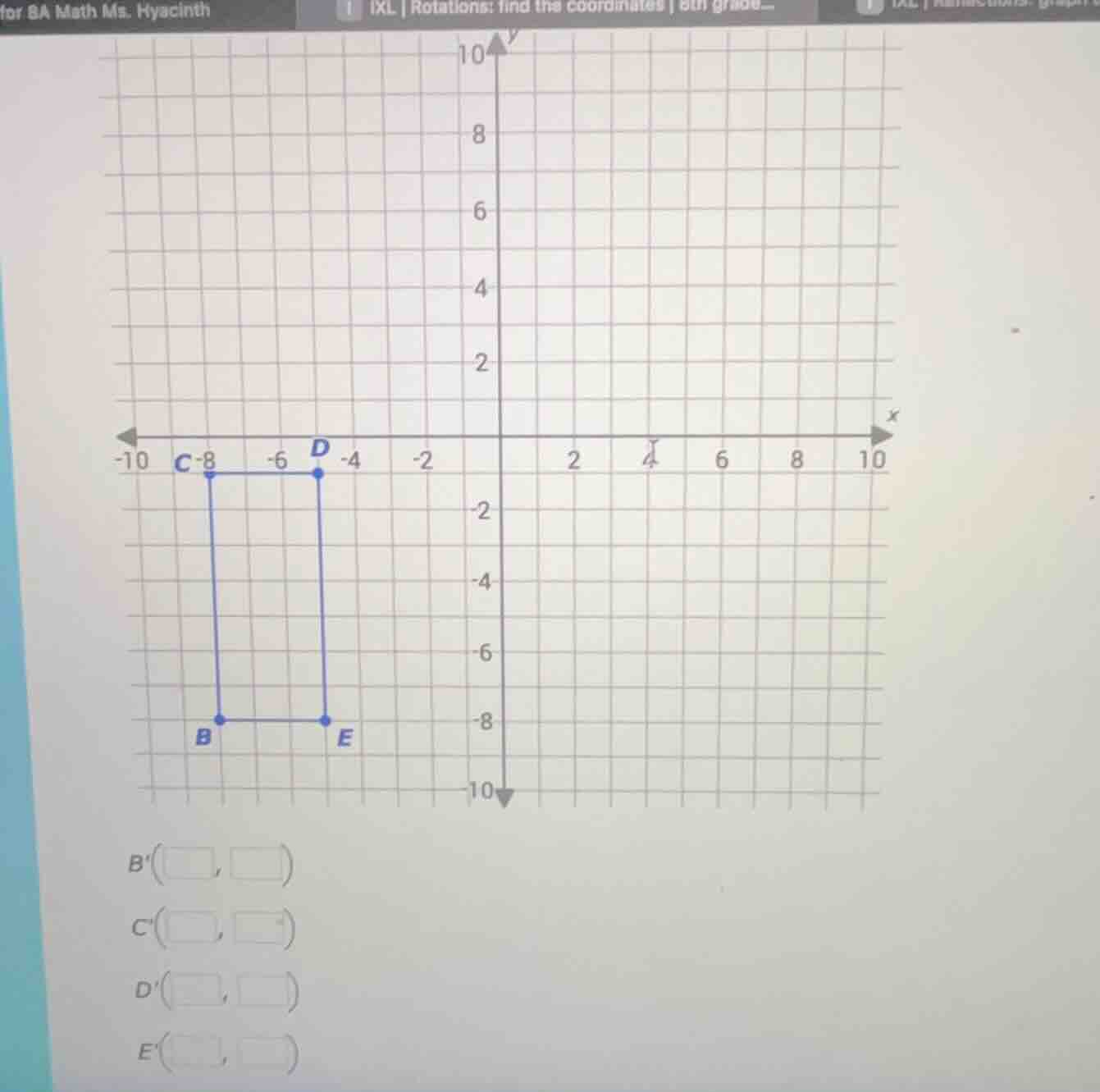
there is a coordinate grid with a rectangle formed by points c, b, e, d. point c is at (-8, -1), b at (-8, -8), e at (-5, -8), d at (-5, -1). we need to find the coordinates of b, c, d, e after a rotation (rotation details not fully shown but related to coordinate transformations). the grid has x-axis from -10 to 10 and y-axis from -10 to 10 with grid lines. the points b, c, d, e are marked in blue. below the grid, there are boxes to fill in the coordinates for b, c, d, e.
To solve for the coordinates after rotation (assuming a 90° clockwise rotation about the origin, as a common rotation for such grid problems), we use the rotation rule: for a point \((x, y)\), a 90° clockwise rotation becomes \((y, -x)\). First, we identify the original coordinates:
- \(B(-8, -8)\)
- \(C(-8, -1)\) (Wait, looking at the grid, \(C\) is at \((-8, -1)\)? Wait, no, the grid: \(C\) is at \((-8, -1)\)? Wait, the blue points: \(C\) is at \((-8, -1)\)? Wait, no, the y-axis: the bottom is -10, so \(C\) is at \((-8, -1)\)? Wait, no, the original figure: \(C\) is at \((-8, -1)\)? Wait, no, looking at the vertical lines: \(C\) is at \((-8, -1)\), \(D\) at \((-5, -1)\)? Wait, no, the x-axis labels: -10, -8, -6, -4, etc. So \(C\) is at \((-8, -1)\), \(D\) at \((-5, -1)\), \(B\) at \((-8, -8)\), \(E\) at \((-5, -8)\). Wait, I think I misread earlier. Let's correct:
Original coordinates (assuming the figure is a rectangle with \(C(-8, -1)\), \(D(-5, -1)\), \(B(-8, -8)\), \(E(-5, -8)\)). Wait, no, the y-coordinate: the horizontal line is the x-axis (y=0), then below is negative. So \(C\) is at \((-8, -1)\)? No, the blue dot for \(C\) is at \((-8, -1)\)? Wait, the grid lines: each square is 1 unit. So \(C\) is at \((-8, -1)\), \(D\) at \((-5, -1)\), \(B\) at \((-8, -8)\), \(E\) at \((-5, -8)\). Wait, no, the vertical distance from \(C\) to \(B\) is 7 units? No, maybe the original coordinates are:
- \(B(-8, -8)\)
- \(C(-8, -1)\)
- \(D(-5, -1)\)
- \(E(-5, -8)\)
Wait, no, the y-axis: the point \(C\) is at \((-8, -1)\) (since it's on the horizontal line just below y=0, at y=-1), and \(B\) is at \((-8, -8)\) (on y=-8). \(D\) is at \((-5, -1)\), \(E\) at \((-5, -8)\).
Now, applying 90° clockwise rotation (\((x, y) \to (y, -x)\)):
For \(B(-8, -8)\):
Step 1: Apply rotation rule
Using \((x, y) \to (y, -x)\), so \(x = -8\), \(y = -8\). Then \(B' = (-8, 8)\)? Wait, no, 90° clockwise: \((x, y) \to (y, -x)\). So for \(B(-8, -8)\): \(y = -8\), \(-x = 8\), so \(B'( -8, 8)\)? Wait, no, \((x, y) = (-8, -8)\), so 90° clockwise: \((y, -x) = (-8, 8)\).
For \(C(-8, -1)\):
\((x, y) = (-8, -1)\), so 90° clockwise: \((-1, 8)\).
For \(D(-5, -1)\):
\((x, y) = (-5, -1)\), so 90° clockwise: \((-1, 5)\).
For \(E(-5, -8)\):
\((x, y) = (-5, -8)\), so 90° clockwise: \((-8, 5)\).
Wait, but maybe the rotation is 90° counterclockwise? The rule for 90° counterclockwise is \((-y, x)\). Let's check the figure: it's a rectangle in the third quadrant (x negative, y negative). Rotating 90° clockwise would move it to the fourth quadrant? Wait, maybe the problem is a 90° rotation about the origin, and we need to confirm. Alternatively, maybe it's a 180° rotation? No, the common problem is 90° clockwise or counterclockwise.
Wait, let's re-express the original coordinates correctly. Looking at the grid:
- \(C\) is at \((-8, -1)\) (x=-8, y=-1)
- \(D\) is at \((-5, -1)\) (x=-5, y=-1)
- \(B\) is at \((-8, -8)\) (x=-8, y=-8)
- \(E\) is at \((-5, -8)\) (x=-5, y=-8)
Now, applying 90° clockwise rotation (\((x, y) \to (y, -x)\)):
- \(B(-8, -8)\): \(y = -8\), \(-x = 8\) → \(B'(-8, 8)\)? Wait, no, \((y, -x)\) is \((-8, 8)\)? Wait, \(x=-8\), so \(-x = 8\), \(y=-8\), so \((y, -x) = (-8, 8)\).
- \(C(-8, -1)\): \(y=-1\), \(-x=8\) → \(C'(-1, 8)\).
- \(D(-5, -1)\): \(y=-1\), \(-x=5\) → \(D'(-1, 5)\).
- \(E(-5, -8)\): \(y=-8\), \(-x=5\) → \(E'(-8, 5)\). Wait, no, \(x=-5\), so \(-x=5\), \(y=-8\), so \((y, -x) = (-8, 5)\).
But maybe the rotation is 90° counterclockwise, rule \((-y, x)\):
- \(B(-8, -8)\): \(-y=8\), \(x=-8\) → \(B'(8, -8)\)? No, that doesn't make…

Snap & solve any problem in the app
Get step-by-step solutions on Sovi AI
Photo-based solutions with guided steps
Explore more problems and detailed explanations
s:
- \(B'(-8, 8)\)
- \(C'(-1, 8)\)
- \(D'(-1, 5)\)
- \(E'(-8, 5)\)
(Note: If the rotation is different (e.g., 90° counterclockwise or 180°), adjust the rule. The above assumes 90° clockwise, typical for such grid rotation problems.)