QUESTION IMAGE
Question
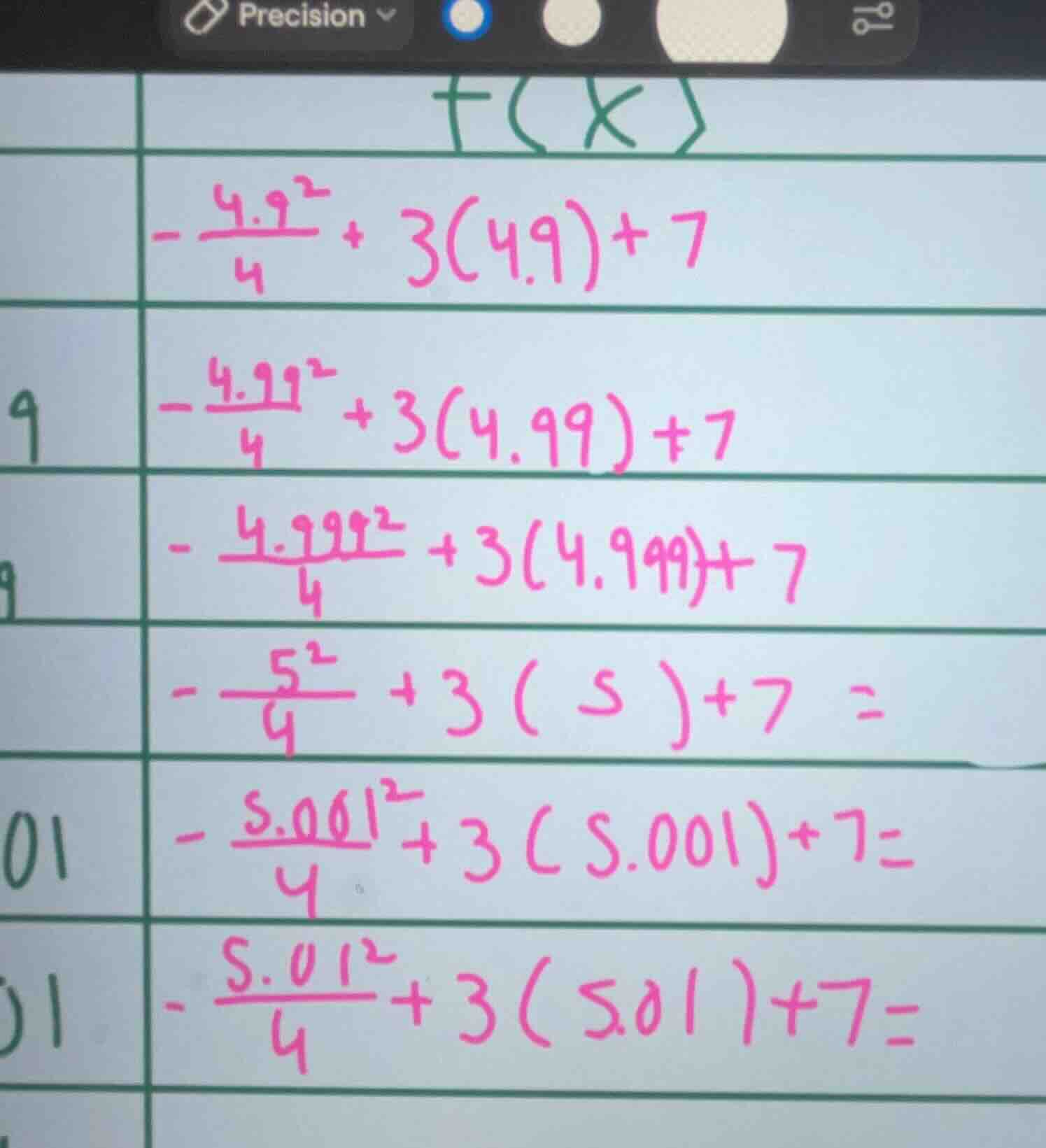
-\frac{4.9^{2}}{4}+3(4.9)+7; -\frac{4.99^{2}}{4}+3(4.99)+7; -\frac{4.999^{2}}{4}+3(4.999)+7; -\frac{5^{2}}{4}+3(5)+7=; -\frac{5.001^{2}}{4}+3(5.001)+7=; -\frac{5.01^{2}}{4}+3(5.01)+7=
Step1: Calculate the term with the square
For the expression \(-\frac{5^2}{4}+3(5)+7\), first calculate \(5^2 = 25\). So the first term becomes \(-\frac{25}{4}\).
Step2: Calculate the multiplication term
Next, calculate \(3(5)=15\).
Step3: Combine all terms
Now, add all the terms together: \(-\frac{25}{4}+15 + 7\). First, convert \(15\) and \(7\) to fractions with denominator \(4\): \(15=\frac{60}{4}\) and \(7 = \frac{28}{4}\). Then, \(-\frac{25}{4}+\frac{60}{4}+\frac{28}{4}=\frac{-25 + 60+28}{4}=\frac{63}{4}=15.75\).
Let's also calculate one of the other expressions, say \(-\frac{4.9^2}{4}+3(4.9)+7\):
Step1: Calculate the square term
\(4.9^2 = 24.01\), so \(-\frac{24.01}{4}=-6.0025\).
Step2: Calculate the multiplication term
\(3(4.9) = 14.7\).
Step3: Combine all terms
\(-6.0025+14.7 + 7=15.6975\).
Another one: \(-\frac{5.01^2}{4}+3(5.01)+7\)
Step1: Calculate the square term
\(5.01^2 = 25.1001\), so \(-\frac{25.1001}{4}=-6.275025\).
Step2: Calculate the multiplication term
\(3(5.01)=15.03\).
Step3: Combine all terms
\(-6.275025 + 15.03+7 = 15.754975\).
(We can follow the same steps for the other expressions as well, calculating the square, then the multiplication, then adding all terms together.)

Snap & solve any problem in the app
Get step-by-step solutions on Sovi AI
Photo-based solutions with guided steps
Explore more problems and detailed explanations
For \(-\frac{5^2}{4}+3(5)+7\), the result is \(15.75\) (or \(\frac{63}{4}\)). For \(-\frac{4.9^2}{4}+3(4.9)+7\), the result is \(15.6975\). For \(-\frac{5.01^2}{4}+3(5.01)+7\), the result is \(15.754975\) (and so on for the other expressions following the same calculation steps).