QUESTION IMAGE
Question
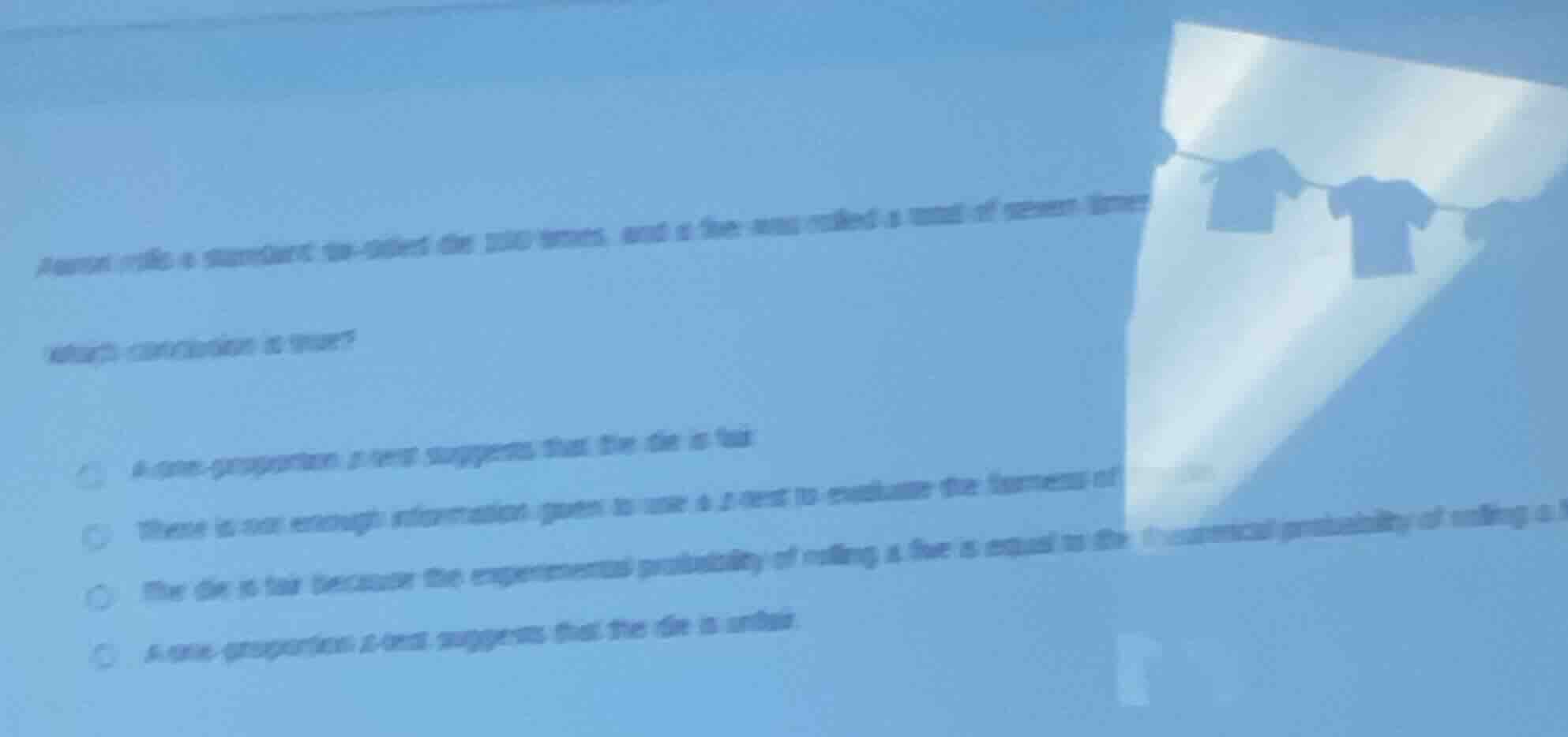
aaron rolls a standard six - sided die 1000 times, and a five was rolled a total of sixteen times. which conclusion is true?
a. a one - proportion z - test supports that the die is fair
b. there is not enough information given to use a z - test to evaluate the fairness of the die
c. the die is fair because the experimental probability of rolling a five is equal to the theoretical probability of rolling a five
d. a one - proportion z - test supports that the die is unfair
Step1: State hypothesized proportion
For a fair 6-sided die, the probability of rolling a 5 is $p_0 = \frac{1}{6} \approx 0.1667$.
Step2: Calculate sample proportion
Aaron rolled 200 times, got 33 fives. $\hat{p} = \frac{33}{200} = 0.165$.
Step3: Check z-test conditions
$np_0 = 200 \times \frac{1}{6} \approx 33.33 > 10$, $n(1-p_0) = 200 \times \frac{5}{6} \approx 166.67 > 10$, so conditions are met.
Step4: Compute z-test statistic
$$z = \frac{\hat{p} - p_0}{\sqrt{\frac{p_0(1-p_0)}{n}}} = \frac{0.165 - 0.1667}{\sqrt{\frac{0.1667 \times 0.8333}{200}}} \approx \frac{-0.0017}{0.0264} \approx -0.064$$
Step5: Interpret the result
The z-score is close to 0, meaning the sample proportion is very close to the hypothesized fair proportion. We fail to reject the null hypothesis that the die is fair, so the z-test supports the die being fair.

Snap & solve any problem in the app
Get step-by-step solutions on Sovi AI
Photo-based solutions with guided steps
Explore more problems and detailed explanations
A. A one-proportion z-test supports that the die is fair