QUESTION IMAGE
Question
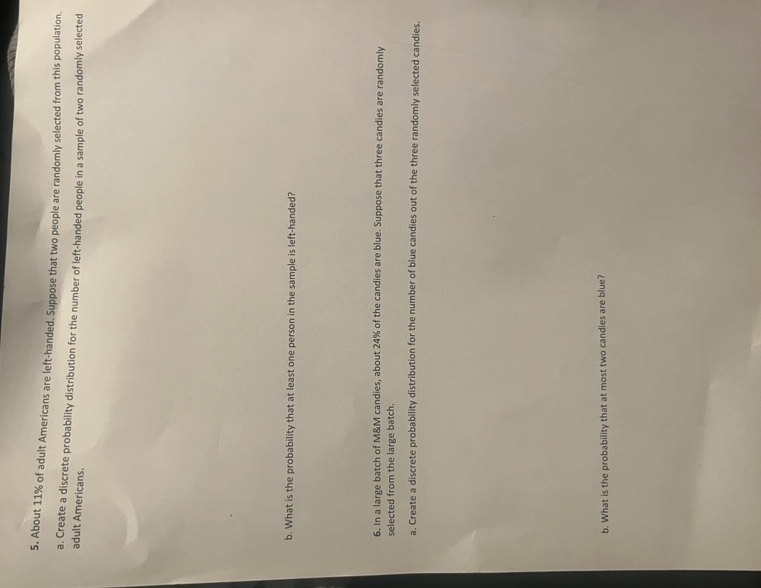
- about 13% of adult americans are left - handed. suppose that two people are randomly selected from this population.
a. create a discrete probability distribution for the number of left - handed people in a sample of two randomly selected adult americans.
b. what is the probability that at least one person in the sample is left - handed?
- in a large batch of m&m candies, about 24% of the candies are blue. suppose that three candies are randomly selected from the large batch.
a. create a discrete probability distribution for the number of blue candies out of the three randomly selected candies.
b. what is the probability that at most two candies are blue?
Problem 5 (Left - handed Americans)
Part a: Discrete Probability Distribution
We are dealing with a binomial distribution here. Let \(X\) be the number of left - handed people in a sample of \(n = 2\) adult Americans. The probability of success (a person being left - handed), \(p=0.13\), and the probability of failure (a person being right - handed), \(q = 1 - p=1 - 0.13 = 0.87\).
The binomial probability formula is \(P(X=k)=C(n,k)\times p^{k}\times q^{n - k}\), where \(C(n,k)=\frac{n!}{k!(n - k)!}\)
- For \(k = 0\):
\(C(2,0)=\frac{2!}{0!(2 - 0)!}=\frac{2!}{2!}=1\)
\(P(X = 0)=C(2,0)\times(0.13)^{0}\times(0.87)^{2}=1\times1\times(0.87)^{2}=0.87^{2}=0.7569\)
- For \(k = 1\):
\(C(2,1)=\frac{2!}{1!(2 - 1)!}=\frac{2!}{1!1!}=2\)
\(P(X = 1)=C(2,1)\times(0.13)^{1}\times(0.87)^{2 - 1}=2\times0.13\times0.87 = 0.2262\)
- For \(k = 2\):
\(C(2,2)=\frac{2!}{2!(2 - 2)!}=1\)
\(P(X = 2)=C(2,2)\times(0.13)^{2}\times(0.87)^{0}=1\times(0.13)^{2}\times1 = 0.0169\)
The discrete probability distribution table is:
| \(X\) | \(P(X)\) |
|---|---|
| 1 | 0.2262 |
| 2 | 0.0169 |
Part b: Probability of at least one left - handed person
The probability of at least one left - handed person is \(P(X\geq1)=P(X = 1)+P(X = 2)\)
We know that \(P(X = 1)=0.2262\) and \(P(X = 2)=0.0169\)
\(P(X\geq1)=0.2262 + 0.0169=0.2431\)
We can also calculate it using the complement rule: \(P(X\geq1)=1 - P(X = 0)\)
Since \(P(X = 0)=0.7569\), \(1-0.7569 = 0.2431\)
Problem 6 (Blue M&M Candies)
Let \(Y\) be the number of blue candies in a sample of \(n = 3\) candies. The probability of success (a candy being blue), \(p = 0.24\), and the probability of failure (a candy not being blue), \(q=1 - p = 0.76\)
Part a: Discrete Probability Distribution
Using the binomial probability formula \(P(Y = k)=C(3,k)\times(0.24)^{k}\times(0.76)^{3 - k}\)
- For \(k = 0\):
\(C(3,0)=\frac{3!}{0!(3 - 0)!}=1\)
\(P(Y = 0)=C(3,0)\times(0.24)^{0}\times(0.76)^{3}=1\times1\times0.76^{3}=0.76\times0.76\times0.76 = 0.438976\)
- For \(k = 1\):
\(C(3,1)=\frac{3!}{1!(3 - 1)!}=\frac{3!}{1!2!}=3\)
\(P(Y = 1)=C(3,1)\times(0.24)^{1}\times(0.76)^{2}=3\times0.24\times0.76^{2}=3\times0.24\times0.5776 = 3\times0.138624=0.415872\)
- For \(k = 2\):
\(C(3,2)=\frac{3!}{2!(3 - 2)!}=3\)
\(P(Y = 2)=C(3,2)\times(0.24)^{2}\times(0.76)^{1}=3\times0.0576\times0.76=3\times0.043776 = 0.131328\)
- For \(k = 3\):
\(C(3,3)=\frac{3!}{3!(3 - 3)!}=1\)
\(P(Y = 3)=C(3,3)\times(0.24)^{3}\times(0.76)^{0}=1\times0.013824\times1 = 0.013824\)
The discrete probability distribution table is:
| \(Y\) | \(P(Y)\) |
|---|---|
| 1 | 0.415872 |
| 2 | 0.131328 |
| 3 | 0.013824 |
Part b: Probability of at most two blue candies
The probability of at most two blue candies is \(P(Y\leq2)=P(Y = 0)+P(Y = 1)+P(Y = 2)\)
\(P(Y\leq2)=0.438976+0.415872 + 0.131328=0.986176\)
We can also calculate it using the complement rule: \(P(Y\leq2)=1 - P(Y = 3)\)
Since \(P(Y = 3)=0.013824\), \(1 - 0.013824=0.986176\)
Final Answers
Problem 5
a.
| \(X\) | \(P(X)\) |
|---|---|
| 1 | 0.2262 |
| 2 | 0.0169 |
b. The probability that at least one person in the sample is left - handed is \(\boldsymbol{0.2431}\)
Problem 6
a.
| \(Y\) | \(P(Y)\) |
|---|---|
| 1 | 0.415872 |
| 2 | 0.131328 |
| 3 | 0.013824 |
b. The probability that at most two candies are blue is \(\boldsymbol{0.986176}\)

Snap & solve any problem in the app
Get step-by-step solutions on Sovi AI
Photo-based solutions with guided steps
Explore more problems and detailed explanations
Problem 5 (Left - handed Americans)
Part a: Discrete Probability Distribution
We are dealing with a binomial distribution here. Let \(X\) be the number of left - handed people in a sample of \(n = 2\) adult Americans. The probability of success (a person being left - handed), \(p=0.13\), and the probability of failure (a person being right - handed), \(q = 1 - p=1 - 0.13 = 0.87\).
The binomial probability formula is \(P(X=k)=C(n,k)\times p^{k}\times q^{n - k}\), where \(C(n,k)=\frac{n!}{k!(n - k)!}\)
- For \(k = 0\):
\(C(2,0)=\frac{2!}{0!(2 - 0)!}=\frac{2!}{2!}=1\)
\(P(X = 0)=C(2,0)\times(0.13)^{0}\times(0.87)^{2}=1\times1\times(0.87)^{2}=0.87^{2}=0.7569\)
- For \(k = 1\):
\(C(2,1)=\frac{2!}{1!(2 - 1)!}=\frac{2!}{1!1!}=2\)
\(P(X = 1)=C(2,1)\times(0.13)^{1}\times(0.87)^{2 - 1}=2\times0.13\times0.87 = 0.2262\)
- For \(k = 2\):
\(C(2,2)=\frac{2!}{2!(2 - 2)!}=1\)
\(P(X = 2)=C(2,2)\times(0.13)^{2}\times(0.87)^{0}=1\times(0.13)^{2}\times1 = 0.0169\)
The discrete probability distribution table is:
| \(X\) | \(P(X)\) |
|---|---|
| 1 | 0.2262 |
| 2 | 0.0169 |
Part b: Probability of at least one left - handed person
The probability of at least one left - handed person is \(P(X\geq1)=P(X = 1)+P(X = 2)\)
We know that \(P(X = 1)=0.2262\) and \(P(X = 2)=0.0169\)
\(P(X\geq1)=0.2262 + 0.0169=0.2431\)
We can also calculate it using the complement rule: \(P(X\geq1)=1 - P(X = 0)\)
Since \(P(X = 0)=0.7569\), \(1-0.7569 = 0.2431\)
Problem 6 (Blue M&M Candies)
Let \(Y\) be the number of blue candies in a sample of \(n = 3\) candies. The probability of success (a candy being blue), \(p = 0.24\), and the probability of failure (a candy not being blue), \(q=1 - p = 0.76\)
Part a: Discrete Probability Distribution
Using the binomial probability formula \(P(Y = k)=C(3,k)\times(0.24)^{k}\times(0.76)^{3 - k}\)
- For \(k = 0\):
\(C(3,0)=\frac{3!}{0!(3 - 0)!}=1\)
\(P(Y = 0)=C(3,0)\times(0.24)^{0}\times(0.76)^{3}=1\times1\times0.76^{3}=0.76\times0.76\times0.76 = 0.438976\)
- For \(k = 1\):
\(C(3,1)=\frac{3!}{1!(3 - 1)!}=\frac{3!}{1!2!}=3\)
\(P(Y = 1)=C(3,1)\times(0.24)^{1}\times(0.76)^{2}=3\times0.24\times0.76^{2}=3\times0.24\times0.5776 = 3\times0.138624=0.415872\)
- For \(k = 2\):
\(C(3,2)=\frac{3!}{2!(3 - 2)!}=3\)
\(P(Y = 2)=C(3,2)\times(0.24)^{2}\times(0.76)^{1}=3\times0.0576\times0.76=3\times0.043776 = 0.131328\)
- For \(k = 3\):
\(C(3,3)=\frac{3!}{3!(3 - 3)!}=1\)
\(P(Y = 3)=C(3,3)\times(0.24)^{3}\times(0.76)^{0}=1\times0.013824\times1 = 0.013824\)
The discrete probability distribution table is:
| \(Y\) | \(P(Y)\) |
|---|---|
| 1 | 0.415872 |
| 2 | 0.131328 |
| 3 | 0.013824 |
Part b: Probability of at most two blue candies
The probability of at most two blue candies is \(P(Y\leq2)=P(Y = 0)+P(Y = 1)+P(Y = 2)\)
\(P(Y\leq2)=0.438976+0.415872 + 0.131328=0.986176\)
We can also calculate it using the complement rule: \(P(Y\leq2)=1 - P(Y = 3)\)
Since \(P(Y = 3)=0.013824\), \(1 - 0.013824=0.986176\)
Final Answers
Problem 5
a.
| \(X\) | \(P(X)\) |
|---|---|
| 1 | 0.2262 |
| 2 | 0.0169 |
b. The probability that at least one person in the sample is left - handed is \(\boldsymbol{0.2431}\)
Problem 6
a.
| \(Y\) | \(P(Y)\) |
|---|---|
| 1 | 0.415872 |
| 2 | 0.131328 |
| 3 | 0.013824 |
b. The probability that at most two candies are blue is \(\boldsymbol{0.986176}\)