QUESTION IMAGE
Question
absent both days
name: eli santana
science course
pre lab date
post lab date
grade: 9
probability lab
background
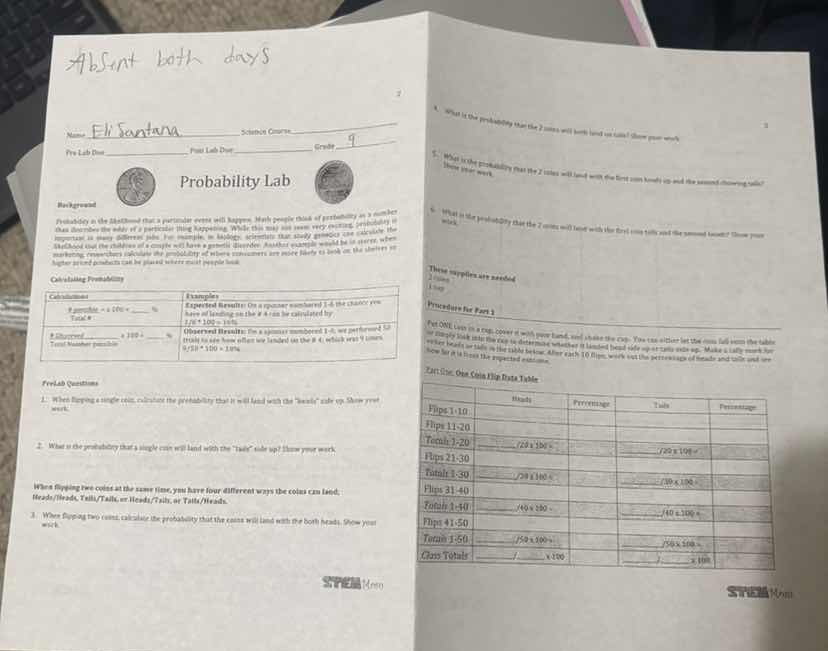
probability is the likelihood that a particular event will happen. most people think of probability as a number that describes the odds of a particular thing happening. however, this is only one way to calculate the probability of an event. probability can also be calculated by performing an experiment. in this lab, you will be flipping coins to find out the probability of a coin landing with heads or tails. after this simple experiment, you will calculate the probability of a more complex event happening. when this has been completed, you will be able to see the difference between the expected outcome and the observed outcome. you will also see that the observed probability can be placed within a certain percentage range.
calculating probability
calculating probability
formula
( \frac{\text{number of favorable}}{\text{total}} \times 100 = %)
example: a spinner is numbered 1 - 8, the chance the spinner lands on the 4 is calculated by ( \frac{1}{8} \times 100 = 12.5% )
observed ( \frac{\text{number of times occurred}}{\text{total number possible}} \times 100 = %)
example: a spinner is numbered 1 - 8, we performed 10 spins and the spinner landed on the 4, 2 times. ( \frac{2}{10} \times 100 = 20% )
pre - lab questions
- when flipping a single coin, calculate the probability that it will land with the “heads” side up. show your work.
- what is the probability that a single coin will land with the “tails” side up? show your work.
when flipping two coins at the same time, you have four different ways the coins can land: heads/heads, tails/tails, heads/tails, or tails/heads.
- when flipping two coins, calculate the probability that the coins will land with the both heads. show your work.
- what is the probability that the 2 coins will both land on tails? show your work.
- what is the probability that the 2 coins will land with the first coin heads up and the second coin tails up? show your work.
- what is the probability that the 2 coins will land with the first coin tails and the second heads? show your work.
these supplies are needed:
procedure
procedure for part 1
for part 1, you will flip a coin, cover it with your hand, and shake the cup. you can either let the coin fall from the table or catch it in your hand. record whether it landed heads up or tails up. make a tally mark for each flip. after 10 flips, calculate the percentage of heads and tails. then, do another 10 flips. after a total of 10 flips, work out the percentage of heads and tails and see how close it is to the expected outcome.
part 1: one coin flip data table
flips 1 - 10
heads:
percentage:
tails:
percentage:
flips 11 - 20
heads: /20 × 100 =
tails: /20 × 100 =
flips 21 - 30
heads: /30 × 100 =
tails: /30 × 100 =
flips 31 - 40
heads: /40 × 100 =
tails: /40 × 100 =
flips 41 - 50
heads: /50 × 100 =
tails: /50 × 100 =
total 1 - 50
heads: /50 × 100 =
tails: /50 × 100 =
class totals
× 100
× 100
To solve these probability questions, we'll use the basic concepts of probability (number of favorable outcomes over total possible outcomes) and, for observed probabilities, the formula for percentage (\(\frac{\text{Observed}}{\text{Total}} \times 100\)).
Question 1: Probability of a single coin landing on "Heads" (Theoretical)
Step 1: Identify outcomes
A fair coin has 2 possible outcomes: Heads (H) or Tails (T).
Step 2: Calculate probability
The number of favorable outcomes (Heads) is 1.
Probability \( P(\text{Heads}) = \frac{\text{Favorable Outcomes}}{\text{Total Outcomes}} = \frac{1}{2} \).
To show as a percentage: \( \frac{1}{2} \times 100 = 50\% \).
Question 2: Probability of a single coin landing on "Tails" (Theoretical)
Step 1: Identify outcomes
Total outcomes for a coin: 2 (Heads, Tails).
Step 2: Calculate probability
Favorable outcomes (Tails) = 1.
Probability \( P(\text{Tails}) = \frac{1}{2} = 0.5 \) or \( 50\% \) (since \( \frac{1}{2} \times 100 = 50\% \)).
Question 3: Probability of two coins both landing on "Heads" (Theoretical)
Step 1: Identify all possible outcomes
When flipping two coins, the 4 possible outcomes are: Heads/Heads, Heads/Tails, Tails/Heads, Tails/Tails.
Step 2: Identify favorable outcomes
Only 1 outcome is Heads/Heads.
Step 3: Calculate probability
Probability \( P(\text{Both Heads}) = \frac{\text{Favorable Outcomes}}{\text{Total Outcomes}} = \frac{1}{4} \).
To show as a percentage: \( \frac{1}{4} \times 100 = 25\% \).
For the "Observed" Probability (e.g., from the lab data table)
If we had observed data (e.g., from flipping a coin 10 times), we use:
\( \text{Observed Probability (\%)} = \frac{\text{Number of times outcome occurred}}{\text{Total number of trials}} \times 100 \).
For example, if in 10 flips, Heads occurred 6 times:
\( P(\text{Observed Heads}) = \frac{6}{10} \times 100 = 60\% \).
Final Answers (Theoretical, unless observed data is provided)
- Probability of single coin landing on Heads: \( \boldsymbol{\frac{1}{2}} \) (or 50%).
- Probability of single coin landing on Tails: \( \boldsymbol{\frac{1}{2}} \) (or 50%).
- Probability of two coins both landing on Heads: \( \boldsymbol{\frac{1}{4}} \) (or 25%).

Snap & solve any problem in the app
Get step-by-step solutions on Sovi AI
Photo-based solutions with guided steps
Explore more problems and detailed explanations
To solve these probability questions, we'll use the basic concepts of probability (number of favorable outcomes over total possible outcomes) and, for observed probabilities, the formula for percentage (\(\frac{\text{Observed}}{\text{Total}} \times 100\)).
Question 1: Probability of a single coin landing on "Heads" (Theoretical)
Step 1: Identify outcomes
A fair coin has 2 possible outcomes: Heads (H) or Tails (T).
Step 2: Calculate probability
The number of favorable outcomes (Heads) is 1.
Probability \( P(\text{Heads}) = \frac{\text{Favorable Outcomes}}{\text{Total Outcomes}} = \frac{1}{2} \).
To show as a percentage: \( \frac{1}{2} \times 100 = 50\% \).
Question 2: Probability of a single coin landing on "Tails" (Theoretical)
Step 1: Identify outcomes
Total outcomes for a coin: 2 (Heads, Tails).
Step 2: Calculate probability
Favorable outcomes (Tails) = 1.
Probability \( P(\text{Tails}) = \frac{1}{2} = 0.5 \) or \( 50\% \) (since \( \frac{1}{2} \times 100 = 50\% \)).
Question 3: Probability of two coins both landing on "Heads" (Theoretical)
Step 1: Identify all possible outcomes
When flipping two coins, the 4 possible outcomes are: Heads/Heads, Heads/Tails, Tails/Heads, Tails/Tails.
Step 2: Identify favorable outcomes
Only 1 outcome is Heads/Heads.
Step 3: Calculate probability
Probability \( P(\text{Both Heads}) = \frac{\text{Favorable Outcomes}}{\text{Total Outcomes}} = \frac{1}{4} \).
To show as a percentage: \( \frac{1}{4} \times 100 = 25\% \).
For the "Observed" Probability (e.g., from the lab data table)
If we had observed data (e.g., from flipping a coin 10 times), we use:
\( \text{Observed Probability (\%)} = \frac{\text{Number of times outcome occurred}}{\text{Total number of trials}} \times 100 \).
For example, if in 10 flips, Heads occurred 6 times:
\( P(\text{Observed Heads}) = \frac{6}{10} \times 100 = 60\% \).
Final Answers (Theoretical, unless observed data is provided)
- Probability of single coin landing on Heads: \( \boldsymbol{\frac{1}{2}} \) (or 50%).
- Probability of single coin landing on Tails: \( \boldsymbol{\frac{1}{2}} \) (or 50%).
- Probability of two coins both landing on Heads: \( \boldsymbol{\frac{1}{4}} \) (or 25%).