QUESTION IMAGE
Question
absolute risk reduction and relative risk
notice that if the absolute risks are the same then the absolute risk reduction is 0 and the relative risk is 1.
if they are not equal we normally order things so that the bigger one comes first and the smaller one second so that absolute risk reduction is positive and relative risk is >1. we make sense of this by putting the number in context.
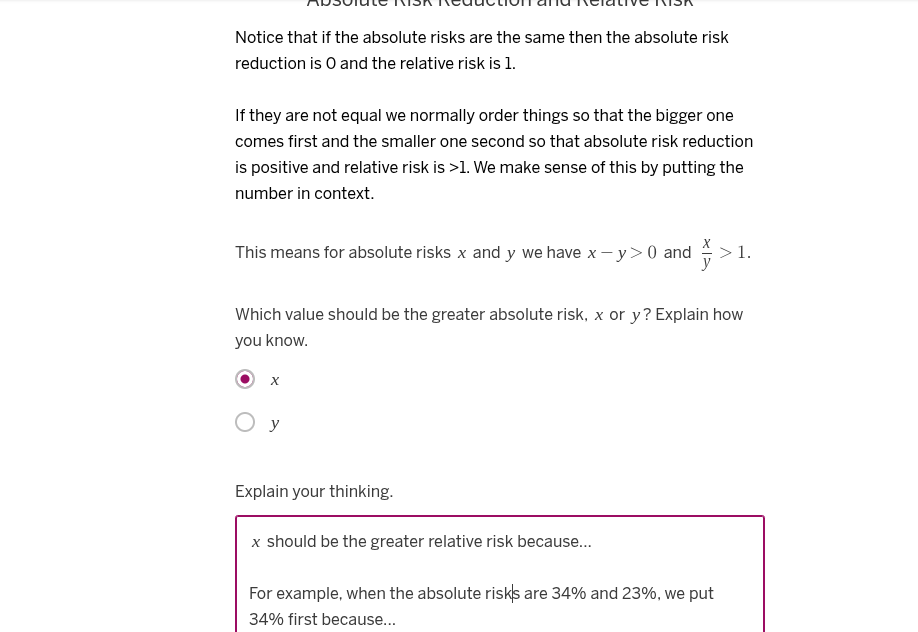
this means for absolute risks x and y we have $x - y > 0$ and $\frac{x}{y} > 1$.
which value should be the greater absolute risk, x or y? explain how you know.
x
y
explain your thinking.
x should be the greater relative risk because...
for example, when the absolute risks are 34% and 23%, we put 34% first because...
We analyze the given inequalities for absolute risk reduction ($x-y>0$) and relative risk ($\frac{x}{y}>1$). Rearranging $x-y>0$ gives $x>y$. For $\frac{x}{y}>1$, since risk values are positive, multiplying both sides by $y$ also gives $x>y$. The example further confirms that the larger absolute risk is listed first as $x$.

Snap & solve any problem in the app
Get step-by-step solutions on Sovi AI
Photo-based solutions with guided steps
Explore more problems and detailed explanations
A. x
x should be the greater absolute risk because the given inequalities $x-y>0$ and $\frac{x}{y}>1$ (with positive risk values) both simplify to $x > y$. For example, when the absolute risks are 34% and 23%, we put 34% first because it is the larger absolute risk, which corresponds to $x$ in the given notation.