QUESTION IMAGE
Question
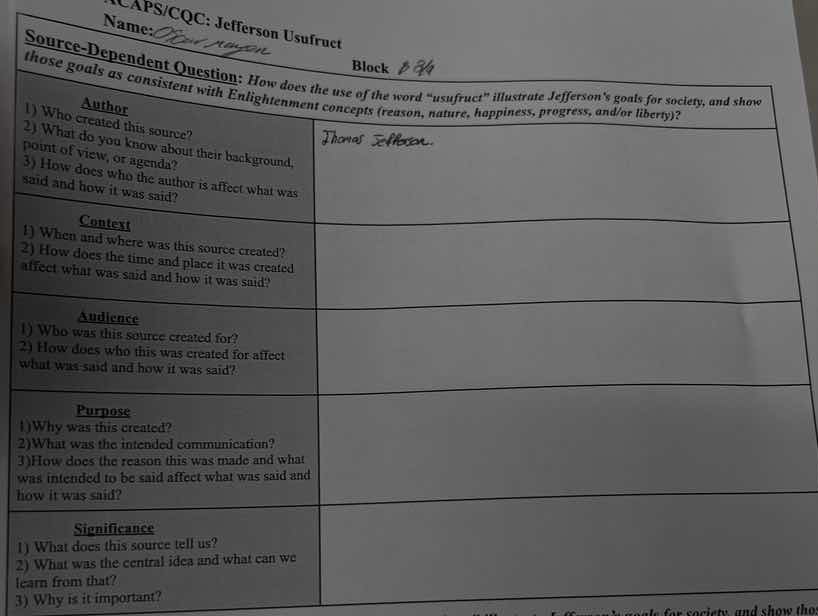
acaps/cqc: jefferson usufruct
name:
block
source-dependent question: how does the use of the word \usufruct\ illustrate jeffersons goals for society, and show those goals as consistent with enlightenment concepts (reason, nature, happiness, progress, and/or liberty)?
author
- who created this source?
- what do you know about their background, point of view, or agenda?
- how does who the author is affect what was said and how it was said?
context
- when and where was this source created?
- how does the time and place it was created affect what was said and how it was said?
audience
- who was this source created for?
- how does who this was created for affect what was said and how it was said?
purpose
1)why was this created?
2)what was the intended communication?
3)how does the reason this was made and what was intended to be said affect what was said and how it was said?
significance
- what does this source tell us?
- what was the central idea and what can we learn from that?
- why is it important?
Brief Explanations
This analysis uses the historical context of Thomas Jefferson and Enlightenment ideals to address each section:
- Author: Thomas Jefferson was a founding father influenced by Enlightenment thinkers like Locke and Rousseau, focused on individual liberty and natural rights. His identity as a revolutionary and statesman shaped his framing of concepts tied to societal freedom.
- Context: The term "usufruct" here relates to Jefferson's writings (likely in debates over land, governance, or natural rights) in late 18th-century America, a period of revolution and building a new nation around Enlightenment principles. The era's push for self-governance and natural rights directly influenced how he used the term to frame societal access to resources and liberty.
- Audience: The work was intended for fellow revolutionaries, political thinkers, and the American public, as well as future generations of citizens. This audience meant Jefferson framed "usufruct" to align with popular demands for natural rights and equitable access to resources, making ideas accessible and persuasive for building a just society.
- Purpose: Jefferson used "usufruct" to argue that society has a right to use shared resources (like land) for collective well-being, advancing his goal of a society rooted in natural rights, progress, and happiness. The term communicated that rights are not static but tied to the practical, equitable flourishing of people.
- Significance: The source tells us Jefferson's vision of a society where natural rights extend to practical access to resources, aligning with Enlightenment concepts of reason (structuring society for collective good), nature (rights derived from natural law), happiness (equitable access to resources), progress (adapting systems for societal growth), and liberty (freedom from unjust control of resources). The central idea is that governance must prioritize the collective, practical well-being of people, which was foundational to American democratic ideals.

Snap & solve any problem in the app
Get step-by-step solutions on Sovi AI
Photo-based solutions with guided steps
Explore more problems and detailed explanations
Author
- Thomas Jefferson
- He was a U.S. Founding Father, Enlightenment-influenced statesman, and advocate for natural rights, liberty, and democratic governance.
- His identity as a revolutionary thinker and architect of American democracy led him to frame "usufruct" as a natural right tied to societal equity, rather than a narrow legal term.
Context
- Likely late 18th-century America, during the formation of U.S. governance or debates over land and natural rights.
- The era of revolutionary struggle for self-rule and Enlightenment-focused reform meant "usufruct" was used to justify equitable access to resources as part of building a free, progressive society.
Audience
- Fellow political leaders, revolutionary thinkers, and the American public (including future citizens).
- To persuade this audience of the legitimacy of natural, equitable resource access, Jefferson framed "usufruct" to align with popular demands for liberty and fair governance.
Purpose
- To advance a vision of a society rooted in Enlightenment natural rights, where collective well-being is prioritized.
- To communicate that society has an inherent right to use shared resources for the happiness and progress of all people.
- This purpose led him to frame "usufruct" as a moral, natural right rather than a technical legal concept, emphasizing its role in upholding liberty and progress.
Significance
- It reveals Jefferson's application of Enlightenment principles to practical societal structures.
- Central idea: "Usufruct" embodies the Enlightenment ideals of natural rights (access to resources as a natural liberty), reason (structuring society for collective good), happiness (equitable resource access for well-being), and progress (adapting systems to serve the people). We learn Jefferson tied abstract Enlightenment concepts to tangible, equitable governance.
- It is important because it shaped American democratic ideals of collective liberty and equitable resource access, linking foundational Enlightenment thought to real-world governance.