QUESTION IMAGE
Question
9)
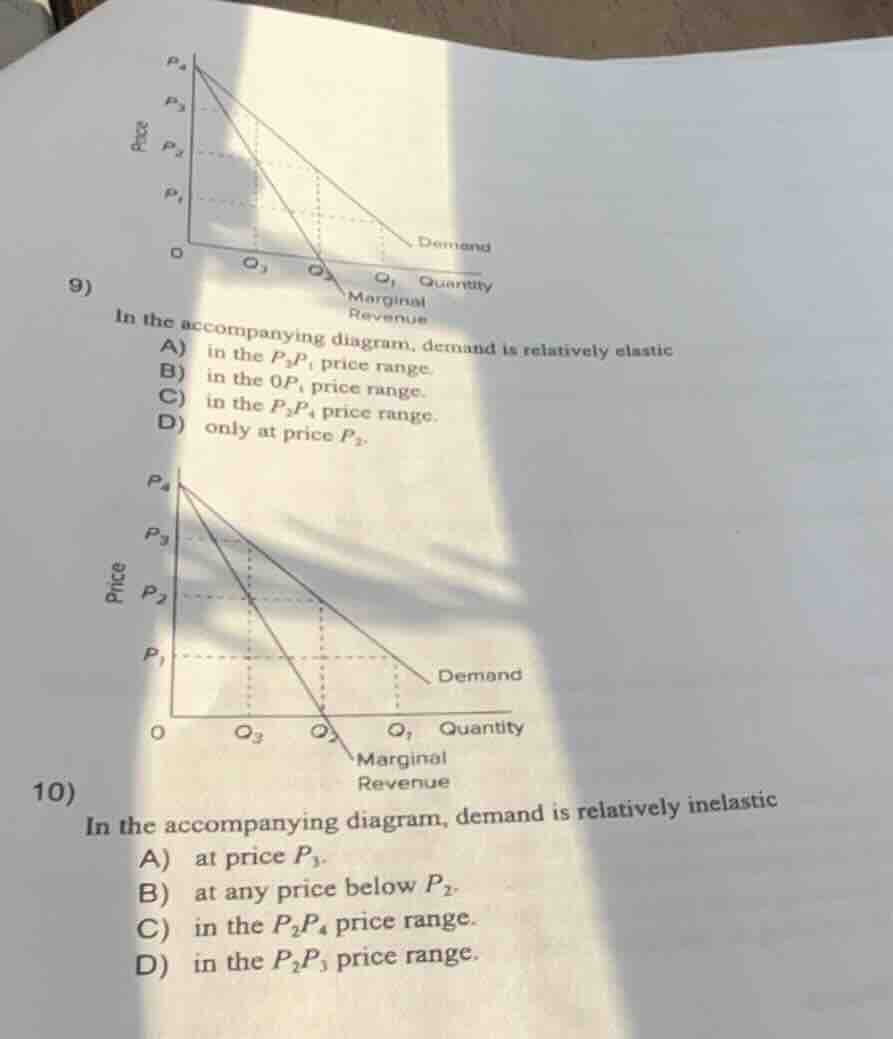
in the accompanying diagram, demand is relatively elastic
a) in the $p_2p_1$ price range.
b) in the $0p_1$ price range.
c) in the $p_2p_4$ price range.
d) only at price $p_2$.
10)
in the accompanying diagram, demand is relatively inelastic
a) at price $p_3$.
b) at any price below $p_2$.
c) in the $p_2p_4$ price range.
d) in the $p_2p_3$ price range.
Question 9
To determine where demand is relatively elastic, we use the relationship between demand (AR) and marginal revenue (MR) curves. For a linear demand curve, demand is elastic when \( MR > 0 \) (since \( MR = AR(1 - \frac{1}{|E|}) \), so \( MR > 0 \) implies \( |E| > 1 \), elastic). The \( MR \) curve lies above the quantity axis (positive \( MR \)) when quantity is less than \( Q_2 \) (from the diagram, where \( MR \) intersects the quantity axis at \( Q_2 \)). The price range corresponding to quantities less than \( Q_2 \) is \( P_2P_4 \)? Wait, no—wait, the first diagram: demand curve is \( P_4 \) to \( Q_1 \), \( MR \) is \( P_4 \) to \( Q_2 \). Wait, no, let's recall: for a linear demand curve \( P = a - bQ \), \( MR = a - 2bQ \). So \( MR = 0 \) at \( Q = \frac{a}{2b} \), which is the midpoint of the demand curve's quantity range. So demand is elastic above the midpoint (in price terms, below the midpoint price? Wait, no: when price is high (low quantity), demand is elastic; when price is low (high quantity), demand is inelastic. The midpoint of the demand curve (in price - quantity space) is where \( MR = 0 \). So in the first diagram, \( MR = 0 \) at \( Q_2 \), so for prices above \( P_2 \) (wait, no—price and quantity are inversely related. So when quantity is less than \( Q_2 \) (left of \( Q_2 \)), price is above \( P_2 \)? Wait, the price points: \( P_4 \) is the highest price, \( P_3 \), \( P_2 \), \( P_1 \) lower. The \( MR \) curve intersects quantity axis at \( Q_2 \). So for quantities less than \( Q_2 \) (i.e., \( Q < Q_2 \)), \( MR > 0 \), so demand is elastic. The price range for \( Q < Q_2 \) is \( P_2P_4 \)? Wait, no, let's check the options. Option C says "in the \( P_2P_4 \) price range". Let's verify: when price is in \( P_2P_4 \), quantity is less than \( Q_2 \) (since lower quantity means higher price), so \( MR > 0 \), hence demand is elastic (\( |E| > 1 \)). Option A: \( P_2P_1 \) is lower price (higher quantity), \( MR \) would be negative (since \( Q > Q_2 \)), so inelastic. Option B: \( 0P_1 \) is very low price, \( MR \) negative, inelastic. Option D: only at \( P_2 \) is the midpoint? No, elastic is a range. So the correct answer is C.
Demand is relatively inelastic when \( |E| < 1 \), which occurs when \( MR < 0 \) (since \( MR = AR(1 - \frac{1}{|E|}) \), so \( MR < 0 \) implies \( |E| < 1 \), inelastic). \( MR < 0 \) when quantity is greater than \( Q_2 \) (right of \( Q_2 \) on the quantity axis), which corresponds to prices less than \( P_2 \) (since lower price means higher quantity). Let's check the options: Option B says "at any price below \( P_2 \)". When price is below \( P_2 \), quantity is greater than \( Q_2 \), so \( MR < 0 \), hence demand is inelastic (\( |E| < 1 \)). Option A: at \( P_3 \), price is above \( P_2 \), \( MR > 0 \), elastic. Option C: \( P_2P_4 \) is above \( P_2 \), \( MR > 0 \), elastic. Option D: \( P_2P_3 \) is above \( P_2 \), \( MR > 0 \), elastic. So the correct answer is B.

Snap & solve any problem in the app
Get step-by-step solutions on Sovi AI
Photo-based solutions with guided steps
Explore more problems and detailed explanations
C. in the \( P_2P_4 \) price range.