QUESTION IMAGE
Question
6.4 accumulation functions
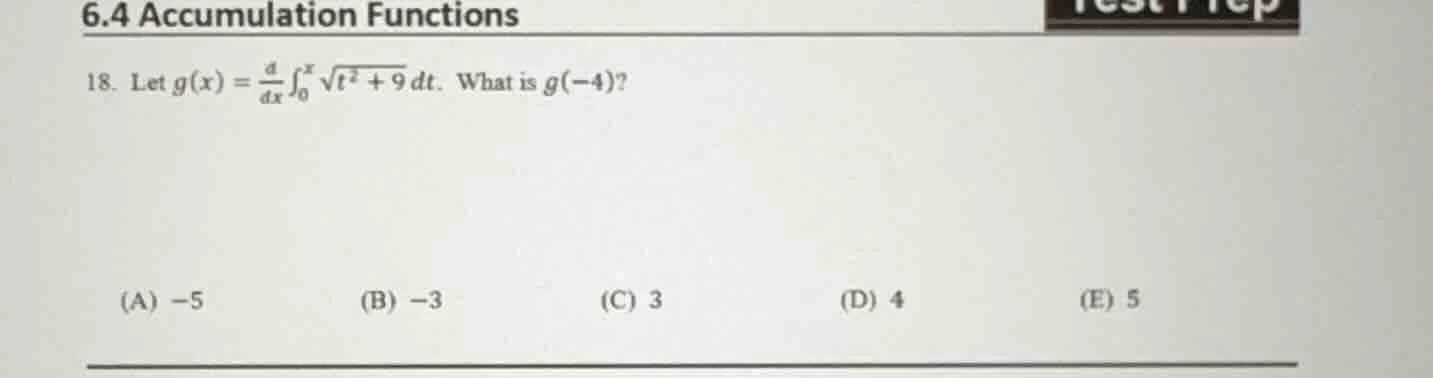
- let ( g(x) = \frac{d}{dx} int_{0}^{x} sqrt{t^2 + 9} , dt ). what is ( g(-4) )?
(a) ( -5 )
(b) ( -3 )
(c) ( 3 )
(d) ( 4 )
(e) ( 5 )
Step1: Apply the Fundamental Theorem of Calculus (Part 1)
The Fundamental Theorem of Calculus, Part 1 states that if \( F(x)=\int_{a}^{x}f(t)dt \), then \( F^\prime(x) = f(x) \). In this problem, \( g(x)=\frac{d}{dx}\int_{0}^{x}\sqrt{t^{2}+9}dt \), so by the Fundamental Theorem of Calculus, \( g(x)=\sqrt{x^{2}+9} \).
Step2: Evaluate \( g(-4) \)
Substitute \( x = - 4 \) into \( g(x) \): \( g(-4)=\sqrt{(-4)^{2}+9} \). First, calculate \( (-4)^{2}=16 \), then \( 16 + 9=25 \), and \( \sqrt{25}=5 \).

Snap & solve any problem in the app
Get step-by-step solutions on Sovi AI
Photo-based solutions with guided steps
Explore more problems and detailed explanations
E. 5