QUESTION IMAGE
Question
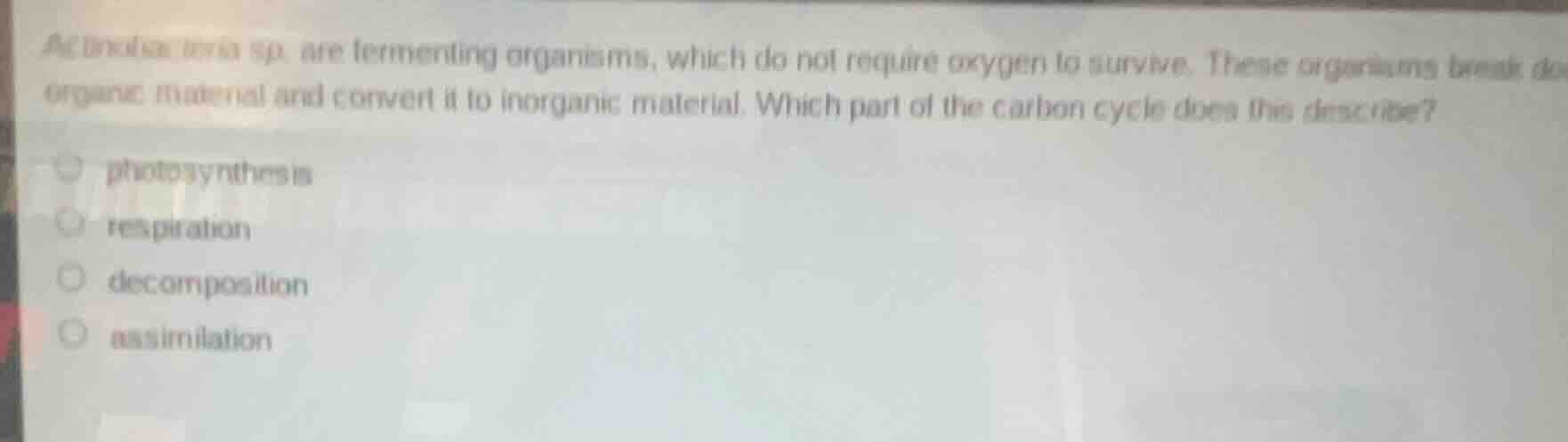
acetobacter sp. are fermenting organisms, which do not require oxygen to survive. these organisms break down organic material and convert it to inorganic material. which part of the carbon cycle does this describe?
- photosynthesis
- respiration
- decomposition
- assimilation
Brief Explanations
- Photosynthesis: Plants use sunlight to convert CO₂ and H₂O to organic matter (glucose), which is the opposite of breaking down organic material. So this is incorrect.
- Respiration: Organisms break down organic matter to release energy, but the key here is the conversion of organic to inorganic material by fermenting organisms (decomposers) which is more about decomposition. Respiration is more about energy release in organisms, not specifically about converting organic to inorganic in the context of the carbon cycle's decomposition step. So this is incorrect.
- Decomposition: Decomposers (like the fermenting organisms here) break down dead organic material into inorganic substances (like CO₂, nutrients), which matches the description of breaking down organic material to inorganic. This is correct.
- Assimilation: Organisms take in and use inorganic nutrients to build organic matter (e.g., plants taking in nitrate to make proteins), which is the reverse of what's described. So this is incorrect.

Snap & solve any problem in the app
Get step-by-step solutions on Sovi AI
Photo-based solutions with guided steps
Explore more problems and detailed explanations
C. decomposition