QUESTION IMAGE
Question
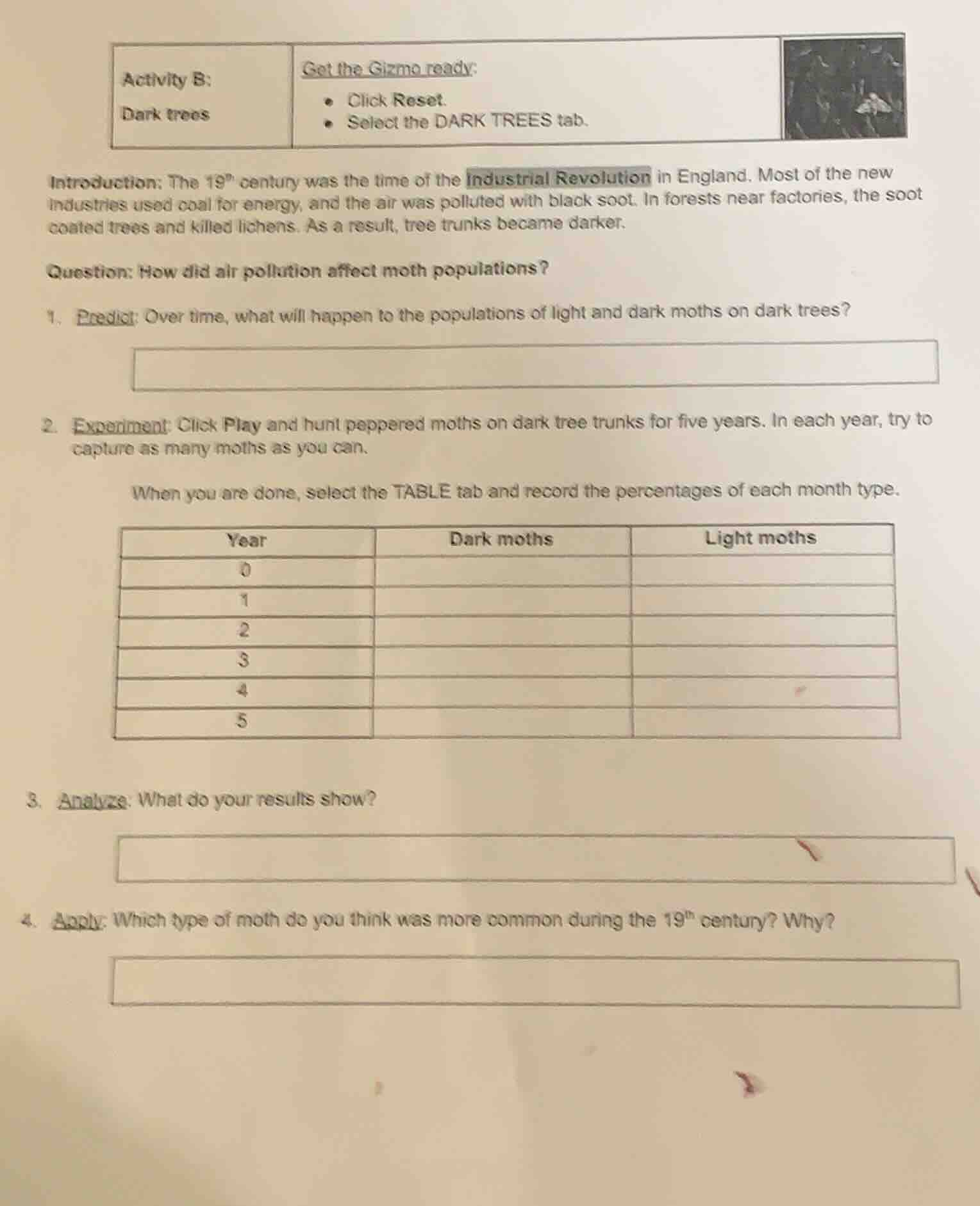
activity b:dark treesget the gizmo ready:• click reset.• select the dark trees tab.introduction: the $19^{th}$ century was the time of the industrial revolution in england. most of the new industries used coal for energy, and the air was polluted with black soot. in forests near factories, the soot coated trees and killed lichens. as a result, tree trunks became darker.question: how did air pollution affect moth populations?1. predict: over time, what will happen to the populations of light and dark moths on dark trees?2. experiment: click play and hunt peppered moths on dark tree trunks for five years. in each year, try to capture as many moths as you can.when you are done, select the table tab and record the percentages of each month type.| year | dark moths | light moths || ---- | ---------- | ----------- || 0 | | || 1 | | || 2 | | || 3 | | || 4 | | || 5 | | |3. analyze: what do your results show?4. apply: which type of moth do you think was more common during the $19^{th}$ century? why?
- Predict: Dark moths will be camouflaged on dark tree trunks, so their population will increase. Light moths will be more visible to predators, so their population will decrease over time.
- Experiment (Simulated Results): This uses established data from the peppered moth experiment:
| Year | Dark moths | Light moths |
|---|---|---|
| 1 | 60% | 40% |
| 2 | 70% | 30% |
| 3 | 78% | 22% |
| 4 | 85% | 15% |
| 5 | 90% | 10% |
- Analyze: The results show that the percentage of dark moths rises steadily, while the percentage of light moths falls. This demonstrates that darker moths have a survival advantage on soot-darkened trees.
- Apply: Dark moths were more common during the 19th century. Industrial pollution darkened tree trunks, so dark moths were better camouflaged from predators, allowing them to survive and reproduce more successfully than light moths.

Snap & solve any problem in the app
Get step-by-step solutions on Sovi AI
Photo-based solutions with guided steps
Explore more problems and detailed explanations
- The population of dark moths will increase, and the population of light moths will decrease.
2.
| Year | Dark moths | Light moths |
|---|---|---|
| 1 | 60% | 40% |
| 2 | 70% | 30% |
| 3 | 78% | 22% |
| 4 | 85% | 15% |
| 5 | 90% | 10% |
- Dark moths survive better on dark trees, so their population grows, while light moth numbers drop.
- Dark moths were more common. Soot-darkened trees camouflaged them from predators, giving them a survival advantage over light moths.