QUESTION IMAGE
Question
activity
part a
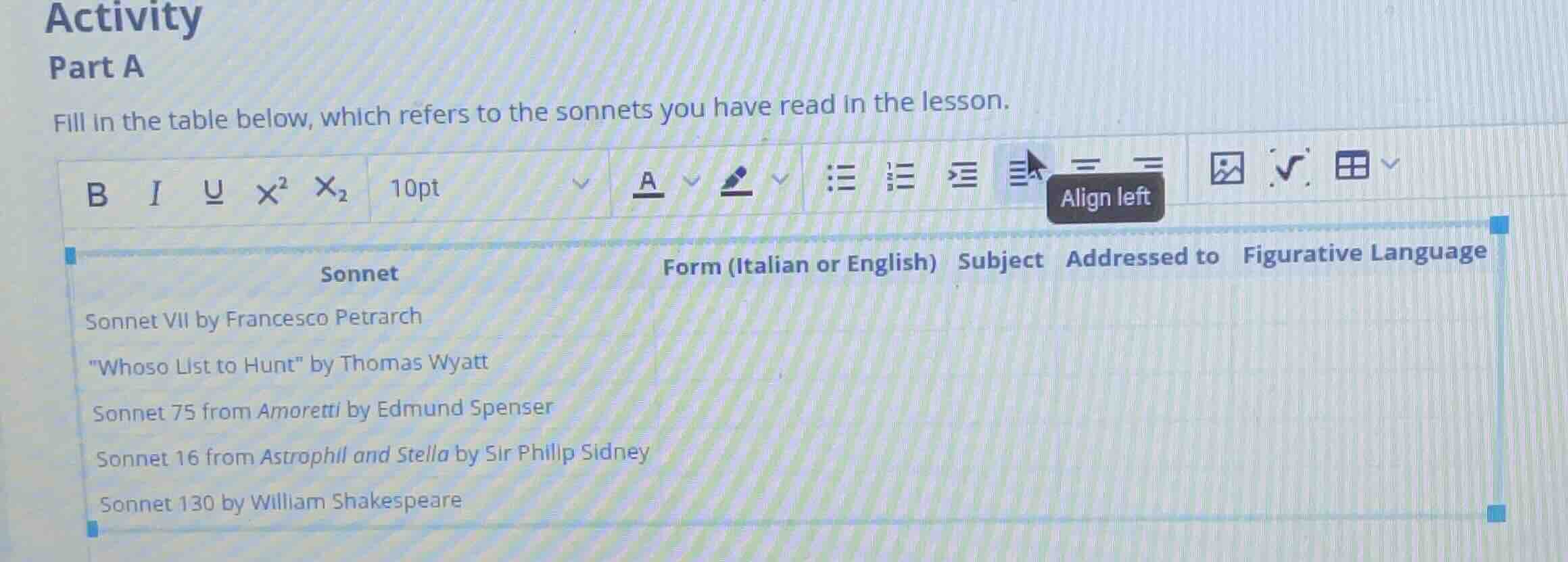
fill in the table below, which refers to the sonnets you have read in the lesson.
sonnet | form (italian or english) | subject | addressed to | figurative language
sonnet vii by francesco petrarch
\whoso list to hunt\ by thomas wyatt
sonnet 75 from amoretti by edmund spenser
sonnet 16 from astrophil and stella by sir philip sidney
sonnet 130 by william shakespeare
To fill in the table, we analyze each sonnet:
1. Sonnet VII by Francesco Petrarch
- Form: Italian (Petrarchan sonnet, 14 lines, octave + sestet).
- Subject: Love, beauty, and the passage of time (reflecting on the poet’s love and aging).
- Addressed to: The poet’s beloved (Laura, in Petrarch’s context).
- Figurative Language: Metaphors (e.g., love as a force), personification (time, beauty), and imagery (descriptions of the beloved).
2. “Whoso List to Hunt” by Thomas Wyatt
- Form: Italian (Petrarchan structure, adapted; 14 lines, octave + sestet).
- Subject: Unrequited love, the futility of pursuing a woman (the “hind” as a metaphor for Anne Boleyn).
- Addressed to: A beloved (the “hind”/Anne Boleyn, or a symbolic representation of unattainable love).
- Figurative Language: Extended metaphor (hunting a hind), allusion (to the king’s ownership of the hind), and imagery (the hunt).
3. Sonnet 75 from Amoretti by Edmund Spenser
- Form: English (Spenserian sonnet; 14 lines, 3 quatrains + couplet, with interlocking rhyme: abab bcbc cdcd ee).
- Subject: Love’s immortality (the poet’s attempt to immortalize his love through poetry).
- Addressed to: The poet’s beloved (Elizabeth Boyle).
- Figurative Language: Metaphor (love as eternal, the wave as time/oblivion), personification (the wave “wash[ing]” away the name), and imagery (the shore, waves, writing in sand).
4. Sonnet 16 from Astrophil and Stella by Sir Philip Sidney
- Form: English (Petrarchan influences, 14 lines, 3 quatrains + couplet, rhyme abba abba cdcd ee).
- Subject: The conflict between reason and passion in love (Astrophil’s struggle to control his feelings for Stella).
- Addressed to: Stella (the poet’s beloved, Penelope Devereux).
- Figurative Language: Personification (reason, passion), metaphor (love as a battle), and imagery (mental conflict).
5. Sonnet 130 by William Shakespeare
- Form: English (Shakespearean sonnet; 14 lines, 3 quatrains + couplet, rhyme abab cdcd efef gg).
- Subject: A realistic (anti-Petrarchan) portrayal of love (rejecting idealized beauty tropes).
- Addressed to: The poet’s beloved (the “Dark Lady” or a lover).
- Figurative Language: Irony (subverting Petrarchan metaphors), simile (e.g., “My mistress’ eyes are nothing like the sun”), and imagery (unflattering descriptions to highlight true love).
Filled Table (Example):
| Sonnet | Form | Subject | Addressed to | Figurative Language |
|---|---|---|---|---|
| “Whoso List to Hunt” by Thomas Wyatt | Italian | Unrequited love, futility of pursuit | Beloved (Anne Boleyn/hind) | Extended metaphor, allusion, imagery |
| Sonnet 75 from Amoretti by Edmund Spenser | English (Spenserian) | Love’s immortality | Elizabeth Boyle (beloved) | Metaphor, personification, imagery |
| Sonnet 16 from Astrophil and Stella by Sir Philip Sidney | English (Petrarchan-influenced) | Reason vs. passion in love | Stella (Penelope Devereux) | Personification, metaphor, imagery |
| Sonnet 130 by William Shakespeare | English (Shakespearean) | Realistic love (anti-Petrarchan) | Beloved (Dark Lady) | Irony, simile, imagery |
Adjust details based on specific lesson content (e.g., exact interpretations of “addressed to” or figurative language).

Snap & solve any problem in the app
Get step-by-step solutions on Sovi AI
Photo-based solutions with guided steps
Explore more problems and detailed explanations
To fill in the table, we analyze each sonnet:
1. Sonnet VII by Francesco Petrarch
- Form: Italian (Petrarchan sonnet, 14 lines, octave + sestet).
- Subject: Love, beauty, and the passage of time (reflecting on the poet’s love and aging).
- Addressed to: The poet’s beloved (Laura, in Petrarch’s context).
- Figurative Language: Metaphors (e.g., love as a force), personification (time, beauty), and imagery (descriptions of the beloved).
2. “Whoso List to Hunt” by Thomas Wyatt
- Form: Italian (Petrarchan structure, adapted; 14 lines, octave + sestet).
- Subject: Unrequited love, the futility of pursuing a woman (the “hind” as a metaphor for Anne Boleyn).
- Addressed to: A beloved (the “hind”/Anne Boleyn, or a symbolic representation of unattainable love).
- Figurative Language: Extended metaphor (hunting a hind), allusion (to the king’s ownership of the hind), and imagery (the hunt).
3. Sonnet 75 from Amoretti by Edmund Spenser
- Form: English (Spenserian sonnet; 14 lines, 3 quatrains + couplet, with interlocking rhyme: abab bcbc cdcd ee).
- Subject: Love’s immortality (the poet’s attempt to immortalize his love through poetry).
- Addressed to: The poet’s beloved (Elizabeth Boyle).
- Figurative Language: Metaphor (love as eternal, the wave as time/oblivion), personification (the wave “wash[ing]” away the name), and imagery (the shore, waves, writing in sand).
4. Sonnet 16 from Astrophil and Stella by Sir Philip Sidney
- Form: English (Petrarchan influences, 14 lines, 3 quatrains + couplet, rhyme abba abba cdcd ee).
- Subject: The conflict between reason and passion in love (Astrophil’s struggle to control his feelings for Stella).
- Addressed to: Stella (the poet’s beloved, Penelope Devereux).
- Figurative Language: Personification (reason, passion), metaphor (love as a battle), and imagery (mental conflict).
5. Sonnet 130 by William Shakespeare
- Form: English (Shakespearean sonnet; 14 lines, 3 quatrains + couplet, rhyme abab cdcd efef gg).
- Subject: A realistic (anti-Petrarchan) portrayal of love (rejecting idealized beauty tropes).
- Addressed to: The poet’s beloved (the “Dark Lady” or a lover).
- Figurative Language: Irony (subverting Petrarchan metaphors), simile (e.g., “My mistress’ eyes are nothing like the sun”), and imagery (unflattering descriptions to highlight true love).
Filled Table (Example):
| Sonnet | Form | Subject | Addressed to | Figurative Language |
|---|---|---|---|---|
| “Whoso List to Hunt” by Thomas Wyatt | Italian | Unrequited love, futility of pursuit | Beloved (Anne Boleyn/hind) | Extended metaphor, allusion, imagery |
| Sonnet 75 from Amoretti by Edmund Spenser | English (Spenserian) | Love’s immortality | Elizabeth Boyle (beloved) | Metaphor, personification, imagery |
| Sonnet 16 from Astrophil and Stella by Sir Philip Sidney | English (Petrarchan-influenced) | Reason vs. passion in love | Stella (Penelope Devereux) | Personification, metaphor, imagery |
| Sonnet 130 by William Shakespeare | English (Shakespearean) | Realistic love (anti-Petrarchan) | Beloved (Dark Lady) | Irony, simile, imagery |
Adjust details based on specific lesson content (e.g., exact interpretations of “addressed to” or figurative language).