QUESTION IMAGE
Question
activity c:
plants and
unicellular life
get the gizmo ready:
- on the landscape tab, select the microalgae
sample.
introduction: most of the animals and plants we are familiar with are multicellular, they are
made up of many cells. however, many living things only consist of a single cell. these
microscopic organisms are unicellular.
question: how are unicellular organisms similar to multicellular organisms?
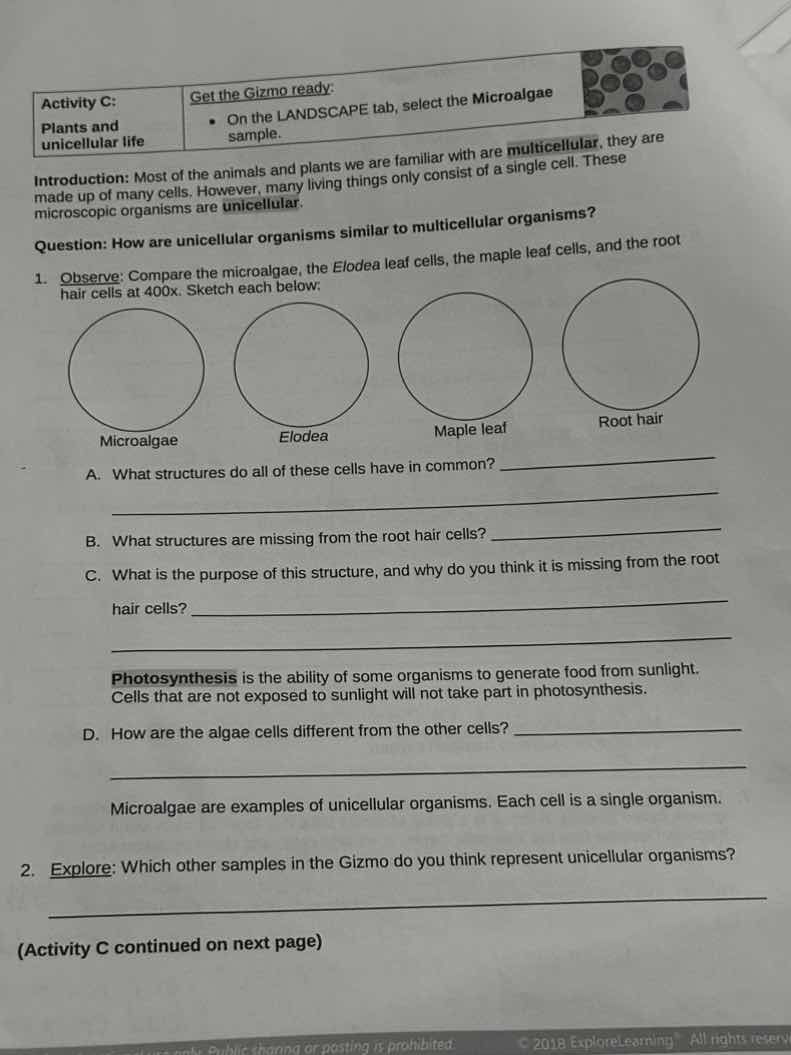
- observe: compare the microalgae, the elodea leaf cells, the maple leaf cells, and the root
hair cells at 400x. sketch each below:
microalgae
elodea
maple leaf
root hair
a. what structures do all of these cells have in common?
b. what structures are missing from the root hair cells?
c. what is the purpose of this structure, and why do you think it is missing from the root
hair cells?
photosynthesis is the ability of some organisms to generate food from sunlight.
cells that are not exposed to sunlight will not take part in photosynthesis.
d. how are the algae cells different from the other cells?
microalgae are examples of unicellular organisms. each cell is a single organism.
- explore: which other samples in the gizmo do you think represent unicellular organisms?
(activity c continued on next page)
A. All these cells are eukaryotic, so they share core eukaryotic cell structures.
B. Root hair cells are underground and do not perform photosynthesis, so they lack the organelle needed for this process.
C. The missing structure enables sunlight-based food production; root hairs are underground with no access to sunlight, so they do not need it.
D. Algae are single, free-living organisms, while the others are specialized cells that are part of larger multicellular organisms.
- Common unicellular samples in such Gizmos are single-celled organisms that function independently as complete life forms.

Snap & solve any problem in the app
Get step-by-step solutions on Sovi AI
Photo-based solutions with guided steps
Explore more problems and detailed explanations
- A. All have a cell membrane, cytoplasm, nucleus, and mitochondria.
B. Chloroplasts
C. Chloroplasts carry out photosynthesis to make food using sunlight. Root hair cells grow underground, where there is no sunlight, so they do not need chloroplasts.
D. Algae cells are entire, independent unicellular organisms, while the Elodea, maple leaf, and root hair cells are specialized cells that are part of multicellular plants.
- Other likely unicellular samples are bacteria, paramecia, or amoebas (common options in this type of educational Gizmo).