QUESTION IMAGE
Question
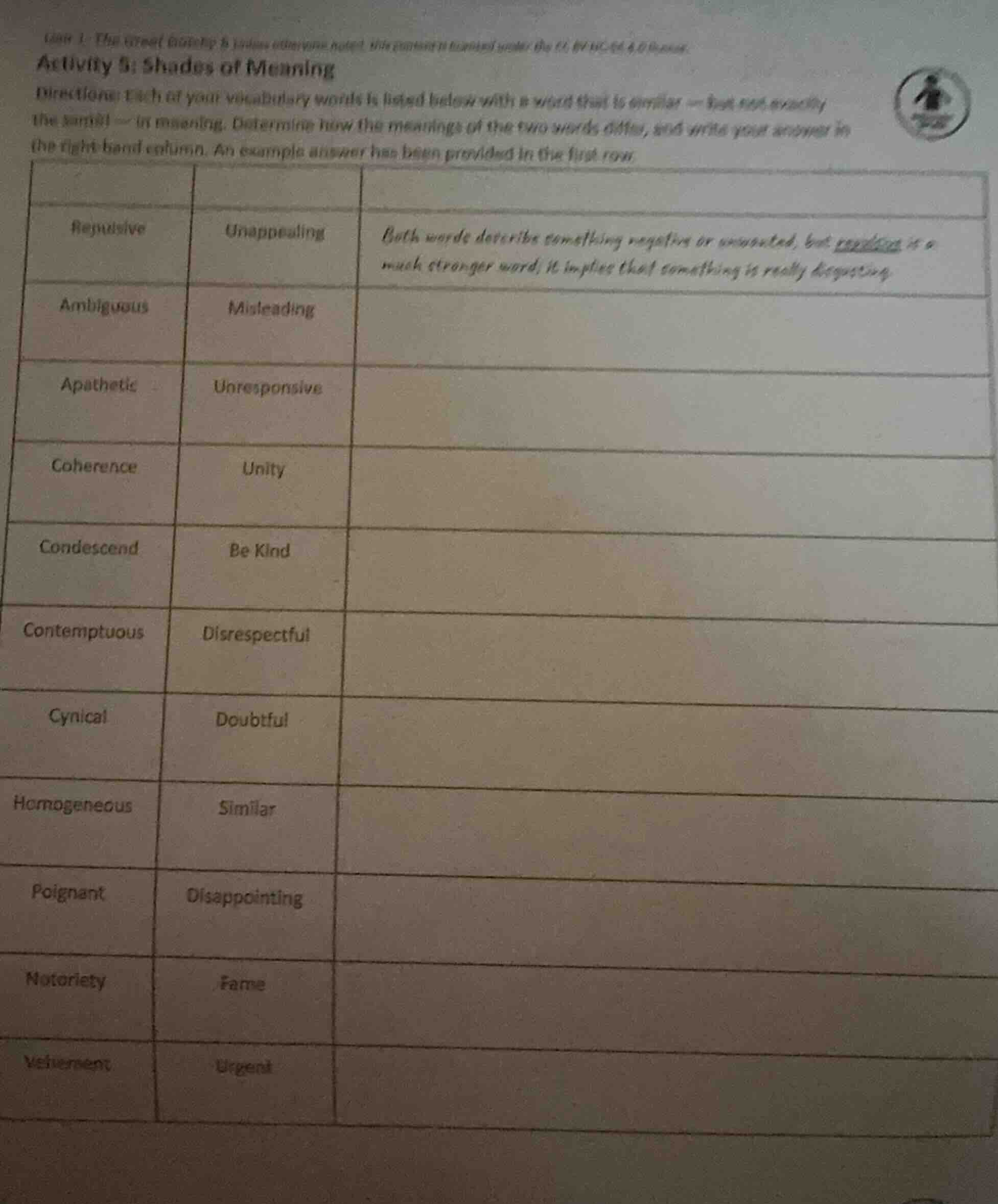
activity 5: shades of meaning
directions: each of your vocabulary words is listed below with a word that is similar — but not exactly
the same! — in meaning. determine how the meanings of the two words differ, and write your answer in
the right - hand column. an example answer has been provided in the first row.
much stronger word; it implies that something is really disgusting. |
| ambiguous | misleading | |
| apathetic | unresponsive | |
| coherence | unity | |
| condescend | be kind | |
| contemptuous | disrespectful | |
| cynical | doubtful | |
| homogeneous | similar | |
| poignant | disappointing | |
| notoriety | fame | |
| vehement | urgent |
To solve this, we analyze each pair by understanding their nuanced differences:
1. Ambiguous vs. Misleading
- Ambiguous: Means a word/statement has multiple possible meanings (unclear which is intended).
- Misleading: Means a word/statement is intended to give a false or distorted impression.
- Difference: Ambiguous = multiple valid interpretations; Misleading = intentional distortion of truth.
2. Apathetic vs. Unresponsive
- Apathetic: Lacks interest, emotion, or concern (internal lack of care).
- Unresponsive: Fails to react/respond (external lack of action, may not involve emotion).
- Difference: Apathetic = emotional indifference; Unresponsive = lack of action/reaction.
3. Coherence vs. Unity
- Coherence: Logical connection, consistency, or flow (how parts relate).
- Unity: Oneness, wholeness, or harmony (overall sense of being a single entity).
- Difference: Coherence = logical connection; Unity = holistic wholeness.
4. Condescend vs. Be Kind
- Condescend: Act superior, patronizing (implies arrogance).
- Be Kind: Act with goodwill, generosity (implies genuine care).
- Difference: Condescend = patronizing superiority; Be Kind = sincere benevolence.
5. Contemptuous vs. Disrespectful
- Contemptuous: Expresses intense dislike, scorn, or disgust.
- Disrespectful: Lacks respect (milder, broader; may not involve intense hatred).
- Difference: Contemptuous = intense scorn; Disrespectful = general lack of respect.
6. Cynical vs. Doubtful
- Cynical: Distrustful of others’ motives (pessimistic, often cynical about humanity).
- Doubtful: Unsure, skeptical (neutral, about facts/claims).
- Difference: Cynical = distrust of motives; Doubtful = uncertainty about truth.
7. Homogeneous vs. Similar
- Homogeneous: Composed of the same kind/type (uniformity).
- Similar: Resembles in some way (weaker, allows variation).
- Difference: Homogeneous = uniform composition; Similar = partial resemblance.
8. Poignant vs. Disappointing
- Poignant: Deeply moving, touching (often bittersweet, evokes emotion).
- Disappointing: Fails to meet expectations (focus on unmet hopes).
- Difference: Poignant = emotional resonance; Disappointing = unmet expectations.
9. Notoriety vs. Fame
- Notoriety: Famous for negative reasons (infamy).
- Fame: Famous for positive/neutral reasons (celebrity, acclaim).
- Difference: Notoriety = negative fame; Fame = positive/neutral recognition.
10. Vehement vs. Urgent
- Vehement: Intense, passionate (emotional force).
- Urgent: Requires immediate action (time-sensitive necessity).
- Difference: Vehement = emotional intensity; Urgent = time-sensitive priority.
(Write these explanations in the right-hand column for each row.)
Example Filled Row (for "Ambiguous" and "Misleading"):
Both words relate to unclear communication, but ambiguous means having multiple valid interpretations (unclear which is intended), while misleading means intentionally distorting the truth to deceive.

Snap & solve any problem in the app
Get step-by-step solutions on Sovi AI
Photo-based solutions with guided steps
Explore more problems and detailed explanations
To solve this, we analyze each pair by understanding their nuanced differences:
1. Ambiguous vs. Misleading
- Ambiguous: Means a word/statement has multiple possible meanings (unclear which is intended).
- Misleading: Means a word/statement is intended to give a false or distorted impression.
- Difference: Ambiguous = multiple valid interpretations; Misleading = intentional distortion of truth.
2. Apathetic vs. Unresponsive
- Apathetic: Lacks interest, emotion, or concern (internal lack of care).
- Unresponsive: Fails to react/respond (external lack of action, may not involve emotion).
- Difference: Apathetic = emotional indifference; Unresponsive = lack of action/reaction.
3. Coherence vs. Unity
- Coherence: Logical connection, consistency, or flow (how parts relate).
- Unity: Oneness, wholeness, or harmony (overall sense of being a single entity).
- Difference: Coherence = logical connection; Unity = holistic wholeness.
4. Condescend vs. Be Kind
- Condescend: Act superior, patronizing (implies arrogance).
- Be Kind: Act with goodwill, generosity (implies genuine care).
- Difference: Condescend = patronizing superiority; Be Kind = sincere benevolence.
5. Contemptuous vs. Disrespectful
- Contemptuous: Expresses intense dislike, scorn, or disgust.
- Disrespectful: Lacks respect (milder, broader; may not involve intense hatred).
- Difference: Contemptuous = intense scorn; Disrespectful = general lack of respect.
6. Cynical vs. Doubtful
- Cynical: Distrustful of others’ motives (pessimistic, often cynical about humanity).
- Doubtful: Unsure, skeptical (neutral, about facts/claims).
- Difference: Cynical = distrust of motives; Doubtful = uncertainty about truth.
7. Homogeneous vs. Similar
- Homogeneous: Composed of the same kind/type (uniformity).
- Similar: Resembles in some way (weaker, allows variation).
- Difference: Homogeneous = uniform composition; Similar = partial resemblance.
8. Poignant vs. Disappointing
- Poignant: Deeply moving, touching (often bittersweet, evokes emotion).
- Disappointing: Fails to meet expectations (focus on unmet hopes).
- Difference: Poignant = emotional resonance; Disappointing = unmet expectations.
9. Notoriety vs. Fame
- Notoriety: Famous for negative reasons (infamy).
- Fame: Famous for positive/neutral reasons (celebrity, acclaim).
- Difference: Notoriety = negative fame; Fame = positive/neutral recognition.
10. Vehement vs. Urgent
- Vehement: Intense, passionate (emotional force).
- Urgent: Requires immediate action (time-sensitive necessity).
- Difference: Vehement = emotional intensity; Urgent = time-sensitive priority.
(Write these explanations in the right-hand column for each row.)
Example Filled Row (for "Ambiguous" and "Misleading"):
Both words relate to unclear communication, but ambiguous means having multiple valid interpretations (unclear which is intended), while misleading means intentionally distorting the truth to deceive.