QUESTION IMAGE
Question
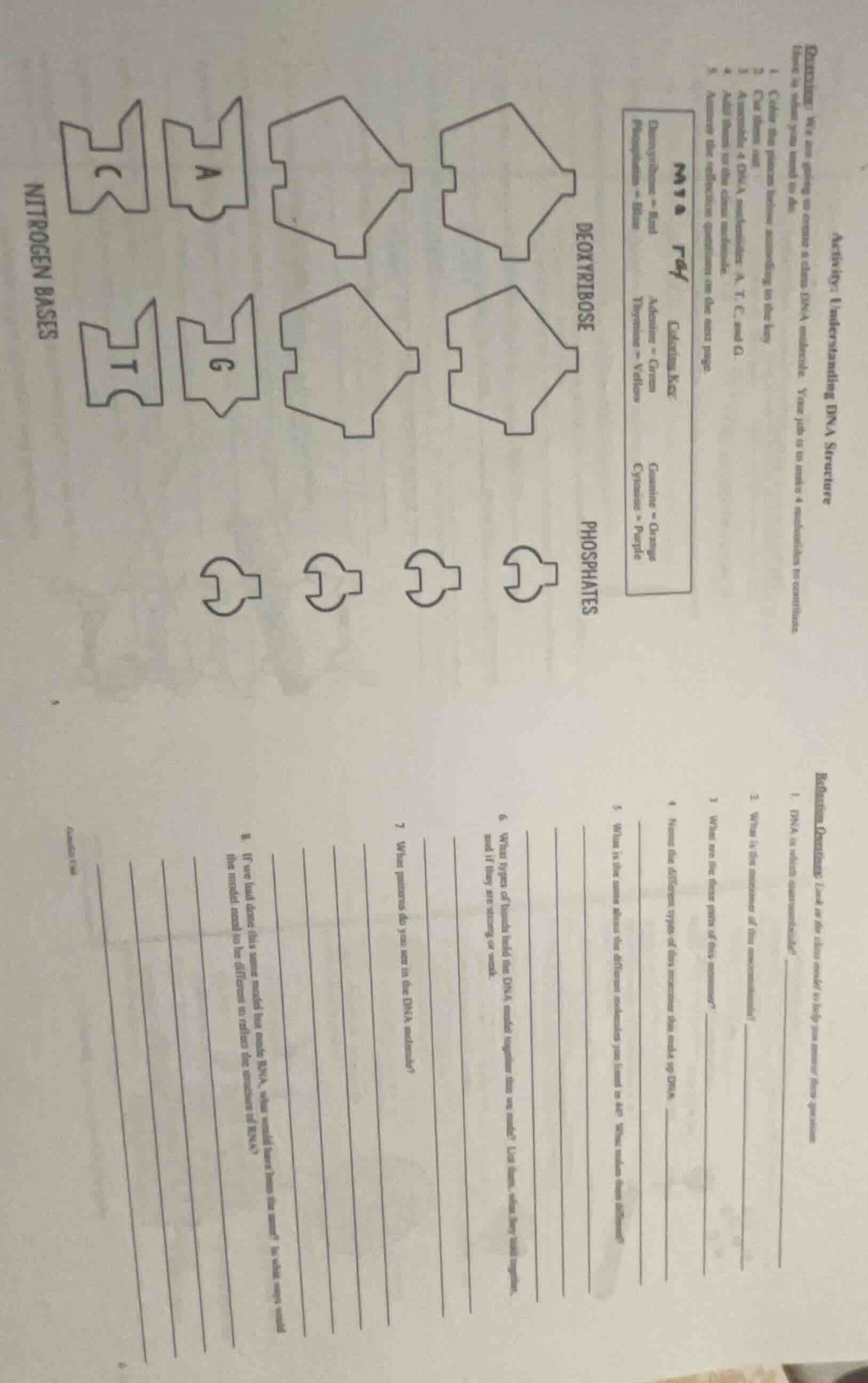
activity: understanding dna structure
direction: we are going to create a dna molecule. your job is to make a model that represents
these is what you need to do.
- color the pattern below according to the key.
- cut them all.
- assemble a dna molecule: a, t, c, and g.
- attach them to the chain molecule.
- answer the following questions on the next page.
key
deoxyribose
phosphates
nitrogen bases
mto ray
color key:
adenine = green
thymine = yellow
guanine = orange
cytosine = purple
reflection question: look at the dna model to help you answer these questions.
- dna is which store molecule?
- what is the importance of this macromolecule?
- what are the three parts of this monomer?
- name the different types of this monomer in the model of dna.
- what is the name where the different molecules are found in? what other than this name?
- what type of bonds hold the dna model together into a single? use data why they will happen
and if they are strong or weak.
- what patterns do you see in the dna molecule?
- if we had done this same model but made rna, what would have been the difference? in what way would
the model need to be different in relation to the structure of rna?
(answer here)
To answer these questions, we analyze each one based on DNA structure knowledge:
Question 1: DNA is which state molecule?
DNA is a double - stranded molecule. The Watson - Crick model of DNA shows it has two polynucleotide chains that run in opposite directions (antiparallel) and are twisted into a double helix. These two strands are held together by hydrogen bonds between complementary nitrogenous bases.
Question 2: What is the structure of the nucleotide?
A nucleotide, the basic unit of DNA, has a three - part structure:
- A deoxyribose sugar (a 5 - carbon sugar).
- A phosphate group (which is negatively charged and helps form the backbone of the DNA strand).
- A nitrogenous base (there are four types in DNA: adenine (A), thymine (T), cytosine (C), and guanine (G)).
Question 3: What are the three parts of the monomer?
The monomer of DNA is the nucleotide. As described above, its three parts are:
- Deoxyribose (5 - carbon sugar).
- Phosphate group.
- Nitrogenous base (A, T, C, or G).
Question 4: Name the different types of the monomer in the model (DNA).
The monomers (nucleotides) in DNA differ by their nitrogenous bases. So the four types are:
- Adenine - containing nucleotide.
- Thymine - containing nucleotide.
- Cytosine - containing nucleotide.
- Guanine - containing nucleotide.
Question 5: What is the same when the different nucleotides join together? What is different?
- Same parts: When nucleotides join to form the DNA strand (through phosphodiester bonds), the deoxyribose sugar and the phosphate group are the same in terms of their structure and function in forming the backbone.
- Different part: The nitrogenous base is different. Each nucleotide has one of the four unique nitrogenous bases (A, T, C, G), and it is the sequence of these bases that carries the genetic information.
Question 6: What type of bonds hold the DNA model together (in a single strand)? What type hold the two strands together?
- Within a single strand: Nucleotides in a single DNA strand are held together by phosphodiester bonds. These bonds form between the 3’ carbon of the deoxyribose sugar of one nucleotide and the 5’ carbon of the phosphate group of the next nucleotide, creating the sugar - phosphate backbone.
- Between two strands: The two strands of the DNA double helix are held together by hydrogen bonds between the complementary nitrogenous bases. Adenine (A) forms two hydrogen bonds with thymine (T), and guanine (G) forms three hydrogen bonds with cytosine (C).
Question 7: What patterns do you see in the DNA molecule?
- Base - pairing pattern: There is a specific complementary base - pairing pattern: A always pairs with T, and G always pairs with C. This is known as Chargaff's rule and is crucial for DNA replication and transcription.
- Double - helix pattern: The two strands of DNA are antiparallel (they run in opposite directions, one from 5’ to 3’ and the other from 3’ to 5’) and are twisted into a double helix shape.
- Backbone pattern: The sugar (deoxyribose) and phosphate groups form a repeating “backbone” on the outside of the helix, while the nitrogenous bases are on the inside, forming the rungs of the DNA “ladder”.
Question 8: If we had done this same model but for RNA, what would have been the difference? Or what would the model need to be different in relation to the structure of RNA?
To adapt the model for RNA (ribonucleic acid) instead of DNA, the following changes would be needed:
- Sugar: Replace deoxyribose (in DNA)…

Snap & solve any problem in the app
Get step-by-step solutions on Sovi AI
Photo-based solutions with guided steps
Explore more problems and detailed explanations
s:
- DNA is a double - stranded molecule.
- A nucleotide has a deoxyribose sugar, a phosphate group, and a nitrogenous base.
- The three parts of the nucleotide (monomer) are deoxyribose sugar, phosphate group, and nitrogenous base.
- The four types of DNA monomers (nucleotides) are those with adenine, thymine, cytosine, and guanine as the nitrogenous base.
- Same: deoxyribose sugar and phosphate group; Different: nitrogenous base.
- Within a strand: phosphodiester bonds; Between strands: hydrogen bonds.
- Patterns include complementary base pairing (A - T, G - C), double - helix structure, and sugar - phosphate backbone with bases inside.
- For RNA: sugar is ribose (not deoxyribose), base uracil (not thymine), and usually single - stranded.