QUESTION IMAGE
Question
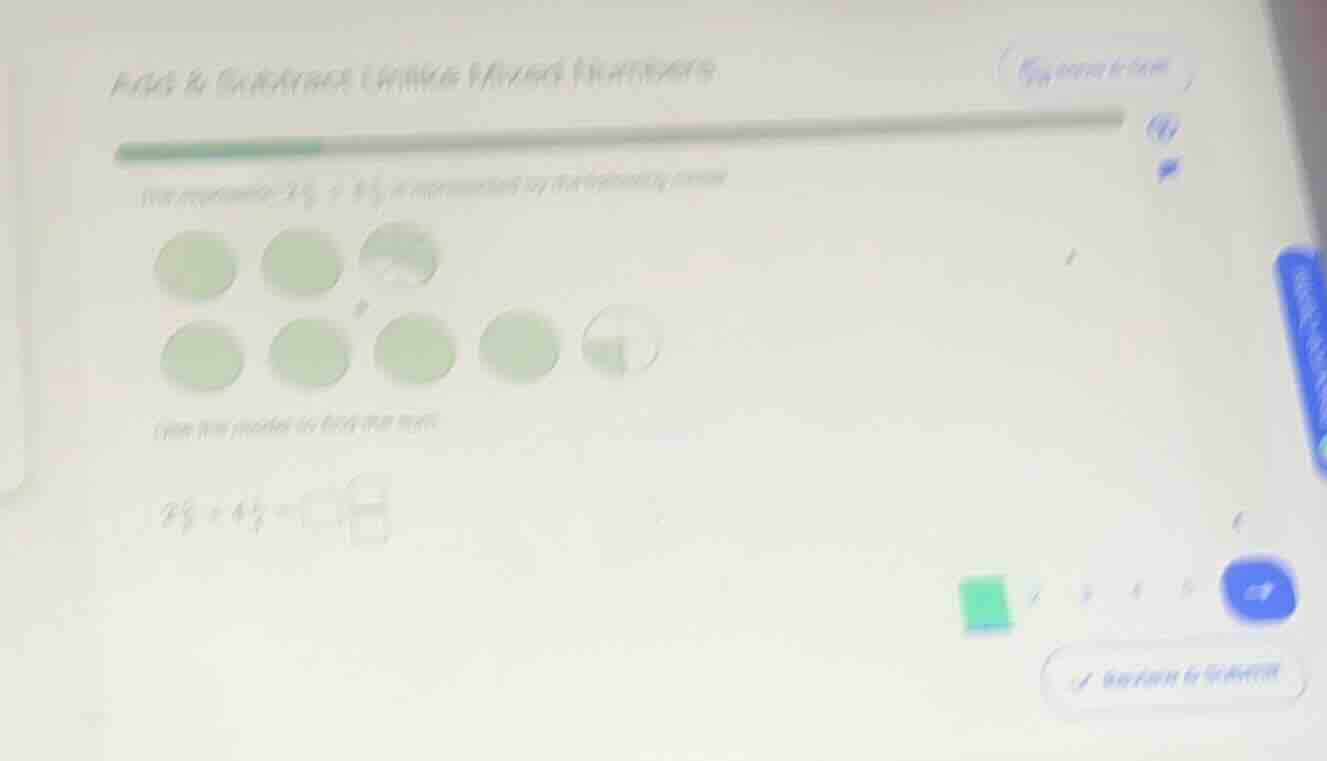
add & subtract using mixed numbers the expression $2\frac{2}{3}+4\frac{1}{3}$ is represented by the following model. can you use the model to find the sum? $2\frac{2}{3}+4\frac{1}{3}=\square\frac{\square}{\square}$
Step1: Convert mixed numbers to improper fractions
First, convert \(2\frac{2}{3}\) to an improper fraction. The formula for converting a mixed number \(a\frac{b}{c}\) to an improper fraction is \(\frac{a\times c + b}{c}\). So for \(2\frac{2}{3}\), we have \(a = 2\), \(b = 2\), \(c = 3\). Then \(\frac{2\times3 + 2}{3}=\frac{6 + 2}{3}=\frac{8}{3}\).
Next, convert \(4\frac{1}{3}\) to an improper fraction. Using the same formula, \(a = 4\), \(b = 1\), \(c = 3\). So \(\frac{4\times3 + 1}{3}=\frac{12 + 1}{3}=\frac{13}{3}\). Wait, no, wait, actually, when adding mixed numbers, we can also add the whole numbers and the fractions separately. Let's correct that.
Wait, the problem is \(2\frac{2}{3}+4\frac{1}{3}\). So we can add the whole number parts and the fractional parts separately. The whole number parts are \(2\) and \(4\), and the fractional parts are \(\frac{2}{3}\) and \(\frac{1}{3}\).
Step2: Add the whole numbers and the fractions
First, add the whole numbers: \(2 + 4 = 6\).
Then, add the fractions: \(\frac{2}{3}+\frac{1}{3}=\frac{2 + 1}{3}=\frac{3}{3}=1\).
Step3: Add the results from Step2
Now, add the sum of the whole numbers and the sum of the fractions: \(6+1 = 7\).
Alternatively, using the improper fraction method: \(2\frac{2}{3}=\frac{8}{3}\), \(4\frac{1}{3}=\frac{13}{3}\)? Wait, no, \(4\times3 + 1 = 13\)? Wait, no, \(4\frac{1}{3}\) is \(\frac{4\times3+1}{3}=\frac{13}{3}\)? Wait, no, \(2\frac{2}{3}\) is \(\frac{8}{3}\), \(4\frac{1}{3}\) is \(\frac{13}{3}\)? Wait, no, that can't be, because \(2\frac{2}{3}+4\frac{1}{3}\) should be \(6 + 1 = 7\). Wait, maybe I made a mistake in the improper fraction conversion for \(4\frac{1}{3}\). Wait, \(4\times3=12\), \(12 + 1 = 13\), so \(\frac{13}{3}\), and \(2\frac{2}{3}\) is \(\frac{8}{3}\). Then \(\frac{8}{3}+\frac{13}{3}=\frac{8 + 13}{3}=\frac{21}{3}=7\). Yes, that's correct.

Snap & solve any problem in the app
Get step-by-step solutions on Sovi AI
Photo-based solutions with guided steps
Explore more problems and detailed explanations
\(7\) (or in the boxed form as per the problem's requirement, but since the problem has a mixed number box, but the result is a whole number, so \(7\) or \(7\frac{0}{3}\), but typically just \(7\)).