QUESTION IMAGE
Question
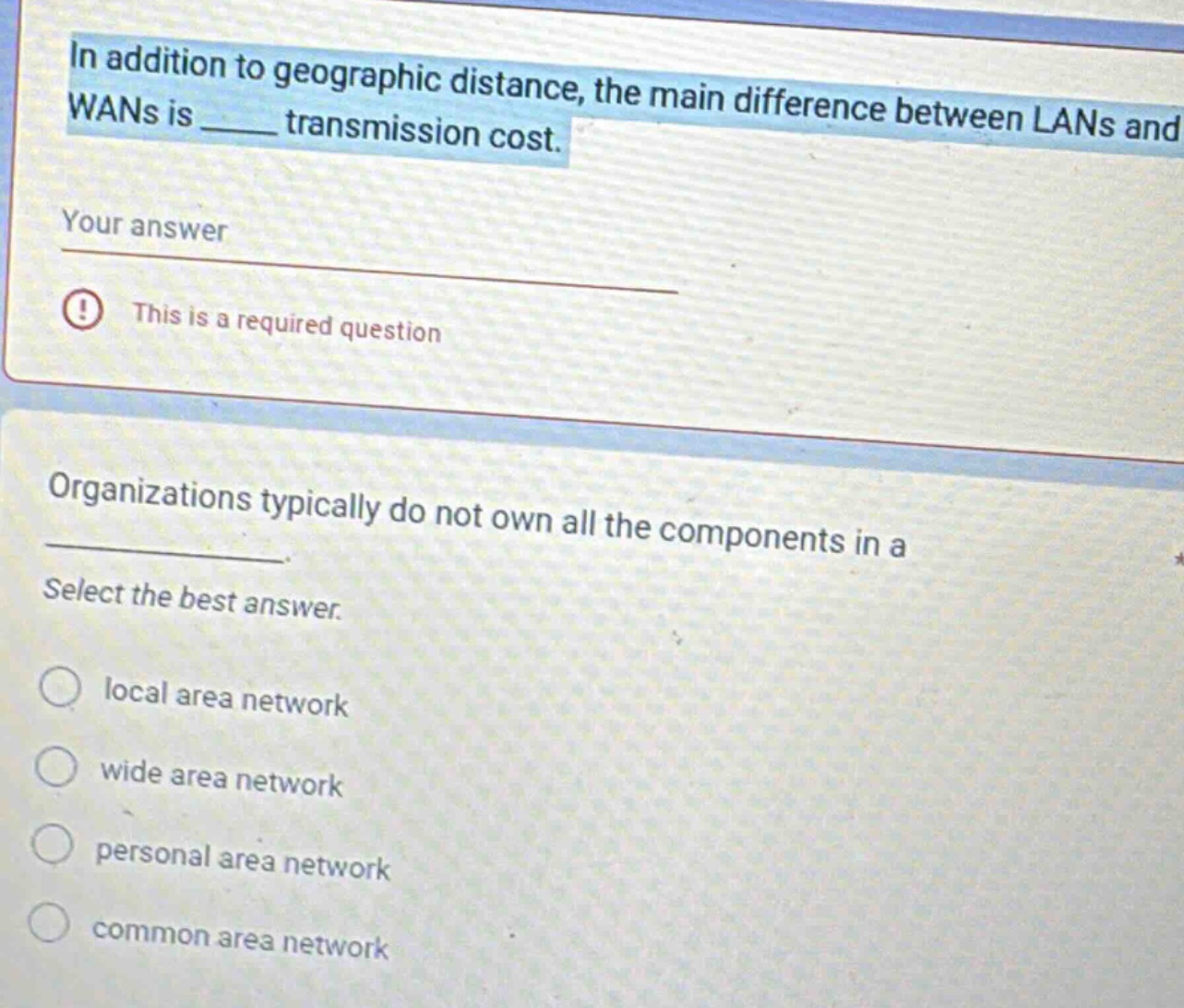
in addition to geographic distance, the main difference between lans and wans is ______ transmission cost.
your answer
❗ this is a required question
organizations typically do not own all the components in a ______.
select the best answer.
○ local area network
○ wide area network
○ personal area network
○ common area network
First Question (Fill - in - the - blank)
LAN (Local Area Network) and WAN (Wide Area Network) differ in transmission cost. WANs typically have higher transmission costs as they cover larger geographic areas and often use public or shared infrastructure. The main difference in transmission cost is that WANs have "higher" transmission cost compared to LANs (in the context of this fill - in - the - blank, the answer is about the nature of transmission cost difference, and the key is that WANs have higher transmission cost. So the blank should be filled with "higher" (or related terms, but based on networking knowledge, the main difference in transmission cost between LAN and WAN is that WAN has higher transmission cost).
- Local Area Network (LAN): Organizations usually own the components of a LAN as it is a network within a limited area (like an office building) and the organization can control and own the hardware, software, and cabling.
- Wide Area Network (WAN): WANs cover large geographic areas (like across cities or countries). They often use public networks (e.g., the Internet, leased lines from telecommunication companies). So organizations typically do not own all the components of a WAN.
- Personal Area Network (PAN): It is a network around an individual (e.g., connecting a smartphone to a wireless earphone), and the individual usually owns the components.
- Common Area Network: This is not a standard network type.

Snap & solve any problem in the app
Get step-by-step solutions on Sovi AI
Photo-based solutions with guided steps
Explore more problems and detailed explanations
higher