QUESTION IMAGE
Question
additional details were added for this assignment.
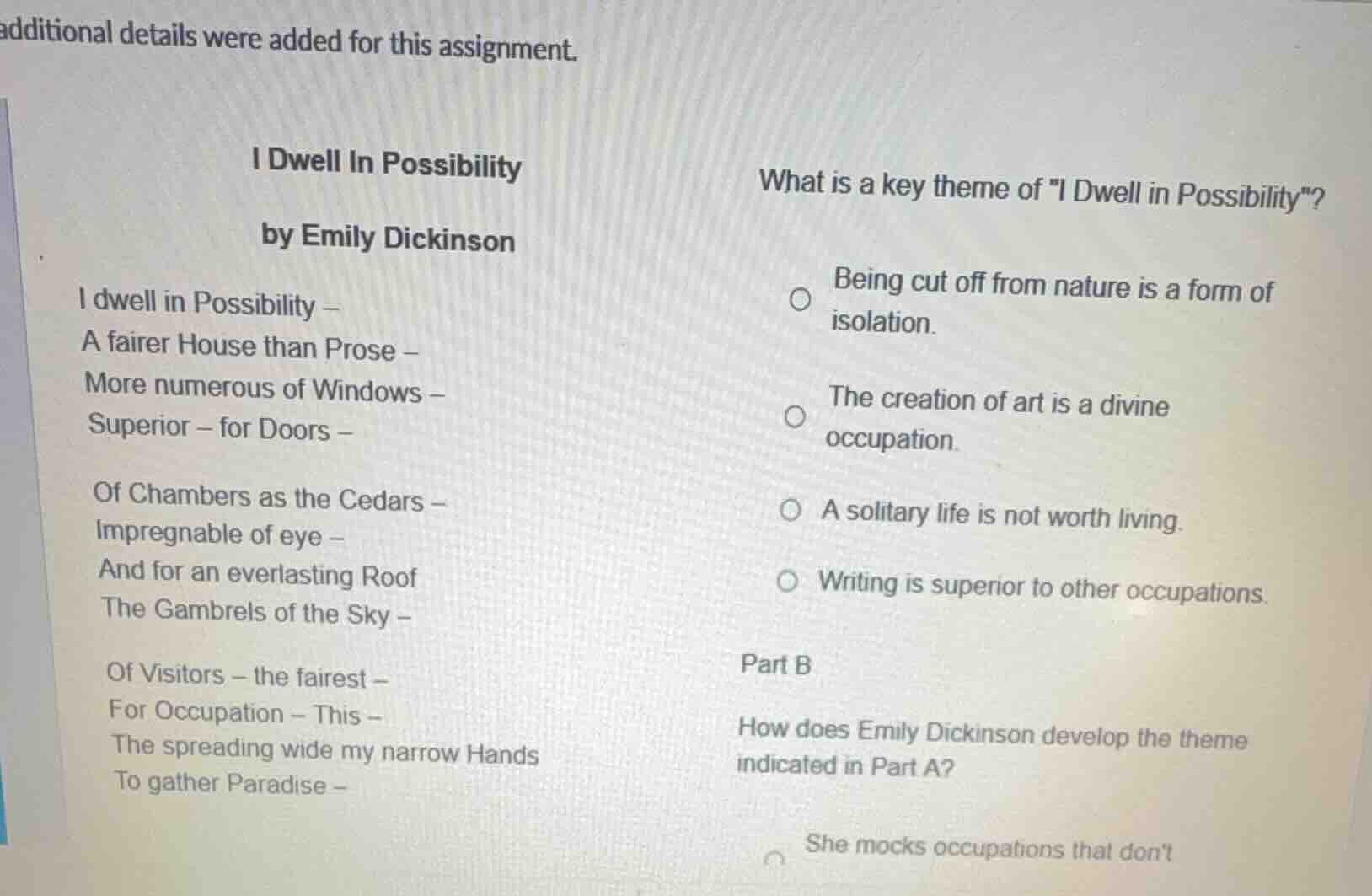
i dwell in possibility
by emily dickinson
i dwell in possibility –
a fairer house than prose –
more numerous of windows –
superior – for doors –
of chambers as the cedars –
impregnable of eye –
and for an everlasting roof
the gambrels of the sky –
of visitors – the fairest –
for occupation – this –
the spreading wide my narrow hands
to gather paradise –
what is a key theme of \i dwell in possibility\?
○ being cut off from nature is a form of isolation.
○ the creation of art is a divine occupation.
○ a solitary life is not worth living.
○ writing is superior to other occupations.
part b
how does emily dickinson develop the theme indicated in part a?
she mocks occupations that dont
For Part A: Emily Dickinson's poem frames poetry (the "House of Possibility") as superior to prose, framing creative writing as a transcendent, almost sacred act that connects to something infinite (like the sky/paradise). The other options do not align: the poem does not focus on nature isolation, rejects the idea a solitary life is worthless, and does not compare writing to all other occupations, only framing poetic creation as divine.
For Part B (note: only one partial option is visible, but based on the poem's structure): Dickinson uses an extended metaphor of poetry as a grand, endless house (with more windows/doors than prose, a sky as a roof) to elevate the act of writing as a way to "gather Paradise," framing it as a divine, expansive act. The visible partial option does not match the poem's reverent tone, as she does not mock other occupations.

Snap & solve any problem in the app
Get step-by-step solutions on Sovi AI
Photo-based solutions with guided steps
Explore more problems and detailed explanations
Part A: The creation of art is a divine occupation.
Part B: (Note: The provided options are incomplete. Based on the poem, Dickinson develops the theme through an extended metaphor of poetry as a vast, transcendent "House" that allows access to infinite, paradise-like possibility, framing artistic creation as a sacred, expansive act.)