QUESTION IMAGE
Question
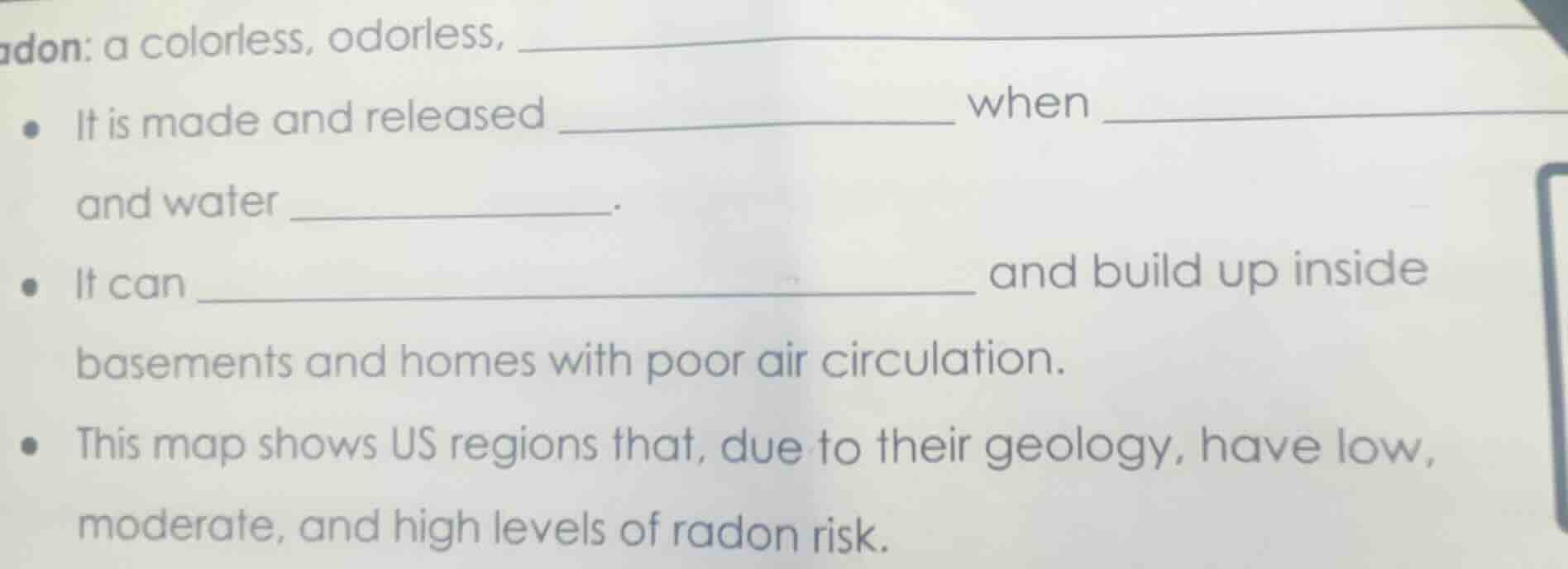
adon: a colorless, odorless, ______
- it is made and released ____ when ____
and water ______.
- it can ______ and build up inside
basements and homes with poor air circulation.
- this map shows us regions that, due to their geology, have low,
moderate, and high levels of radon risk.
To fill in the blanks about radon, we use knowledge from Environmental Sciences (a subfield of Natural Science) about radon's properties and behavior:
First blank (description of radon):
Radon is a colorless, odorless, radioactive gas (it’s a radioactive noble gas, naturally occurring).
Second and related blanks (formation/release):
It is made and released naturally when uranium (a radioactive element in soil/rock) and water interact (or “break down”/“decay”—uranium in soil, rock, or water decays, producing radon).
Third blank (movement):
It can seep into buildings (or “enter homes,” “permeate structures”) and build up inside basements and homes with poor air circulation (radon moves from soil/rock into enclosed spaces).
If you need specific phrasing or have more context, let me know! For example, the most precise scientific answers would be:
- First blank: radioactive gas
- Formation: naturally; uranium in soil, rock, or water; decay (or “break down”)
- Movement: seep into buildings (or “enter homes”)
(Note: The problem involves environmental science/geology concepts about radon, a radioactive gas from natural uranium decay, which accumulates in poorly ventilated spaces.)

Snap & solve any problem in the app
Get step-by-step solutions on Sovi AI
Photo-based solutions with guided steps
Explore more problems and detailed explanations
To fill in the blanks about radon, we use knowledge from Environmental Sciences (a subfield of Natural Science) about radon's properties and behavior:
First blank (description of radon):
Radon is a colorless, odorless, radioactive gas (it’s a radioactive noble gas, naturally occurring).
Second and related blanks (formation/release):
It is made and released naturally when uranium (a radioactive element in soil/rock) and water interact (or “break down”/“decay”—uranium in soil, rock, or water decays, producing radon).
Third blank (movement):
It can seep into buildings (or “enter homes,” “permeate structures”) and build up inside basements and homes with poor air circulation (radon moves from soil/rock into enclosed spaces).
If you need specific phrasing or have more context, let me know! For example, the most precise scientific answers would be:
- First blank: radioactive gas
- Formation: naturally; uranium in soil, rock, or water; decay (or “break down”)
- Movement: seep into buildings (or “enter homes”)
(Note: The problem involves environmental science/geology concepts about radon, a radioactive gas from natural uranium decay, which accumulates in poorly ventilated spaces.)