QUESTION IMAGE
Question
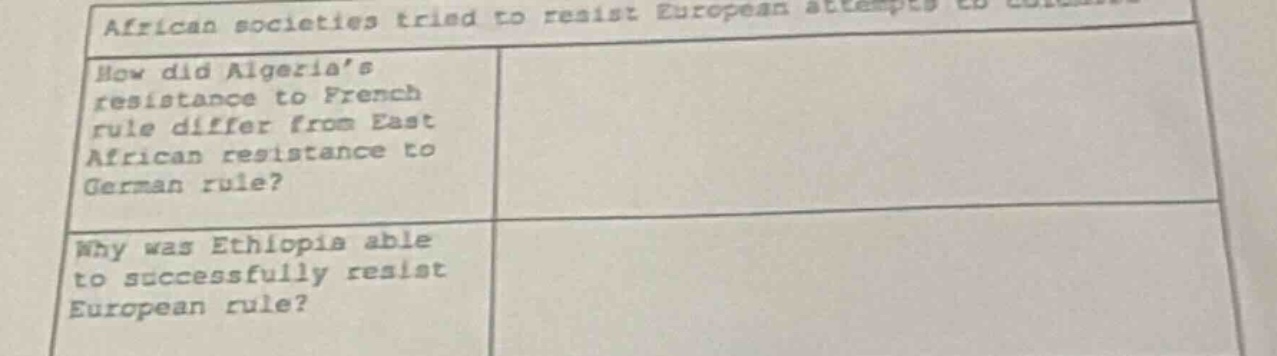
african societies tried to resist european attempts to how did algeria’s resistance to french rule differ from east african resistance to german rule? why was ethiopia able to successfully resist european rule?
Brief Explanations
- For the first question: Algeria's resistance was a long, sustained, large-scale guerrilla and conventional war (1830-1871) led by unified local leaders against full French colonial occupation that aimed to settle and assimilate Algeria. East African resistance to German rule (in places like Tanganyika) was more fragmented, smaller-scale, often localized uprisings (like the Maji Maji Rebellion 1905-1907) against extractive German economic policies, with less coordinated leadership, and was crushed more quickly.
- For the second question: Ethiopia maintained a centralized, unified state with a strong, well-armed modern military (equipped with European weapons) under Emperor Menelik II. It also used diplomatic maneuvering to exploit rivalries between European powers, and won a decisive military victory at the Battle of Adwa (1896) against Italian forces, which deterred further European conquest attempts.

Snap & solve any problem in the app
Get step-by-step solutions on Sovi AI
Photo-based solutions with guided steps
Explore more problems and detailed explanations
- Algeria waged a decades-long, coordinated, large-scale military and guerrilla resistance against French settler colonialism, while East African resistance to German rule was fragmented, localized, and focused on opposing extractive economic policies, with shorter, less coordinated uprisings that were suppressed rapidly.
- Ethiopia was able to resist European rule because it had a centralized, unified government, a modernized, well-armed military, skillful diplomatic use of European rivalries, and achieved a decisive military victory over Italian forces at the 1896 Battle of Adwa.