QUESTION IMAGE
Question
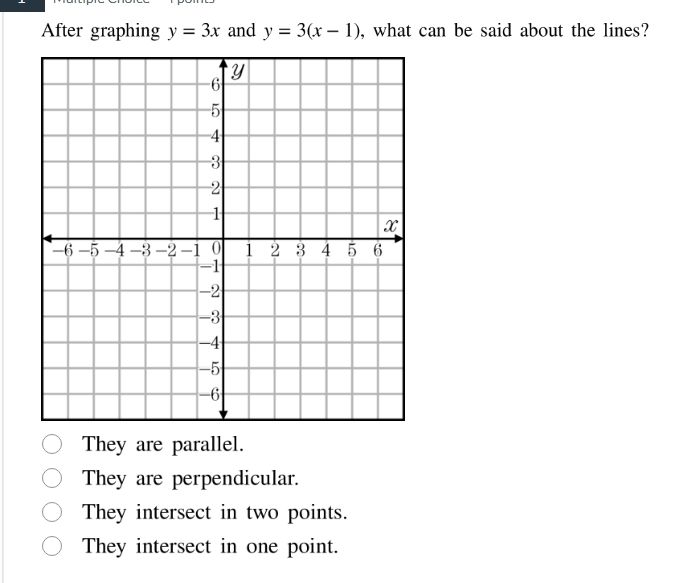
after graphing $y = 3x$ and $y = 3(x - 1)$, what can be said about the lines?
they are parallel.
they are perpendicular.
they intersect in two points.
they intersect in one point.
Step1: Recall slope-intercept form
The slope - intercept form of a line is \(y = mx + b\), where \(m\) is the slope and \(b\) is the y - intercept.
For the line \(y = 3x\), comparing with \(y=mx + b\), we have \(m_1=3\) and \(b_1 = 0\).
Step2: Simplify the second equation
For the line \(y=3(x - 1)\), we expand it: \(y=3x-3\). Comparing with \(y = mx + b\), we have \(m_2 = 3\) and \(b_2=-3\).
Step3: Analyze the slopes and y - intercepts
Two lines are parallel if their slopes are equal and their y - intercepts are different. Here, \(m_1=m_2 = 3\) and \(b_1
eq b_2\) (since \(0
eq - 3\)).
Two lines are perpendicular if the product of their slopes is \(- 1\). Since \(m_1\times m_2=3\times3 = 9
eq - 1\), they are not perpendicular.
A system of two linear equations in two variables (non - parallel lines) intersects at one point, and parallel lines (with different y - intercepts) do not intersect. Since these two lines are parallel, they do not intersect at all, so they can't intersect at one or two points.

Snap & solve any problem in the app
Get step-by-step solutions on Sovi AI
Photo-based solutions with guided steps
Explore more problems and detailed explanations
They are parallel.