QUESTION IMAGE
Question
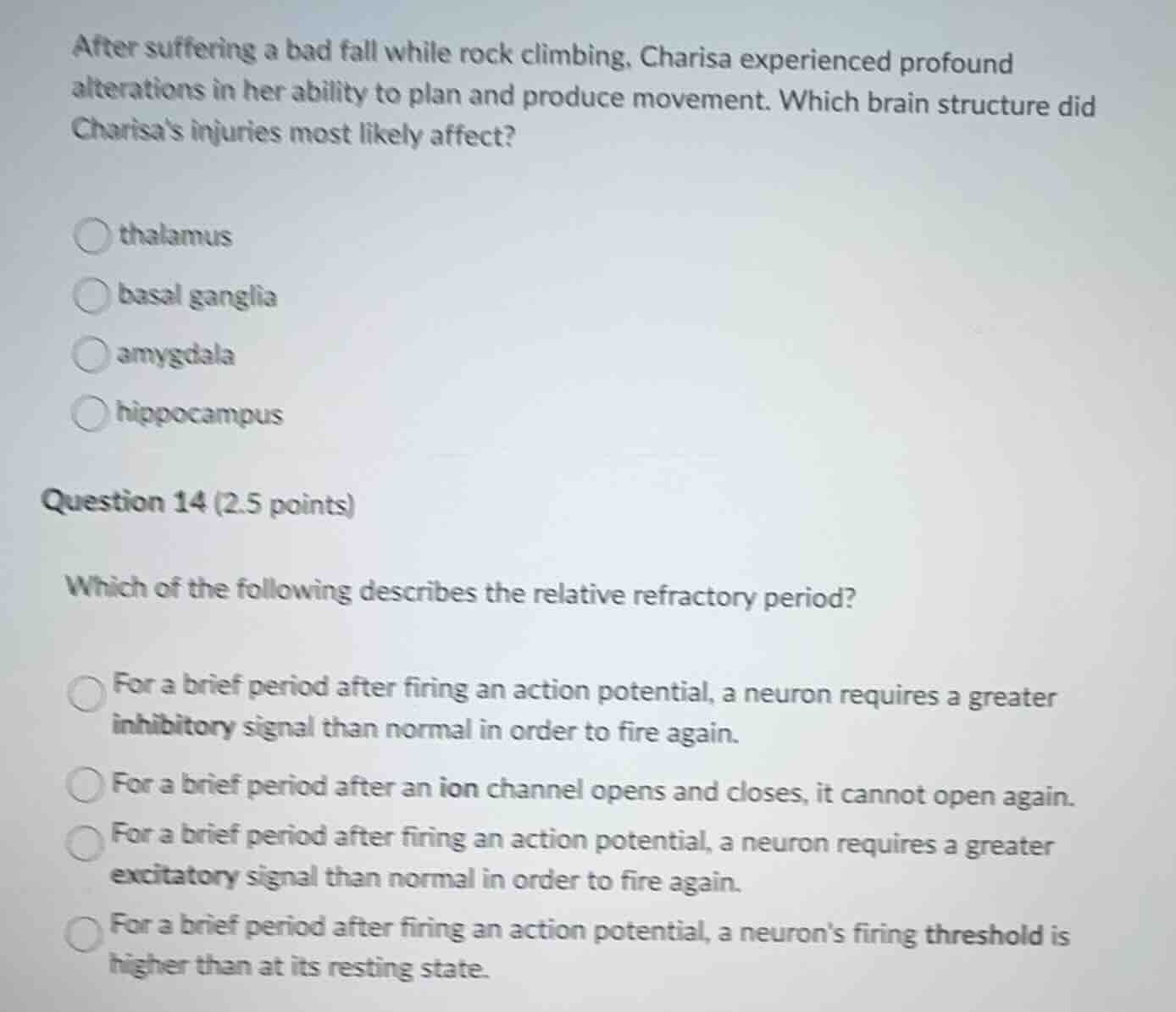
after suffering a bad fall while rock climbing, charisa experienced profound alterations in her ability to plan and produce movement. which brain structure did charisa’s injuries most likely affect?
thalamus
basal ganglia
amygdala
hippocampus
question 14 (2.5 points)
which of the following describes the relative refractory period?
for a brief period after firing an action potential, a neuron requires a greater inhibitory signal than normal in order to fire again.
for a brief period after an ion channel opens and closes, it cannot open again.
for a brief period after firing an action potential, a neuron requires a greater excitatory signal than normal in order to fire again.
for a brief period after firing an action potential, a neuron’s firing threshold is higher than at its resting state.
First Question (Brain Structure Affecting Movement)
- Thalamus: Primarily a sensory relay, not movement planning/production.
- Basal ganglia: Involved in movement planning, control, and production.
- Amygdala: Related to emotions/fear, not movement.
- Hippocampus: Involved in memory, not movement.
So the basal ganglia is the correct choice as it’s linked to movement planning and execution.
- Option 1: Relative refractory period involves excitatory, not inhibitory, signals. Eliminate.
- Option 2: Describes absolute refractory period (ion channels can’t open). Eliminate.
- Option 3: During relative refractory period, a neuron needs a stronger excitatory signal to fire again (since some channels are reset, but not all). Correct.
- Option 4: The firing threshold isn’t “higher” in the way this implies; the key is needing a stronger excitatory signal, which aligns with Option 3.

Snap & solve any problem in the app
Get step-by-step solutions on Sovi AI
Photo-based solutions with guided steps
Explore more problems and detailed explanations
B. basal ganglia