QUESTION IMAGE
Question
aint i a woman?
by sojourner truth
delivered 1851
womens convention, akron, ohio
well, children, where there is so much racket there must be something out of kilter. i think that twixt the negroes of the south and the women at the north, all talking about rights, the white men will be in a fix pretty soon. but whats all this here talking about?
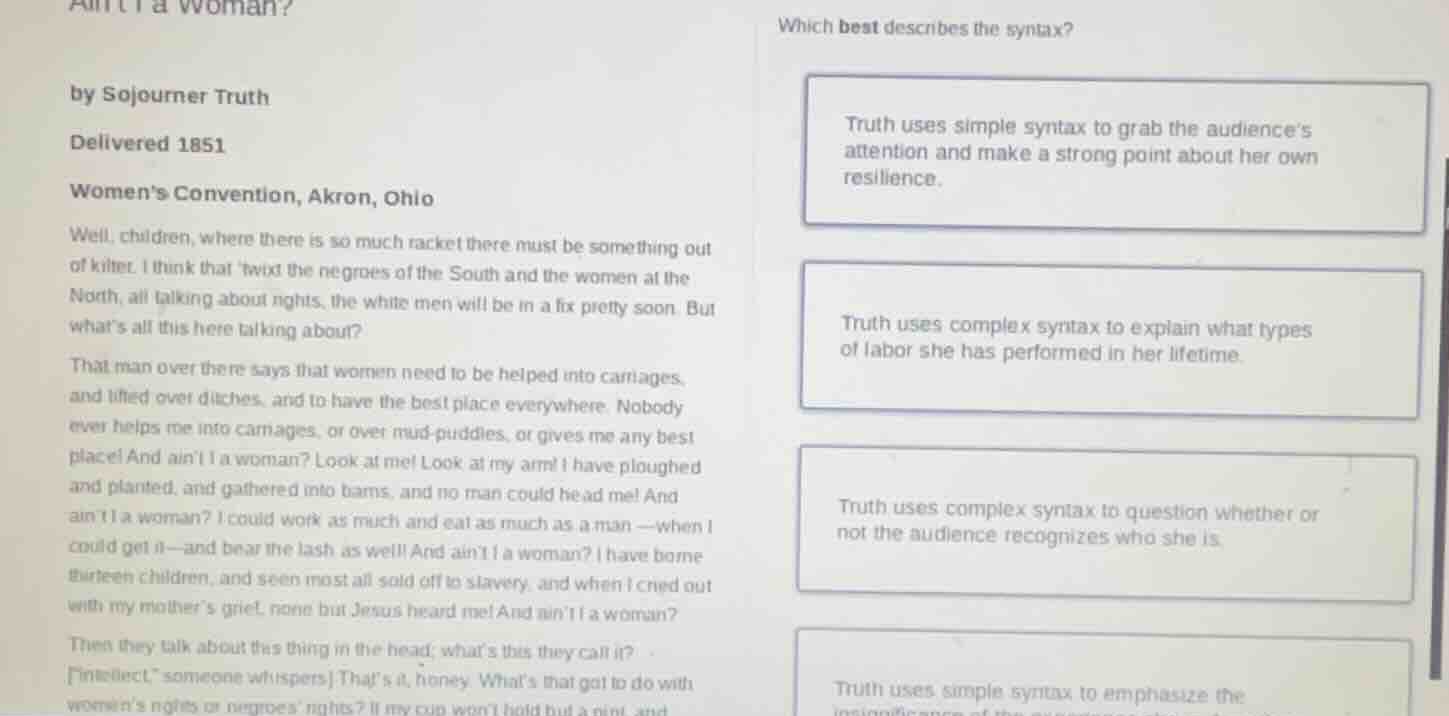
that man over there says that women need to be helped into carriages, and lifted over ditches, and to have the best place everywhere. nobody ever helps me into carriages, or over mud - puddles, or gives me any best place! and aint i a woman? look at me! look at my arm! i have ploughed and planted, and gathered into barns, and no man could head me! and aint i a woman? i could work as much and eat as much as a man — when i could get it — and bear the lash as well! and aint i a woman? i have borne thirteen children, and seen most all sold off to slavery, and when i cried out with my mothers grief, none but jesus heard me! and aint i a woman?
then they talk about this thing in the head; whats this they call it? “intellect,” someone whispers. thats it, honey. whats that got to do with womens rights or negroes rights? if my cup wont hold but a pint, and
which best describes the syntax?
truth uses simple syntax to grab the audiences attention and make a strong point about her own resilience.
truth uses complex syntax to explain what types of labor she has performed in her lifetime.
truth uses complex syntax to question whether or not the audience recognizes who she is.
truth uses simple syntax to emphasize the
Sojourner Truth's speech uses short, repetitive, simple sentence structures (like the refrain "And ain't I a woman?") and straightforward phrasing. This simple syntax is designed to command the audience's attention and highlight her resilience and the injustice of her experience, rather than complex, convoluted sentences. The first option aligns with this analysis; the other options incorrectly claim complex syntax is used, or misstate the purpose of the syntax.

Snap & solve any problem in the app
Get step-by-step solutions on Sovi AI
Photo-based solutions with guided steps
Explore more problems and detailed explanations
Truth uses simple syntax to grab the audience's attention and make a strong point about her own resilience.