QUESTION IMAGE
Question
an aircraft travels with the wind for 120 miles in 0.75 of an hour. the return trip is flown against the wind and takes exactly 1 hour.\
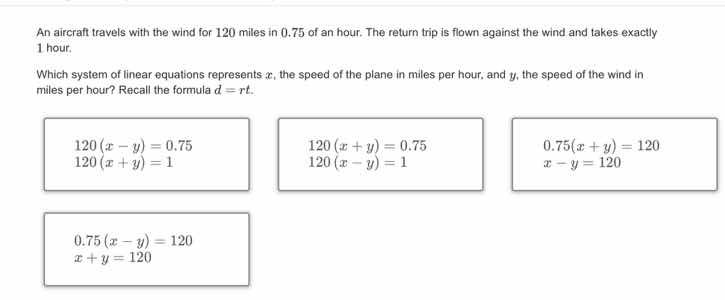
which system of linear equations represents ( x ), the speed of the plane in miles per hour, and ( y ), the speed of the wind in miles per hour? recall the formula ( d = rt ).\
\
\\( \
\\)\
\\( \
\\)\
\\( \
\\)\
\\( \
\\)
Step1: Analyze with - wind trip
When the aircraft travels with the wind, its effective speed is the sum of the plane's speed (\(x\)) and the wind's speed (\(y\)), so the speed is \(x + y\). The distance \(d = 120\) miles and time \(t = 0.75\) hours. Using the formula \(d=rt\), we substitute the values: \(120 = 0.75(x + y)\), which can be rewritten as \(0.75(x + y)=120\).
Step2: Analyze against - wind trip
When the aircraft travels against the wind, its effective speed is the difference between the plane's speed (\(x\)) and the wind's speed (\(y\)), so the speed is \(x - y\). The distance \(d = 120\) miles and time \(t = 1\) hour. Using the formula \(d = rt\), we substitute the values: \(120=1\times(x - y)\), which is \(x - y = 120\)? Wait, no, wait. Wait, the time for against wind is 1 hour, distance is 120, so \(d=rt\) gives \(120=(x - y)\times1\), so \(x - y=120\)? Wait, no, no, I made a mistake. Wait, the third option is \(0.75(x + y)=120\) and \(x - y = 120\)? Wait, no, let's re - check.
Wait, when going with the wind: speed is \(x + y\), time is \(0.75\) hours, distance is \(120\) miles. So \(d=rt\) implies \(120=(x + y)\times0.75\), which is \(0.75(x + y)=120\).
When going against the wind: speed is \(x - y\), time is \(1\) hour, distance is \(120\) miles. So \(d = rt\) implies \(120=(x - y)\times1\), which is \(x - y=120\)? Wait, no, that can't be. Wait, no, the third option is \(0.75(x + y)=120\) and \(x - y = 120\)? Wait, no, let's check the options again.
Wait, the third option is:
\(0.75(x + y)=120\)
\(x - y = 120\)
Wait, no, when against the wind, time is 1 hour, distance is 120, so \(r=\frac{d}{t}=\frac{120}{1}=120\), and \(r=x - y\), so \(x - y = 120\). And with the wind, \(r=x + y\), \(t = 0.75\), \(d = 120\), so \(x + y=\frac{120}{0.75}=160\), and \(0.75(x + y)=120\) is correct. So the third option is the correct system.

Snap & solve any problem in the app
Get step-by-step solutions on Sovi AI
Photo-based solutions with guided steps
Explore more problems and detailed explanations
\(0.75(x + y)=120\)
\(x - y = 120\) (the third option among the given boxes)