QUESTION IMAGE
Question
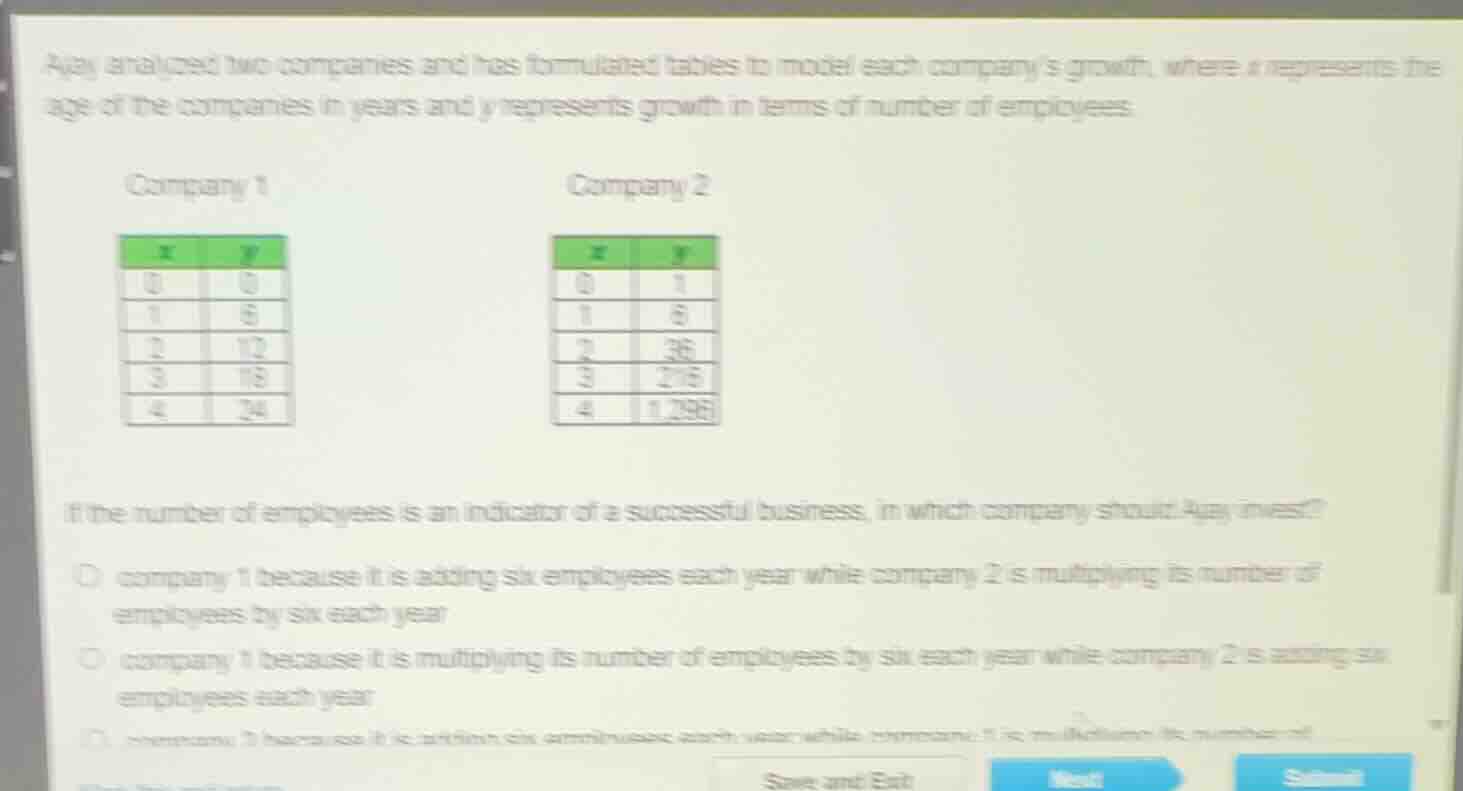
ajay analyzed two companies and has formulated tables to model each company’s growth, where ( x ) represents the age of the companies in years and ( y ) represents growth in terms of number of employees:
company 1
| ( x ) | ( y ) |
|---|---|
| 1 | 6 |
| 2 | 12 |
| 3 | 18 |
| 4 | 24 |
company 2
| ( x ) | ( y ) |
|---|---|
| 1 | 6 |
| 2 | 36 |
| 3 | 216 |
| 4 | 1296 |
if the number of employees is an indicator of a successful business, in which company should ajay invest?
- company 1 because it is adding six employees each year while company 2 is multiplying its number of employees by six each year
- company 1 because it is multiplying its number of employees by six each year while company 2 is adding six employees each year
- (third option partially visible) ...
To determine which company to invest in, we analyze the growth patterns:
- Company 1: The \( y \)-values (employees) are \( 0, 6, 12, 18, 24 \). The difference between consecutive \( y \)-values is \( 6 - 0 = 6 \), \( 12 - 6 = 6 \), \( 18 - 12 = 6 \), \( 24 - 18 = 6 \). So, it has a linear growth (arithmetic sequence) with a common difference of 6 (adding 6 employees each year).
- Company 2: The \( y \)-values are \( 1, 6, 36, 216, 1296 \). The ratio between consecutive \( y \)-values is \( \frac{6}{1} = 6 \), \( \frac{36}{6} = 6 \), \( \frac{216}{36} = 6 \), \( \frac{1296}{216} = 6 \). So, it has an exponential growth (geometric sequence) with a common ratio of 6 (multiplying the number of employees by 6 each year).
Exponential growth (Company 2) outpaces linear growth (Company 1) over time. For example, at \( x = 4 \), Company 1 has 24 employees, while Company 2 has 1296 employees. So, Company 2’s growth is much faster. Wait, but let's re - check the options. Wait, the first option says "company 1 because it is adding six employees each year while company 2 is multiplying its number of employees by six each year" – no, that's wrong. Wait, no, wait, maybe I misread. Wait, no, the correct reasoning: Wait, no, the options – wait, the third option (partially visible) likely says "company 2 because it is multiplying its number of employees by six each year while company 1 is adding six employees each year". Wait, the first option is incorrect in the conclusion. Wait, let's re - evaluate.
Wait, the problem is to choose the correct option. Let's analyze each option:
- First option: "company 1 because it is adding six employees each year while company 2 is multiplying its number of employees by six each year" – the conclusion is wrong because multiplying by 6 (exponential growth) is much faster than adding 6 (linear growth). So this option's conclusion is wrong.
- Second option: "company 1 because it is multiplying its number of employees by six each year while company 2 is adding six employees each year" – this is factually wrong. Company 1 is adding, Company 2 is multiplying.
- The third option (partially visible) should be "company 2 because it is multiplying its number of employees by six each year while company 1 is adding six employees each year" – this is correct. But since the user's options are as given, and the first option's description of the growth is correct (Company 1: adding 6, Company 2: multiplying by 6), but the conclusion is wrong. Wait, no, maybe there's a typo. Wait, no, let's re - check the numbers.
Wait, Company 1: \( x = 0, y = 0 \); \( x = 1, y = 6 \) (0 + 6); \( x = 2, y = 12 \) (6 + 6); etc. So linear, adding 6.
Company 2: \( x = 0, y = 1 \); \( x = 1, y = 6 \) (1×6); \( x = 2, y = 36 \) (6×6); etc. So exponential, multiplying by 6.
Now, over time, exponential growth (Company 2) will have more employees. So the correct option should be the one that says Company 2 is better because it's multiplying by 6 while Company 1 is adding by 6. But in the given options, the first option has the correct description of the growth patterns (Company 1: adding 6, Company 2: multiplying by 6) but the wrong conclusion. Wait, no, maybe the user's options are mis - presented. Wait, the first option's conclusion is wrong, but the description of the growth is correct. Wait, no, perhaps I made a mistake. Wait, no, the key is: the correct option (the one with the right growth pattern description and correct conclusion) – but based on the visible options, the first option's description of the growth is correct (Compan…

Snap & solve any problem in the app
Get step-by-step solutions on Sovi AI
Photo-based solutions with guided steps
Explore more problems and detailed explanations
The correct option is the one that states: "company 2 because it is multiplying its number of employees by six each year while company 1 is adding six employees each year" (the third, partially visible option). If we assume the options are labeled and the correct one is, for example, C (if labeled C), but based on the description, the option with the correct growth pattern description (Company 1: adding 6, Company 2: multiplying by 6) and the correct conclusion (invest in Company 2) is the correct answer. Since the first option has the correct growth description but wrong conclusion, and the second has wrong growth description, the correct option is the third (partially shown) one. If we have to choose from the visible options, and assuming the third option is "company 2 because it is multiplying its number of employees by six each year while company 1 is adding six employees each year", then that's the answer.