QUESTION IMAGE
Question
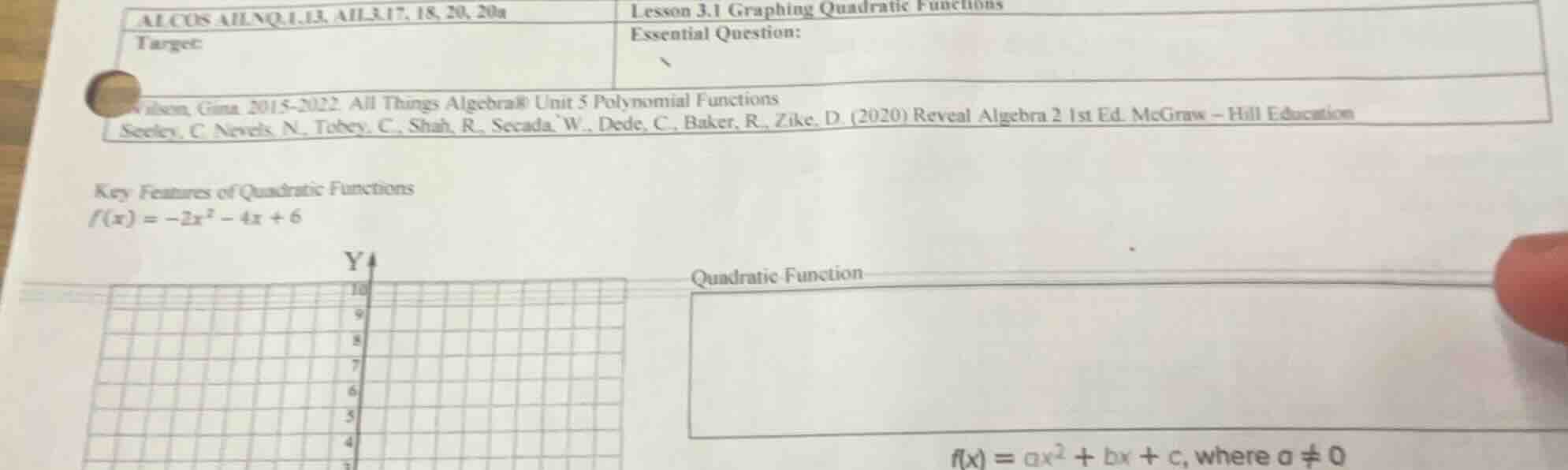
alcos ailnq.1,13, ail3.17, 18, 20, 20a lesson 3.1 graphing quadratic functions target essential question: wilson, gina. 2015 - 2022. all things algebra® unit 5 polynomial functions seeley, c, nevels, n., tobey, c., shah, r., secada, w., dede, c., baker, r., zike, d. (2020) reveal algebra 2 1st ed. mcgraw - hill education key features of quadratic functions f(x) = -2x² - 4x + 6 quadratic function f(x) = ax² + bx + c, where a ≠ 0
To analyze the key features of the quadratic function \( f(x) = -2x^2 - 4x + 6 \), we can follow these steps:
Step 1: Determine the direction of the parabola
The coefficient of \( x^2 \) is \( a = -2 \). Since \( a < 0 \), the parabola opens downward.
Step 2: Find the vertex
The \( x \)-coordinate of the vertex of a quadratic function \( f(x) = ax^2 + bx + c \) is given by \( x = -\frac{b}{2a} \).
For \( f(x) = -2x^2 - 4x + 6 \), \( a = -2 \) and \( b = -4 \).
\[
x = -\frac{-4}{2(-2)} = -\frac{4}{-4} = -1
\]
To find the \( y \)-coordinate, substitute \( x = -1 \) into the function:
\[
f(-1) = -2(-1)^2 - 4(-1) + 6 = -2(1) + 4 + 6 = -2 + 4 + 6 = 8
\]
Thus, the vertex is at \( (-1, 8) \).
Step 3: Find the \( y \)-intercept
The \( y \)-intercept occurs where \( x = 0 \). Substitute \( x = 0 \) into the function:
\[
f(0) = -2(0)^2 - 4(0) + 6 = 6
\]
So, the \( y \)-intercept is \( (0, 6) \).
Step 4: Find the \( x \)-intercepts (roots)
Set \( f(x) = 0 \) and solve for \( x \):
\[
-2x^2 - 4x + 6 = 0
\]
Divide both sides by \( -2 \) to simplify:
\[
x^2 + 2x - 3 = 0
\]
Factor the quadratic:
\[
(x + 3)(x - 1) = 0
\]
Set each factor equal to zero:
\( x + 3 = 0 \) or \( x - 1 = 0 \)
Thus, \( x = -3 \) or \( x = 1 \).
The \( x \)-intercepts are \( (-3, 0) \) and \( (1, 0) \).
Step 5: Analyze the axis of symmetry
The axis of symmetry is the vertical line passing through the vertex. For this function, the axis of symmetry is \( x = -1 \).
Final Key Features:
- Direction: Opens downward.
- Vertex: \( (-1, 8) \) (maximum point, since it opens downward).
- \( y \)-intercept: \( (0, 6) \).
- \( x \)-intercepts: \( (-3, 0) \) and \( (1, 0) \).
- Axis of Symmetry: \( x = -1 \).
To graph the function:
- Plot the vertex \( (-1, 8) \).
- Plot the \( y \)-intercept \( (0, 6) \) and its mirror image across the axis of symmetry \( x = -1 \), which is \( (-2, 6) \).
- Plot the \( x \)-intercepts \( (-3, 0) \) and \( (1, 0) \).
- Draw a smooth, downward-opening parabola through these points.

Snap & solve any problem in the app
Get step-by-step solutions on Sovi AI
Photo-based solutions with guided steps
Explore more problems and detailed explanations
To analyze the key features of the quadratic function \( f(x) = -2x^2 - 4x + 6 \), we can follow these steps:
Step 1: Determine the direction of the parabola
The coefficient of \( x^2 \) is \( a = -2 \). Since \( a < 0 \), the parabola opens downward.
Step 2: Find the vertex
The \( x \)-coordinate of the vertex of a quadratic function \( f(x) = ax^2 + bx + c \) is given by \( x = -\frac{b}{2a} \).
For \( f(x) = -2x^2 - 4x + 6 \), \( a = -2 \) and \( b = -4 \).
\[
x = -\frac{-4}{2(-2)} = -\frac{4}{-4} = -1
\]
To find the \( y \)-coordinate, substitute \( x = -1 \) into the function:
\[
f(-1) = -2(-1)^2 - 4(-1) + 6 = -2(1) + 4 + 6 = -2 + 4 + 6 = 8
\]
Thus, the vertex is at \( (-1, 8) \).
Step 3: Find the \( y \)-intercept
The \( y \)-intercept occurs where \( x = 0 \). Substitute \( x = 0 \) into the function:
\[
f(0) = -2(0)^2 - 4(0) + 6 = 6
\]
So, the \( y \)-intercept is \( (0, 6) \).
Step 4: Find the \( x \)-intercepts (roots)
Set \( f(x) = 0 \) and solve for \( x \):
\[
-2x^2 - 4x + 6 = 0
\]
Divide both sides by \( -2 \) to simplify:
\[
x^2 + 2x - 3 = 0
\]
Factor the quadratic:
\[
(x + 3)(x - 1) = 0
\]
Set each factor equal to zero:
\( x + 3 = 0 \) or \( x - 1 = 0 \)
Thus, \( x = -3 \) or \( x = 1 \).
The \( x \)-intercepts are \( (-3, 0) \) and \( (1, 0) \).
Step 5: Analyze the axis of symmetry
The axis of symmetry is the vertical line passing through the vertex. For this function, the axis of symmetry is \( x = -1 \).
Final Key Features:
- Direction: Opens downward.
- Vertex: \( (-1, 8) \) (maximum point, since it opens downward).
- \( y \)-intercept: \( (0, 6) \).
- \( x \)-intercepts: \( (-3, 0) \) and \( (1, 0) \).
- Axis of Symmetry: \( x = -1 \).
To graph the function:
- Plot the vertex \( (-1, 8) \).
- Plot the \( y \)-intercept \( (0, 6) \) and its mirror image across the axis of symmetry \( x = -1 \), which is \( (-2, 6) \).
- Plot the \( x \)-intercepts \( (-3, 0) \) and \( (1, 0) \).
- Draw a smooth, downward-opening parabola through these points.