QUESTION IMAGE
Question
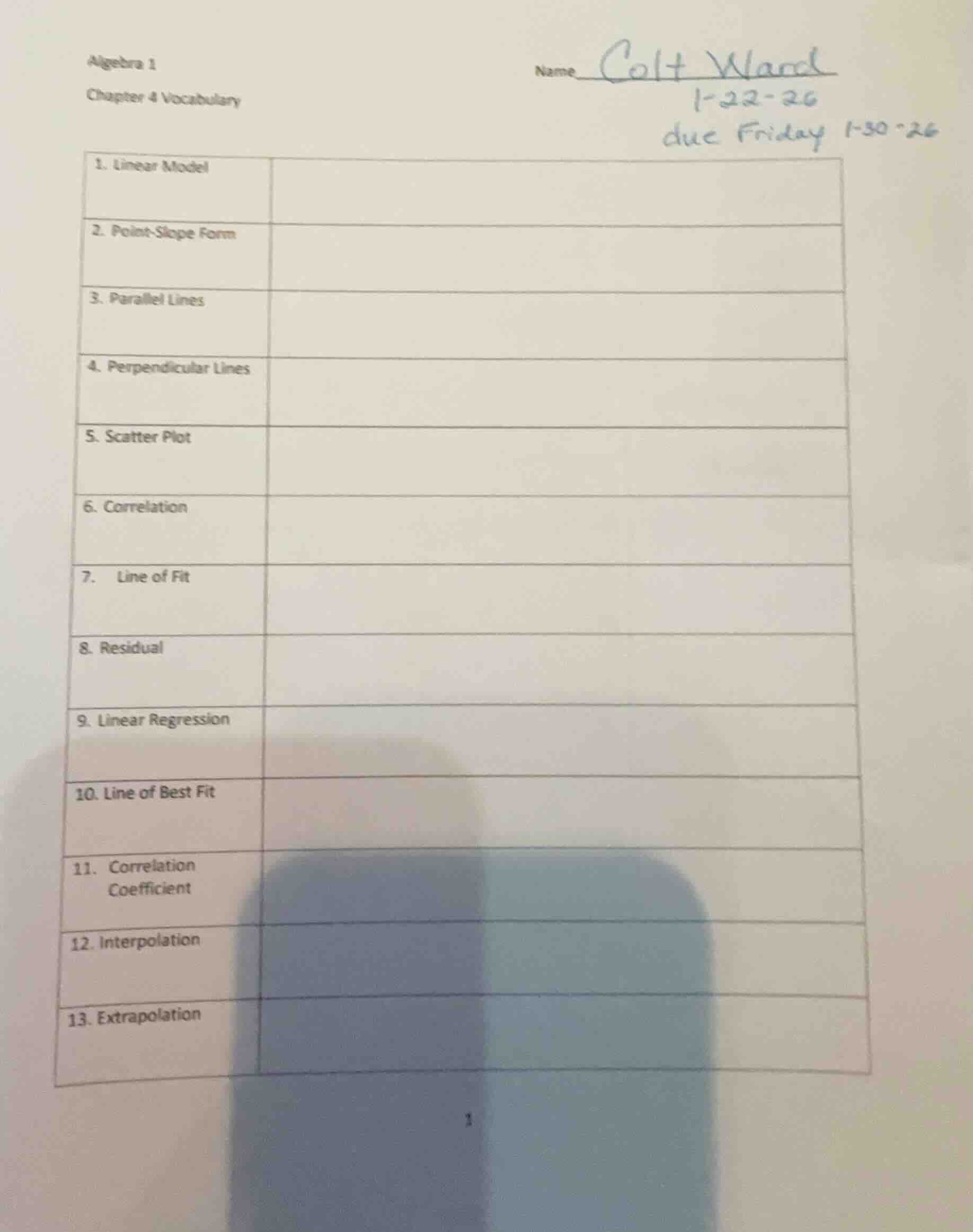
algebra 1
chapter 4 vocabulary
name colt ward
1-22-26
due friday 1-30-26
- linear model
- point - slope form
- parallel lines
- perpendicular lines
- scatter plot
- correlation
- line of fit
- residual
- linear regression
- line of best fit
- correlation coefficient
- interpolation
- extrapolation
Brief Explanations
Definitions for each Algebra 1 vocabulary term, tailored to introductory level:
- A mathematical representation of a linear relationship between variables.
- A linear equation format using a point and slope.
- Lines that never intersect, with equal slopes.
- Lines intersecting at a right angle, slopes are negative reciprocals.
- A graph plotting paired data points to show trends.
- A measure of the relationship between two variables.
- A line approximating the trend in a scatter plot.
- The difference between observed and predicted values.
- A method to find the best-fitting linear model for data.
- The line that most closely fits all data points in a set.
- A numerical value (-1 to 1) measuring correlation strength.
- Estimating values within the given data range.
- Estimating values outside the given data range.

Snap & solve any problem in the app
Get step-by-step solutions on Sovi AI
Photo-based solutions with guided steps
Explore more problems and detailed explanations
- Linear Model: A linear equation ($y=mx+b$ or similar) that describes a straight-line relationship between two variables, used to predict or analyze data.
- Point-Slope Form: A linear equation written as $y - y_1 = m(x - x_1)$, where $m$ is the slope and $(x_1,y_1)$ is a point on the line.
- Parallel Lines: Two or more lines in the same plane that never intersect; they have identical slopes ($m_1 = m_2$) and different y-intercepts.
- Perpendicular Lines: Two lines that intersect at a 90° (right) angle; their slopes are negative reciprocals, meaning $m_1 = -\frac{1}{m_2}$ (and $m_1 \times m_2 = -1$).
- Scatter Plot: A graph that uses dots to represent paired numerical data points, showing the relationship (if any) between two variables.
- Correlation: A measure of how strongly two variables are related and the direction of that relationship (positive, negative, or no correlation).
- Line of Fit: A straight line drawn on a scatter plot that approximates the general trend of the data points, used to make predictions.
- Residual: The vertical distance between an observed data point and the corresponding predicted value from a line of fit, calculated as $\text{Residual} = \text{Observed Value} - \text{Predicted Value}$.
- Linear Regression: A statistical method used to calculate the equation of the line of best fit for a set of data, minimizing the total of squared residuals.
- Line of Best Fit: The line that most accurately represents the trend of a scatter plot, calculated via linear regression to minimize the overall distance to all data points.
- Correlation Coefficient: A numerical value (denoted $r$) ranging from -1 to 1 that quantifies the strength and direction of the linear relationship between two variables. $r=1$ is a perfect positive correlation, $r=-1$ is a perfect negative correlation, and $r=0$ means no linear correlation.
- Interpolation: The process of estimating a value between two known data points using a line of fit or regression model.
- Extrapolation: The process of estimating a value that falls outside the range of the known data points using a line of fit or regression model.