QUESTION IMAGE
Question
algebra extend patterns simplify expressions equations & inequalities coordinate graphing *functions and matrices
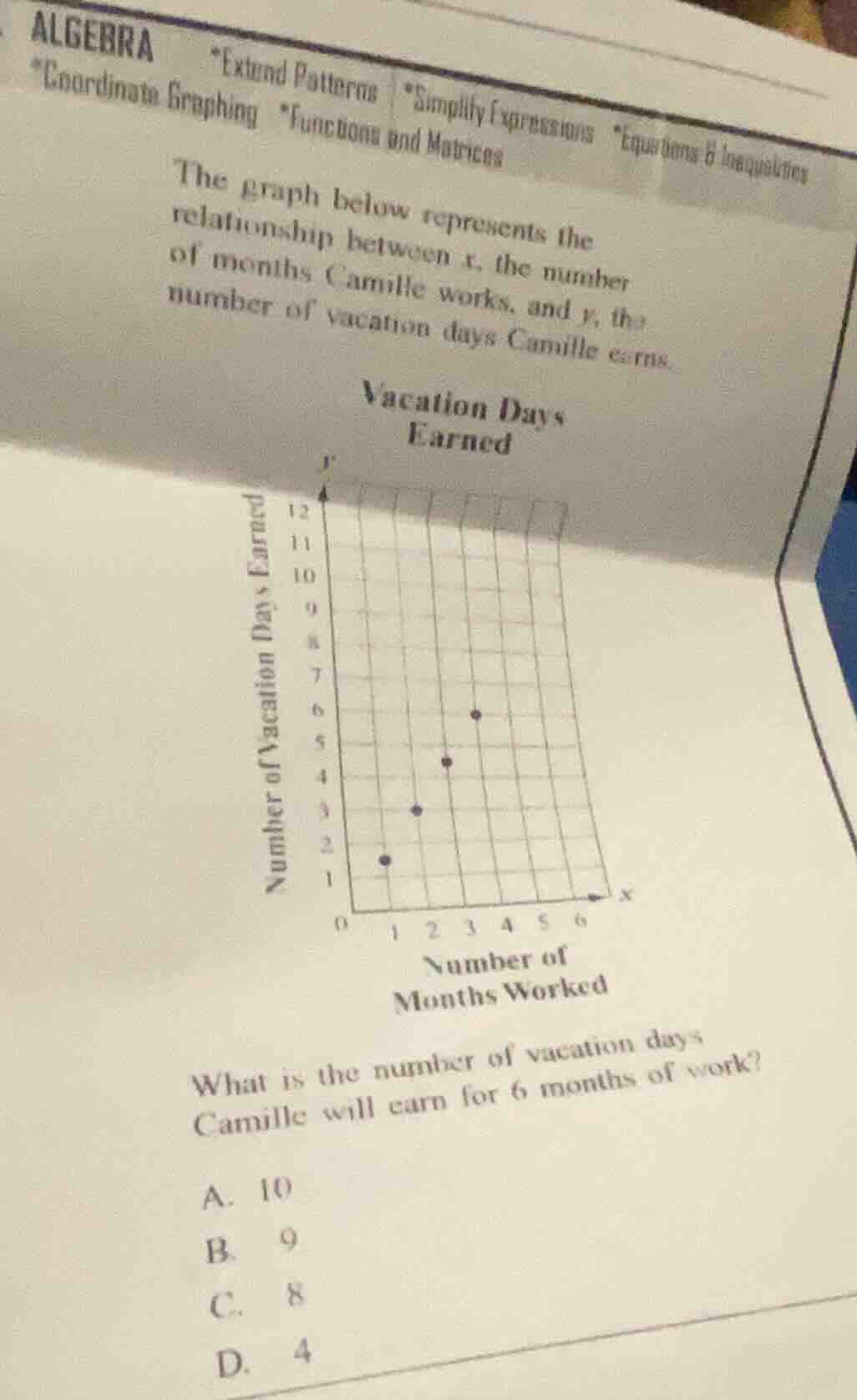
the graph below represents the relationship between x, the number of months camille works, and y, the number of vacation days camille earns.
graph titled vacation days earned with x - axis number of months worked (0 - 6) and y - axis number of vacation days earned (0 - 12), with points plotted
what is the number of vacation days camille will earn for 6 months of work?
a. 10
b. 9
c. 8
d. 4
Step1: Identify the pattern
From the graph, when \( x = 1 \), \( y = 1.5 \)? Wait, no, looking at the points: when \( x = 1 \), \( y \approx 1.5 \)? Wait, no, the points seem to be at \( (1, 1.5) \)? Wait, no, the grid: let's check the coordinates. Let's list the points: at \( x = 1 \), \( y = 1.5 \)? Wait, no, maybe the points are \( (1, 1.5) \), \( (2, 3) \), \( (3, 4.5) \), \( (4, 6) \). Wait, no, looking at the graph, the first point is at \( x = 1 \), \( y = 1.5 \)? Wait, no, maybe the slope. Let's calculate the slope between two points. Let's take \( (2, 3) \) and \( (4, 6) \). The slope \( m=\frac{6 - 3}{4 - 2}=\frac{3}{2}=1.5 \). So the equation is \( y = 1.5x \). Now, for \( x = 6 \), \( y=1.5\times6 = 9 \).
Step2: Verify with other points
Check \( x = 1 \): \( y = 1.5\times1 = 1.5 \), which matches the first point (around \( y = 1.5 \)). \( x = 2 \): \( y = 3 \), which matches. \( x = 3 \): \( y = 4.5 \), but the point is at \( y = 4.5 \)? Wait, the graph shows at \( x = 3 \), \( y \) is 4.5? Wait, the options are 10,9,8,4. Wait, maybe my initial point reading was wrong. Wait, let's re - examine the graph. The points: at \( x = 1 \), \( y = 1.5 \)? No, maybe the points are \( (1, 1.5) \) is not, maybe the first point is \( (1, 1.5) \), second \( (2, 3) \), third \( (3, 4.5) \), fourth \( (4, 6) \). So the pattern is linear, with slope \( 1.5 \). So for \( x = 6 \), \( y=1.5\times6 = 9 \).

Snap & solve any problem in the app
Get step-by-step solutions on Sovi AI
Photo-based solutions with guided steps
Explore more problems and detailed explanations
B. 9