QUESTION IMAGE
Question
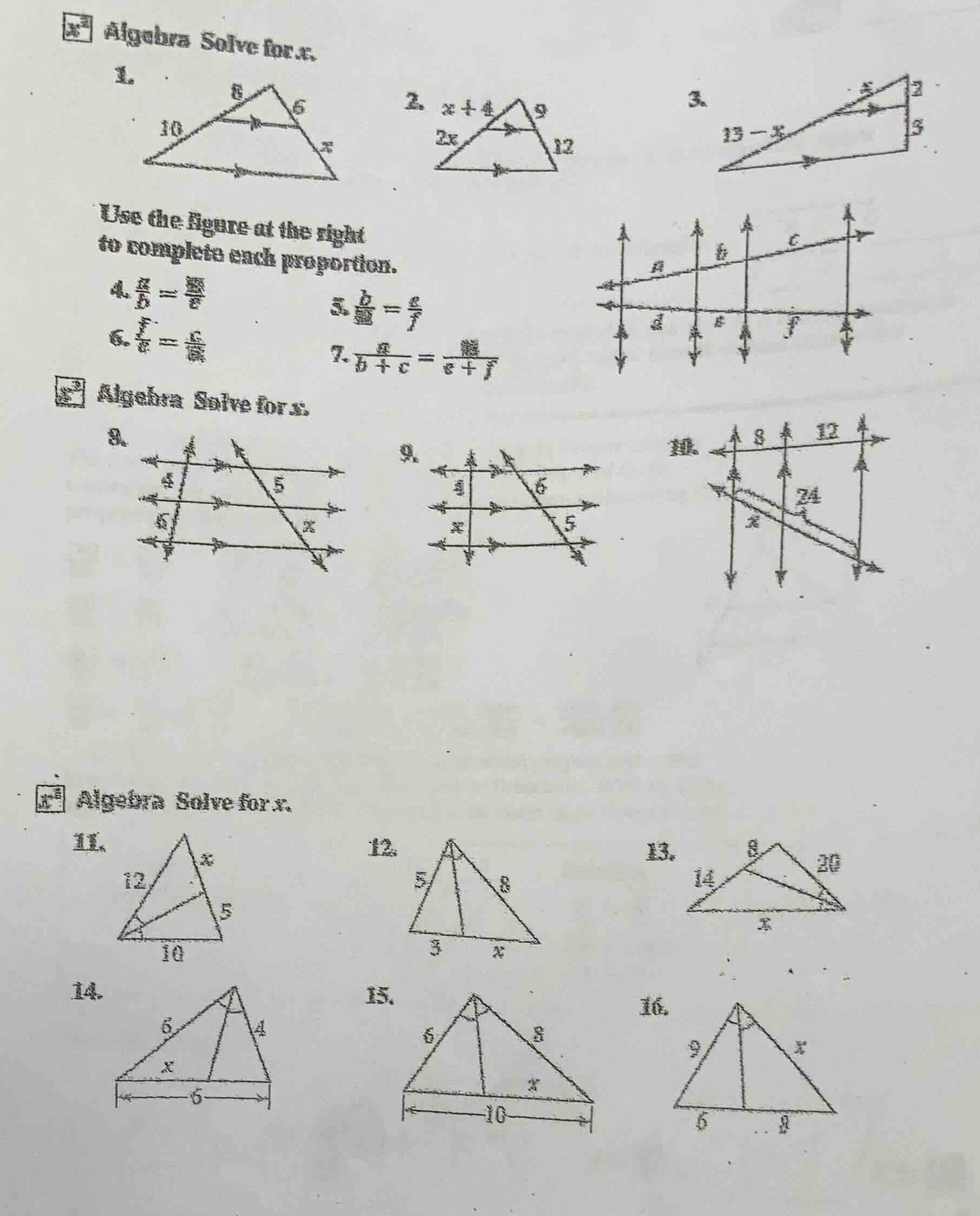
algebra solve for $x$.
1.
- $x+4$
- $13-x$
use the figure at the right to complete each proportion.
- $\frac{a}{b} = \frac{\mathbf{\square}}{e}$
- $\frac{b}{\mathbf{\square}} = \frac{c}{f}$
- $\frac{f}{e} = \frac{c}{\mathbf{\square}}$
- $\frac{a}{b+c} = \frac{\mathbf{\square}}{e+f}$
algebra solve for $x$.
8.
9.
10.
algebra solve for $x$.
11.
12.
13.
14.
15.
16.
---
Problems 1-3 (Triangle Midsegment/Proportionality)
---
Problem 1:
Step1: Set up proportionality
$\frac{10}{6} = \frac{x}{6}$
Step2: Solve for $x$
$x = 10$
Problem 2:
Step1: Set up proportionality
$\frac{2x}{x+4} = \frac{12}{9}$
Step2: Simplify ratio & solve
$\frac{2x}{x+4} = \frac{4}{3} \implies 6x = 4(x+4) \implies 6x=4x+16 \implies 2x=16 \implies x=8$
Problem 3:
Step1: Set up proportionality
$\frac{x}{13-x} = \frac{2}{3}$
Step2: Cross-multiply & solve
$3x = 2(13-x) \implies 3x=26-2x \implies 5x=26 \implies x=\frac{26}{5}=5.2$
---
Problems 4-7 (Basic Proportions)
---
Problem 4:
Step1: Match corresponding segments
$\frac{a}{b} = \frac{d}{e}$
Problem 5:
Step1: Match corresponding segments
$\frac{b}{c} = \frac{e}{f}$
Problem 6:
Step1: Match corresponding segments
$\frac{f}{e} = \frac{c}{b}$
Problem 7:
Step1: Apply addendo property
$\frac{a}{b+c} = \frac{d}{e+f}$
---
Problems 8-10 (Parallel Line Proportionality)
---
Problem 8:
Step1: Set up proportionality
$\frac{4}{6} = \frac{5}{x}$
Step2: Solve for $x$
$4x=30 \implies x=\frac{30}{4}=7.5$
Problem 9:
Step1: Set up proportionality
$\frac{4}{x} = \frac{6}{5}$
Step2: Solve for $x$
$6x=20 \implies x=\frac{20}{6}=\frac{10}{3}\approx3.33$
Problem 10:
Step1: Set up proportionality
$\frac{8}{12} = \frac{x}{24}$
Step2: Solve for $x$
$12x=192 \implies x=16$
---
Problems 11-16 (Angle Bisector Theorem)
---
Problem 11:
Step1: Apply Angle Bisector Theorem
$\frac{12}{x} = \frac{10}{5}$
Step2: Solve for $x$
$10x=60 \implies x=6$
Problem 12:
Step1: Apply Angle Bisector Theorem
$\frac{5}{8} = \frac{3}{x}$
Step2: Solve for $x$
$5x=24 \implies x=\frac{24}{5}=4.8$
Problem 13:
Step1: Apply Angle Bisector Theorem
$\frac{14}{x} = \frac{8}{20}$
Step2: Solve for $x$
$8x=280 \implies x=35$
Problem 14:
Step1: Apply Angle Bisector Theorem
$\frac{x}{6-x} = \frac{6}{4}$
Step2: Simplify & solve
$\frac{x}{6-x} = \frac{3}{2} \implies 2x=18-3x \implies 5x=18 \implies x=\frac{18}{5}=3.6$
Problem 15:
Step1: Apply Angle Bisector Theorem
$\frac{10-x}{x} = \frac{6}{8}$
Step2: Simplify & solve
$\frac{10-x}{x} = \frac{3}{4} \implies 40-4x=3x \implies 7x=40 \implies x=\frac{40}{7}\approx5.71$
Problem 16:
Step1: Apply Angle Bisector Theorem
$\frac{9}{x} = \frac{6}{8}$
Step2: Solve for $x$
$6x=72 \implies x=12$
---

Snap & solve any problem in the app
Get step-by-step solutions on Sovi AI
Photo-based solutions with guided steps
Explore more problems and detailed explanations
- $x=10$
- $x=8$
- $x=\frac{26}{5}=5.2$
- $\frac{a}{b} = \frac{d}{e}$
- $\frac{b}{c} = \frac{e}{f}$
- $\frac{f}{e} = \frac{c}{b}$
- $\frac{a}{b+c} = \frac{d}{e+f}$
- $x=7.5$
- $x=\frac{10}{3}\approx3.33$
- $x=16$
- $x=6$
- $x=\frac{24}{5}=4.8$
- $x=35$
- $x=\frac{18}{5}=3.6$
- $x=\frac{40}{7}\approx5.71$
- $x=12$