QUESTION IMAGE
Question
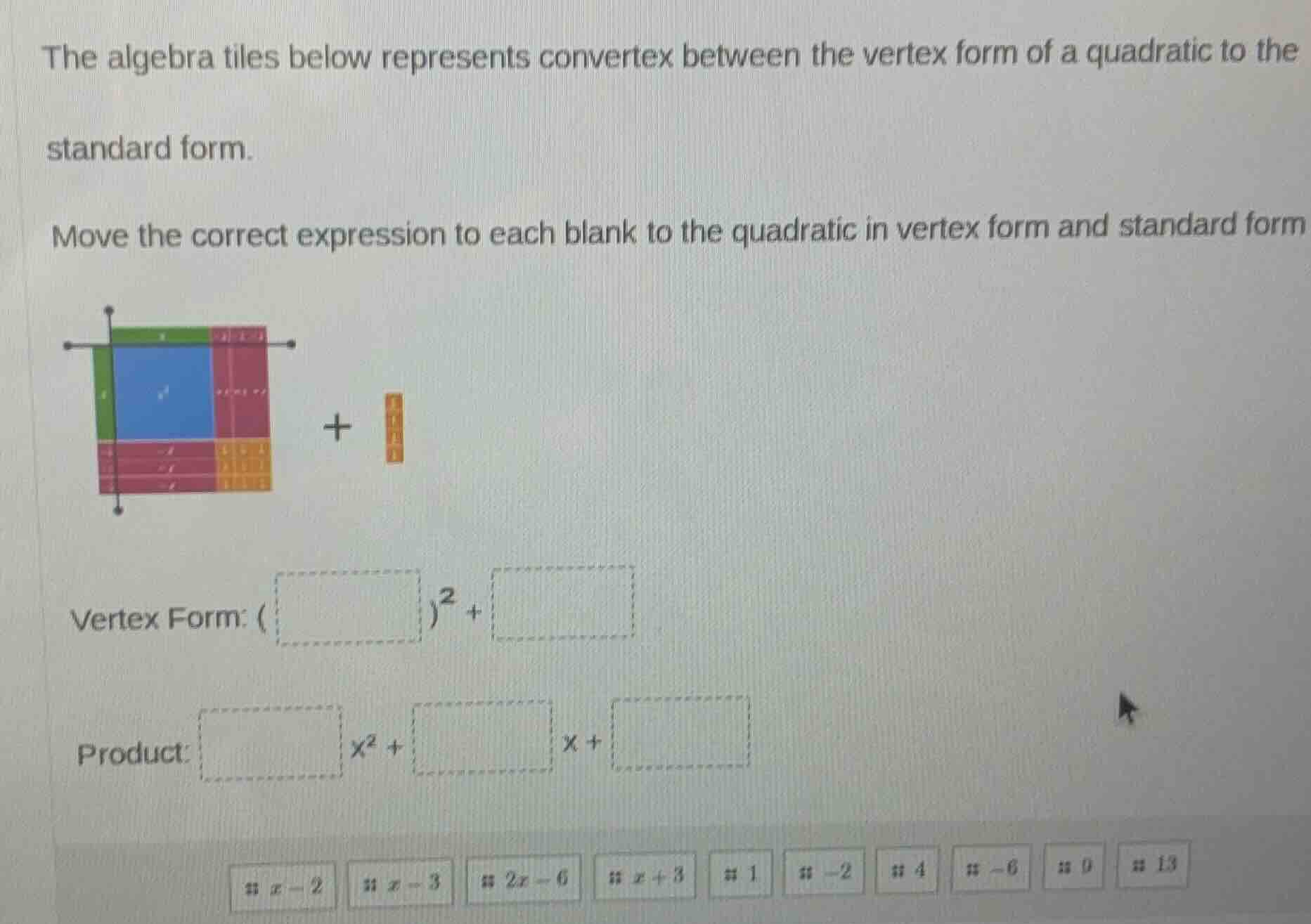
the algebra tiles below represents convertex between the vertex form of a quadratic to the standard form. move the correct expression to each blank to the quadratic in vertex form and standard form vertex form: $\left(\square\
ight)^2 + \square$ product: $\square x^2 + \square x + \square$ $x - 2$ $x - 3$ $2x - 6$ $x + 3$ $1$ $-2$ $4$ $-6$ $9$ $13$
Step1: Analyze Vertex Form Structure
Vertex form of a quadratic is \(y = a(x - h)^2 + k\). From the algebra tiles, we need to find the binomial for \((x - h)\) and the constant \(k\). Looking at the tiles and options, let's assume the vertex form binomial. Let's check the product (standard form) later. The vertex form binomial: let's see the tiles. The blue square is \(x^2\), green rectangles are \(x\) terms, red and orange are constants. Let's first find the vertex form. The binomial should be \(x - 3\) (from options: \(x - 3\) is a candidate). Then the constant term for vertex form: let's see the orange tile. Wait, maybe first expand the vertex form to standard form.
Step2: Expand Vertex Form to Standard Form
Suppose vertex form is \((x - 3)^2 + 4\)? Wait, no, let's check the options. Wait, the options for vertex form binomial: \(x - 3\), \(x - 2\), etc. Let's expand \((x - 3)^2\): \(x^2 - 6x + 9\). Then add the constant? Wait, no, the vertex form is \((x - 3)^2 + 4\)? Wait, no, let's look at the standard form (product) which is \(x^2 + bx + c\). Wait, the options for standard form coefficients: \(x^2\) coefficient is 1 (since the blue tile is \(x^2\)), so the first blank in product is 1? Wait, no, the options have \(x^2\) coefficient as 1? Wait, the options for the first blank in product: the tiles show \(x^2\), so coefficient is 1? Wait, no, the options given: the first blank in product is for \(x^2\) coefficient, but the options include 1? Wait, the options are: \(x - 2\), \(x - 3\), \(2x - 6\), \(x + 3\), \(1\), \(-2\), \(4\), \(-6\), \(9\), \(13\). Wait, the product is \(x^2 + bx + c\), so the coefficient of \(x^2\) is 1 (since the blue tile is \(x^2\)), so the first blank in product is \(1\)? Wait, no, the options have \(1\) as an option. Wait, maybe I misread. Let's re-express:
Vertex Form: \((x - 3)^2 + 4\)? Wait, no, let's check the expansion of \((x - 3)^2\): \(x^2 - 6x + 9\). Then if we add a constant, but maybe the vertex form is \((x - 3)^2 + 4\)? Wait, no, the options for the constant in vertex form: \(4\) is an option. Wait, let's check the standard form. If vertex form is \((x - 3)^2 + 4\), expanding: \(x^2 - 6x + 9 + 4 = x^2 - 6x + 13\). But the options for standard form: \(x^2 + bx + c\), with \(b\) as \(-6\) (option \(-6\)) and \(c\) as \(13\) (option \(13\))? Wait, no, the options for the middle term (x coefficient) are \(-6\), and constant term \(13\)? Wait, let's check the tiles again. The green rectangles: maybe \(x - 3\) as the binomial. Let's proceed:
Vertex Form: \((x - 3)^2 + 4\)? Wait, no, the options for the binomial: \(x - 3\) is an option, and the constant term: \(4\) is an option. Then expanding \((x - 3)^2 + 4 = x^2 - 6x + 9 + 4 = x^2 - 6x + 13\). So the product (standard form) is \(x^2 - 6x + 13\). Let's check the options:
- Vertex Form binomial: \(x - 3\)
- Vertex Form constant: \(4\)
- Product \(x^2\) coefficient: \(1\) (option \(1\))
- Product \(x\) coefficient: \(-6\) (option \(-6\))
- Product constant: \(13\) (option \(13\))
Wait, let's verify:
- Vertex Form: \((x - 3)^2 + 4\)
- Binomial: \(x - 3\)
- Constant: \(4\)
- Expand \((x - 3)^2 + 4\):
- \((x - 3)^2 = x^2 - 6x + 9\)
- Add \(4\): \(x^2 - 6x + 13\)
So the product (standard form) is \(1x^2 + (-6)x + 13\)
Now check the options:
- Vertex Form binomial: \(x - 3\) (option)
- Vertex Form constant: \(4\) (option)
- Product \(x^2\) coefficient: \(1\) (option)
- Product \(x\) coefficient: \(-6\) (option)
- Product constant: \(13\) (option)
Let's confirm each blank:
- Vertex Form: \((x - 3)^2 + 4\)
- Product: \(1x^2…

Snap & solve any problem in the app
Get step-by-step solutions on Sovi AI
Photo-based solutions with guided steps
Explore more problems and detailed explanations
Vertex Form: \(\boldsymbol{(x - 3)^2 + 4}\) (so first blank: \(x - 3\), second blank: \(4\))
Product: \(\boldsymbol{1x^2 + (-6)x + 13}\) (so first blank: \(1\), second blank: \(-6\), third blank: \(13\))
(Note: The exact blanks' placement depends on the drag-and-drop, but the correct expressions are:
Vertex Form binomial: \(x - 3\), Vertex Form constant: \(4\)
Product \(x^2\) coefficient: \(1\), Product \(x\) coefficient: \(-6\), Product constant: \(13\))