QUESTION IMAGE
Question
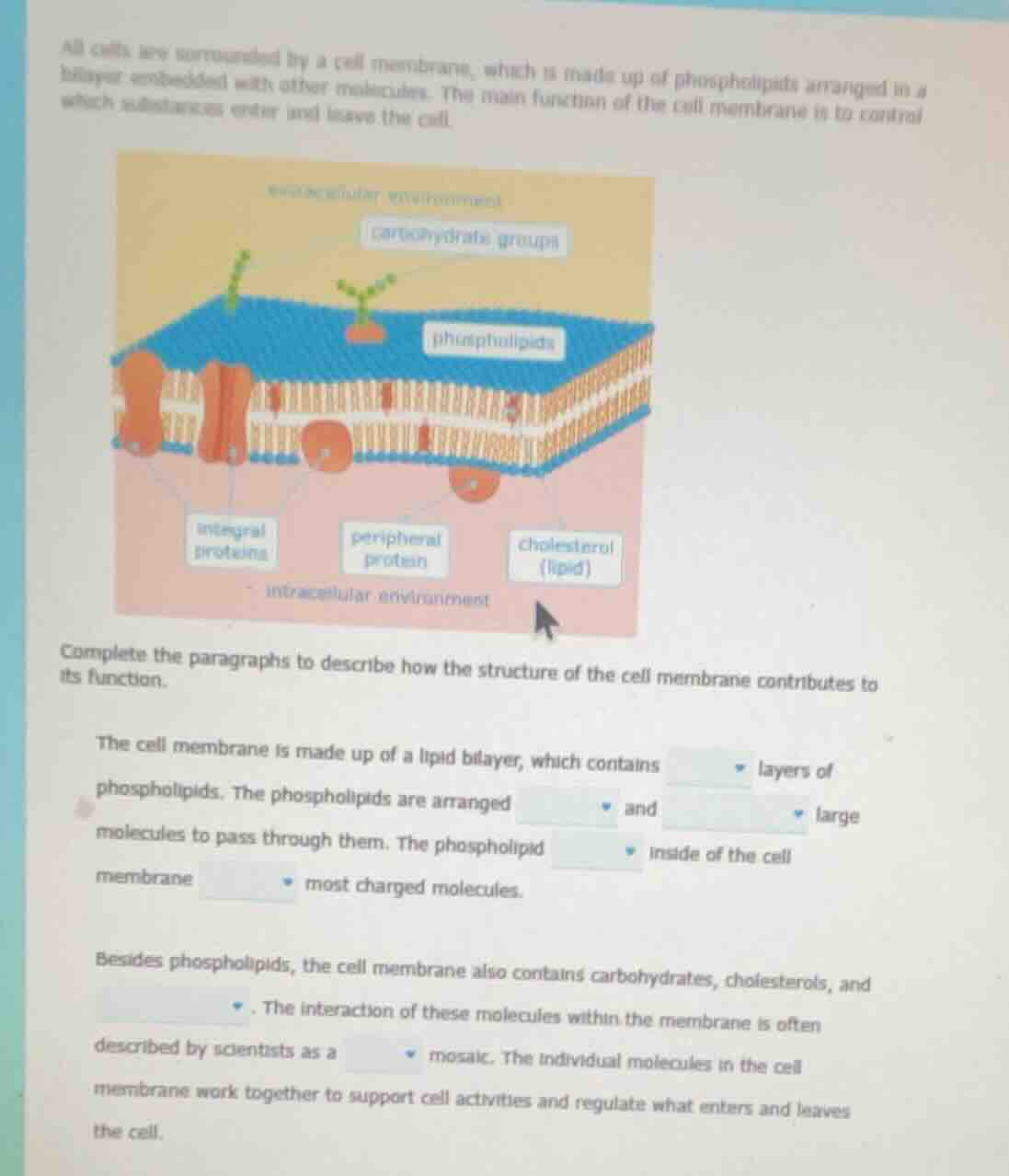
all cells are surrounded by a cell membrane, which is made up of phospholipids arranged in a bilayer embedded with other molecules. the main function of the cell membrane is to control which substances enter and leave the cell.
complete the paragraphs to describe how the structure of the cell membrane contributes to its function.
the cell membrane is made up of a lipid bilayer, which contains __ layers of phospholipids. the phospholipids are arranged and large molecules to pass through them. the phospholipid inside of the cell membrane __ most charged molecules.
besides phospholipids, the cell membrane also contains carbohydrates, cholesterols, and __. the interaction of these molecules within the membrane is often described by scientists as a __ mosaic. the individual molecules in the cell membrane work together to support cell activities and regulate what enters and leaves the cell.
To solve this, we analyze the structure and function of the cell membrane (a key concept in Biology, a subfield of Natural Science) by recalling relevant biological knowledge:
First Paragraph:
- Lipid bilayer layers: A lipid bilayer has 2 layers of phospholipids.
- Phospholipid arrangement: Phospholipids are arranged with hydrophilic heads (interacting with water, outside/inside) and hydrophobic tails (inside the bilayer, away from water). This arrangement is tail - to - tail (hydrophobic tails face each other).
- Permeability to large molecules: The hydrophobic core (from tail - to - tail arrangement) prevents large molecules from passing through freely.
- Phospholipid part inside the membrane: The tails (hydrophobic) are inside the cell membrane (between the hydrophilic heads).
- Effect on charged molecules: The hydrophobic tails (and the structure) prevent most charged molecules (which are polar) from passing through, as they are repelled by the non - polar hydrophobic region.
Second Paragraph:
- Other molecules in cell membrane: Besides phospholipids, the cell membrane has carbohydrates, cholesterols, and proteins (integral and peripheral proteins, which have roles in transport, structure, etc.).
- Membrane model description: The interaction of these molecules (phospholipids, proteins, carbs, cholesterol) is described as a fluid mosaic (the fluid mosaic model, where molecules can move within the membrane).
Now, filling in the blanks (in order of the dropdowns in the first paragraph, then the second):
- 2 (two)
- tail - to - tail
- prevent
- tails
- prevent
- proteins
- fluid
(Note: The exact wording of some options might vary slightly depending on the provided dropdown choices, but the above is based on standard cell membrane structure/function knowledge.)
The problem is about the structure and function of the cell membrane, which is a topic in Biology (Natural Science). We use biological knowledge of the cell membrane's lipid bilayer (2 layers of phospholipids, tail - to - tail arrangement), its permeability (prevents large/charged molecules), and the fluid mosaic model (includes proteins, is a fluid mosaic) to fill the blanks.

Snap & solve any problem in the app
Get step-by-step solutions on Sovi AI
Photo-based solutions with guided steps
Explore more problems and detailed explanations
- 2 (two)
- tail - to - tail
- prevent
- tails
- prevent
- proteins
- fluid