QUESTION IMAGE
Question
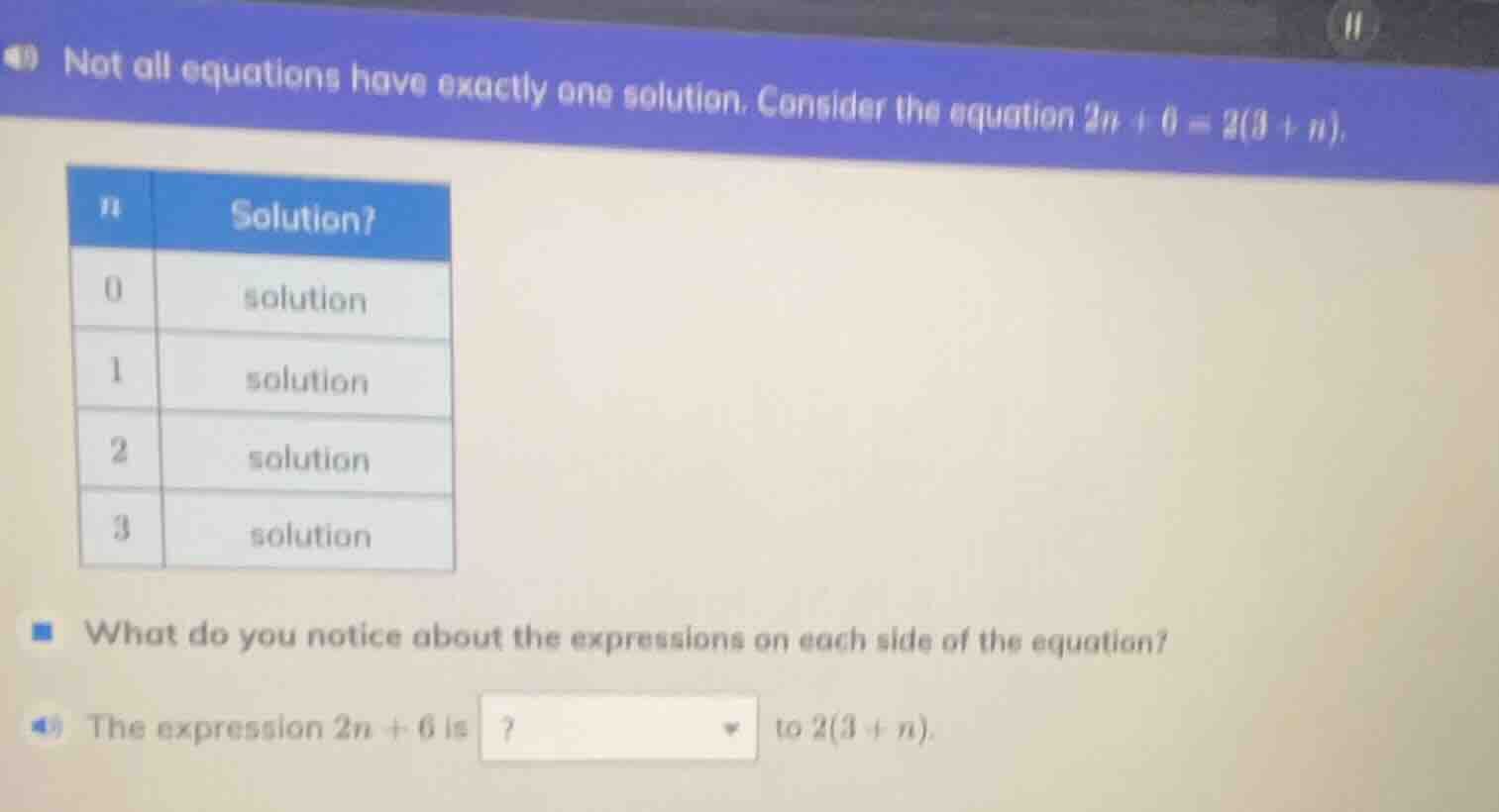
not all equations have exactly one solution. consider the equation $2n + 6 = 2(3 + n)$. \
what do you notice about the expressions on each side of the equation? \
the expression $2n + 6$ is? to $2(3 + n)$.
Step1: Simplify the right-hand side
Use distributive property: $2(3 + n) = 2\times3 + 2\times n = 6 + 2n$
Step2: Compare both sides
Left-hand side: $2n + 6$; Right-hand side: $2n + 6$
Step3: Test given values
For $n=0$: $2(0)+6=6$, $2(3+0)=6$ (solution)
For $n=1$: $2(1)+6=8$, $2(3+1)=8$ (solution)
For $n=2$: $2(2)+6=10$, $2(3+2)=10$ (solution)
For $n=3$: $2(3)+6=12$, $2(3+3)=12$ (solution)

Snap & solve any problem in the app
Get step-by-step solutions on Sovi AI
Photo-based solutions with guided steps
Explore more problems and detailed explanations
The expressions on each side of the equation are identical when simplified, so every real number $n$ is a solution. The expression $2n + 6$ is equivalent to $2(3 + n)$.